Mumbai Pink E-Rickshaw Scheme: Dedicated Routes, 40% Subsidy and GPS Safety Features Planned Across MMR

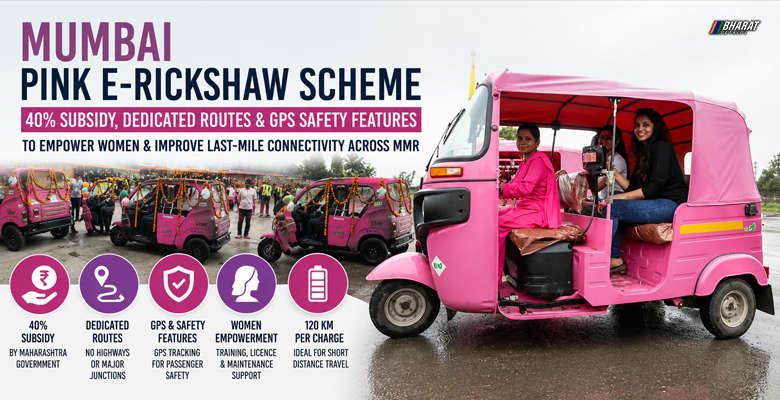
Mumbai Pink E-Rickshaw Scheme is set to become one of Maharashtra’s most ambitious women-focused mobility initiatives, combining safer last-mile transport with new income opportunities for women across the Mumbai Metropolitan Region (MMR).
The Maharashtra government has begun work on identifying dedicated operating routes for the proposed pink electric rickshaws, which are expected to serve residential neighbourhoods, railway stations, metro stations and public transport hubs. Officials say the scheme is being designed not only to improve urban mobility but also to encourage women to enter the transport sector as independent entrepreneurs.
The initiative comes at a time when cities across India are exploring cleaner transportation alternatives while also looking for ways to create employment opportunities for women. By integrating electric mobility with women-led entrepreneurship, the state government hopes to address multiple challenges through a single programme.
Contents
Focus on Last-Mile Connectivity
One of the biggest transportation challenges in large urban centres such as Mumbai is last-mile connectivity. While suburban railways, metro services and buses handle millions of daily commuters, reaching the final destination often remains difficult.
Under the proposed scheme, pink e-rickshaws are expected to bridge this gap by providing short-distance connectivity between transport hubs and nearby residential or commercial areas.
Officials involved in the planning process have indicated that these vehicles will primarily operate on feeder routes and internal roads. Such routes are expected to help commuters travel conveniently between stations, bus depots and housing societies without relying on private vehicles or longer auto-rickshaw journeys.
Transport experts believe this approach could make public transportation more accessible, especially for women, senior citizens and daily commuters who frequently struggle with first-mile and last-mile travel.
Dedicated Routes to Reduce Traffic Impact
A major aspect of the scheme is route planning. State authorities have instructed transport officials and traffic management teams to identify corridors where e-rickshaws can operate efficiently without creating additional congestion.
Unlike conventional rickshaws that travel across various road networks, the pink e-rickshaws are likely to have designated operating areas.
Current plans suggest that the vehicles will not be allowed on highways, major arterial roads or heavily congested traffic junctions. Instead, authorities are focusing on internal roads and local connectivity corridors where lower-speed electric vehicles can function safely and effectively.
This route-based approach is expected to help manage traffic flow while ensuring commuters receive reliable transportation services in areas where connectivity is currently limited.
The exercise will cover several important regions across the Mumbai Metropolitan Region, including Mumbai suburbs, Thane, Navi Mumbai, Panvel, Vasai-Virar and Kalyan-Dombivli.
A New Opportunity for Women Entrepreneurs
Beyond transportation benefits, the scheme has a strong economic empowerment component.
Government officials view the initiative as a way to encourage women to become vehicle owners and operators rather than simply passengers. By providing financial assistance and support services, authorities aim to reduce barriers that often prevent women from entering the transport business.
Women selected under the programme are expected to receive assistance at multiple stages of the process, from training to licensing and vehicle maintenance. This support structure could help first-time entrepreneurs establish a stable source of income while contributing to local transport networks.
The initiative is also expected to generate self-employment opportunities for women who may otherwise face difficulties accessing formal jobs or business financing.
Subsidy Increased to 40%
One of the most significant announcements linked to the scheme is the increase in government financial support.
The state government’s contribution towards purchasing an e-rickshaw has reportedly been raised from 20 percent to 40 percent of the vehicle cost. The move is intended to make ownership more affordable and encourage greater participation among eligible women.
The revised funding structure is expected to substantially reduce the upfront financial burden on beneficiaries. While the final vehicle pricing has not yet been officially announced, officials believe the higher subsidy will make the programme accessible to a larger section of women interested in joining the initiative.
For many potential applicants, access to financing has traditionally been a major obstacle. By increasing the subsidy component, the government hopes to improve affordability and accelerate adoption once the scheme is formally rolled out.
Financing Model Designed to Ease Ownership
Apart from direct government assistance, beneficiaries are expected to receive support through institutional financing.
Under the proposed model, a significant portion of the remaining vehicle cost may be covered through bank loans, while beneficiaries would contribute a smaller share from their own resources.
This blended financing approach aims to reduce financial risk for applicants while ensuring they have a stake in the ownership of the vehicle.
Officials believe such a structure can create a sustainable model that allows women to become business owners without requiring large initial investments.
For many aspiring entrepreneurs, particularly those from economically weaker backgrounds, this financing arrangement could make the difference between participating in the scheme and being unable to afford a vehicle.
Training and Licensing Support for Beneficiaries
The Mahila Pink E-Rickshaw Scheme is not limited to providing financial assistance for purchasing vehicles. It also includes a support system aimed at helping women become confident and independent commercial drivers.
According to officials, women selected under the programme will receive free driving training, enabling them to safely operate electric rickshaws in urban environments. In addition, the government plans to assist beneficiaries in obtaining the commercial driving licence required to legally operate passenger vehicles.
Vehicle ownership often involves ongoing maintenance costs and technical knowledge. To address this, beneficiaries are also expected to receive guidance on vehicle upkeep and basic maintenance, helping them reduce operational expenses and improve the lifespan of their e-rickshaws.
By combining financial support with practical training, the government aims to ensure that women entering the transport sector have the skills and resources needed to build a sustainable livelihood.
Priority for Economically Weaker Women
The scheme has been designed with a focus on social inclusion.
Officials have indicated that preference will be given to women from economically weaker sections of society. Widows, divorced women and women belonging to marginalised communities are expected to receive priority during the selection process.
The objective is to create employment opportunities for women who may have limited access to traditional sources of income. By enabling them to own and operate electric rickshaws, the government hopes to strengthen financial independence while supporting inclusive economic growth.
Social welfare experts believe such targeted initiatives can improve household incomes and encourage greater participation of women in sectors where they have traditionally been underrepresented.
Electric Vehicles with a Practical Urban Range
The proposed pink e-rickshaws are designed for short-distance urban travel rather than long highway journeys.
Officials have indicated that each vehicle is expected to offer a driving range of approximately 120 kilometres on a single charge. This range is considered sufficient for multiple local trips throughout the day, making the vehicles suitable for neighbourhood connectivity and feeder services.
Electric vehicles also have lower running costs compared to conventional fuel-powered vehicles. Reduced fuel expenses and simpler maintenance requirements could improve earnings for operators while supporting Maharashtra’s broader push towards environmentally friendly transportation.
As charging infrastructure continues to expand across the Mumbai Metropolitan Region, electric rickshaws are expected to become an increasingly viable option for public transport services.
GPS Tracking to Strengthen Passenger Safety
Passenger safety remains one of the key priorities under the proposed scheme.
To improve security and operational monitoring, every pink e-rickshaw will be equipped with a GPS-enabled tracking system. The technology is expected to help authorities monitor vehicle movement while offering an additional layer of safety for passengers.
GPS tracking can also support better fleet management, route monitoring and emergency response if required.
Women commuters often cite safety as an important factor while choosing public transport. The inclusion of digital tracking technology is expected to improve confidence among passengers using the service, particularly during evening travel.
Officials have also indicated that additional safety measures suitable for urban passenger transport may be incorporated before the scheme is fully launched.
Government Exploring Better Battery Technology
The Transport Department is also holding discussions with electric vehicle manufacturers to improve the overall efficiency of the proposed fleet.
Officials are exploring options related to battery performance, vehicle durability, charging efficiency and operating speed. The objective is to ensure that the e-rickshaws remain practical for daily commercial use while maintaining reliability in busy urban conditions.
Battery technology has advanced significantly in recent years, and improvements in charging time and driving range could further enhance the usefulness of electric rickshaws for both operators and passengers.
Industry experts believe continuous technological improvements will play an important role in making electric mobility more attractive across Indian cities.
Fare Structure Yet to Be Announced
While several operational aspects of the scheme have been outlined, the government has not yet announced the fare structure for passengers.
Officials are expected to finalise pricing closer to the launch of the programme after route planning and operational guidelines are completed.
A balanced fare structure will be important to ensure the service remains affordable for commuters while allowing operators to earn a sustainable income.
Transport experts suggest that competitive pricing, combined with reliable service and improved connectivity, could encourage greater public adoption of the pink e-rickshaw network.
Multi-Department Coordination Underway
The planning process involves close coordination between multiple government departments and agencies.
Senior officials from the Transport Department, Regional Transport Offices (RTOs), the Traffic Police and the Women and Child Development Department are working together to finalise operational guidelines.
A recent review meeting at Mantralaya, chaired by senior state officials, focused on route identification, implementation strategy, financial assistance and safety standards.
Such coordination is expected to ensure that the scheme is implemented efficiently while addressing practical challenges related to traffic management, licensing and public safety.
Why the Scheme Matters
The Pink E-Rickshaw Scheme represents more than just the introduction of another public transport option. It reflects a broader effort to combine women’s economic empowerment with sustainable urban mobility.
By providing financial assistance, skill development and employment opportunities, the initiative seeks to encourage greater participation of women in the transport sector—an industry where female representation has traditionally been limited.
At the same time, the use of electric vehicles aligns with Maharashtra’s long-term environmental goals by promoting cleaner transportation and reducing dependence on conventional fuel-powered vehicles.
If implemented successfully, the scheme could become a model for other metropolitan regions looking to improve last-mile connectivity while creating meaningful livelihood opportunities for women.
Although the official rollout timeline and fare details are still awaited, the government’s focus on dedicated routes, enhanced subsidies and passenger safety indicates that the initiative is moving steadily towards implementation. Commuters and prospective beneficiaries are expected to receive additional updates once route mapping and operational planning are completed.