Jantar Mantar No Longer Delhi’s Designated Protest Site; Police Name Three Alternative Venues

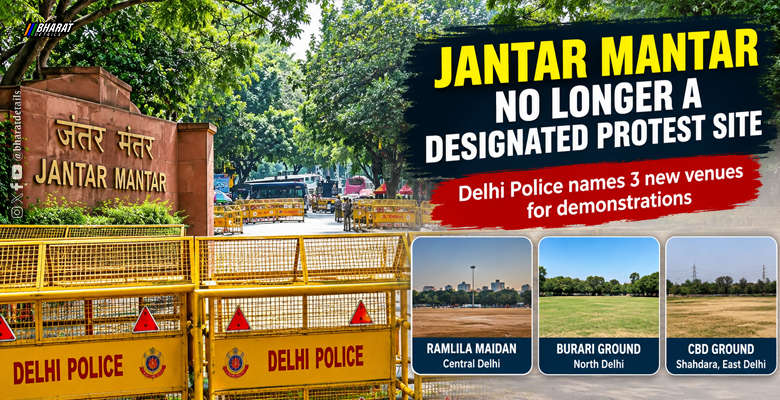
Delhi’s Jantar Mantar is no longer a designated protest site, with the Delhi Police announcing three alternative venues for demonstrations following recommendations from a committee constituted by the Union Ministry of Home Affairs. The decision, formalised in a standing order issued on October 11, 2026, changes where public protests can officially be organised in the national capital.
The three newly designated locations are Ramlila Maidan in Central Delhi, Burari Ground in North Delhi and CBD Ground in Shahdara, East Delhi. The revised arrangement partially modifies an earlier standing order issued on April 28, 2022.
According to the police order, the Home Ministry had formed a committee to examine alternative locations that would allow citizens to exercise their right to organise protests and demonstrations. Based on the committee’s recommendations, Jantar Mantar has been removed from the list of designated protest venues.
The Delhi Police has also stated that detailed standard operating procedures (SOPs), including the process for seeking permission to hold demonstrations at the new locations, will be issued separately.
Contents
Three New Venues for Protests in Delhi
The alternative locations are spread across different parts of the capital, moving officially designated demonstrations beyond the central administrative area around Parliament.
Ramlila Maidan, a longstanding venue for political rallies and public gatherings, is approximately 3 km from Jantar Mantar. Burari Ground, in North Delhi, is around 16 km away, while CBD Ground in Shahdara is more than 26 km from the former protest site.
Ramlila Maidan has hosted several significant political movements over the decades, including Jayaprakash Narayan’s rally in 1975 and Anna Hazare’s anti-corruption movement in 2011. Burari Ground and CBD Ground will now serve as alternative locations under the revised police arrangement.
The practical impact of the change will depend partly on the permission process and the detailed guidelines that the police are expected to announce.
Why Has Jantar Mantar Been Removed as a Protest Venue?
The decision comes amid heightened political activity in Delhi and calls for demonstrations against the Election Commission of India, particularly over allegations concerning the Special Intensive Revision (SIR) of electoral rolls.
Opposition parties have raised concerns about alleged irregularities in the voter-list revision exercise and have demanded accountability from Chief Election Commissioner Gyanesh Kumar. The allegations have intensified following an investigative report that raised questions about decisions linked to the SIR process.
According to the report, Election Commissioners Sukhbir Singh Sandhu and Vivek Joshi had recorded objections on at least 14 occasions over the preceding 10 months regarding certain SIR-related decisions and orders that they allegedly said were issued without their knowledge or recommendation. These claims have added to the political controversy surrounding the Election Commission. The allegations remain distinct from any independently established finding of wrongdoing.
The Congress-led INDIA bloc had also planned a march towards the Supreme Court to protest the alleged irregularities and demand the Chief Election Commissioner’s resignation.
Ahead of planned demonstrations, Delhi witnessed heightened security and preventive detentions, including those of several former chief ministers. Police said the action was intended to maintain law and order amid protest calls from various groups.
Security personnel continued to monitor the Jantar Mantar area following the announcement, with barricades and restrictions placed along access roads to regulate movement and prevent unauthorised gatherings.
Jantar Mantar’s Long History as a Protest Site
Jantar Mantar has been one of Delhi’s most recognisable locations for political demonstrations, public campaigns and protests over social and economic issues.
The site became the capital’s principal designated protest venue in 1993, replacing the Boat Club lawns near India Gate, in an area now associated with Kartavya Path. The shift followed concerns over large gatherings disrupting central Delhi, including a major farmers’ rally led by Mahendra Singh Tikait in 1988.
Over the years, Jantar Mantar became a familiar meeting point for citizens, activists, political organisations and campaigners seeking to draw public attention to their demands.
Its location near Parliament and other important government institutions gave demonstrations held there considerable visibility. The removal of its designated status therefore represents a significant change in the way officially organised protests will be accommodated in the capital.
However, the order concerns its status as a designated protest venue. The precise implications for particular gatherings and the applicable permission requirements will depend on the relevant police directions and other legal provisions.
Cockroach Janta Party Criticises the Decision
The announcement has drawn sharp criticism from the Cockroach Janta Party (CJP), whose recent protest activity has brought renewed attention to Jantar Mantar.
The party, founded by Abhijeet Dipke, has been associated with youth-led demonstrations over political and public accountability issues. Its protests have also attracted attention over alleged examination irregularities and demands for action against those responsible. Claims concerning the movement’s role in subsequent political developments should be distinguished from officially confirmed reasons for any resignation or administrative decision.
Reacting to the removal of Jantar Mantar from the designated list, Dipke criticised the move in a post on X, declaring that the entire country would become Jantar Mantar.
The party also objected to the decision on the grounds that it could restrict the visibility of public demonstrations. CJP co-convener Saurav Das questioned whether the government had consulted citizens and organisations before changing the venue’s status. He described the move as an attack on the right to protest and peaceful assembly.
The party’s objections centre on the concern that moving demonstrations away from a prominent central location could make it more difficult for protesters to draw public and political attention to their demands.
CJP Gives Delhi Police 24 Hours to Respond
Earlier on Monday, CJP leaders Ashutosh Ranka and Saurav Das, accompanied by their lawyers, met Delhi Police officials to seek clarity on arranging a protest at Jantar Mantar.
Das said the party had approached the police because protesters were required to seek permission in advance. According to him, the delegation wanted the authorities to communicate the proposed date and time for the demonstration.
Following a meeting lasting approximately 30 minutes, the party said it had given the police 24 hours to respond. Ranka indicated that the organisation would decide its next course of action depending on the authorities’ reply.
The party also warned that it could reconsider when and how to return to Jantar Mantar if the police did not provide a response within the stipulated period.
The development leaves open the question of how the authorities will handle requests from organisations seeking to demonstrate at the former designated venue, particularly while the revised procedures for the three new locations are awaited.
What Happens Next?
The immediate next step is the issuance of detailed SOPs for demonstrations at Ramlila Maidan, Burari Ground and CBD Ground. These guidelines are expected to clarify the permission process and the conditions under which gatherings can be organised at the designated locations.
The decision is likely to remain a point of political debate, especially among groups that regard Jantar Mantar’s proximity to Parliament and central government offices as essential to making their demands heard.
For now, Delhi Police has formally shifted the designated venues for protests to three alternative grounds. Whether the arrangement reduces pressure on central Delhi or intensifies concerns about access to prominent protest spaces will become clearer as the revised rules are implemented and organisations respond to the change.