Election Commission SIR Row: 14 Objections, EC’s Unanimity Claim and Opposition Push for Action Against CEC Gyanesh Kumar

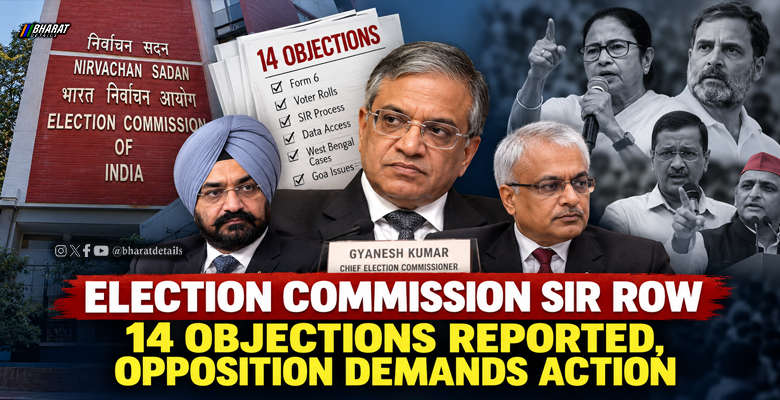
The Election Commission SIR controversy has intensified after reports that Election Commissioners Sukhbir Singh Sandhu and Vivek Joshi recorded at least 14 objections over decisions taken by the poll panel during a 10-month period. The Election Commission, however, has rejected the suggestion of an internal split and said all decisions, including those related to the Special Intensive Revision (SIR) of electoral rolls, were ultimately taken unanimously.
The issue has now triggered a wider political confrontation, with Opposition parties demanding action against Chief Election Commissioner Gyanesh Kumar and discussing a fresh impeachment motion. At the same time, the Election Commission has maintained that written observations and objections by individual commissioners are part of the normal decision-making process within a constitutional body.
The controversy centres on how decisions concerning voter registration, deletion and restoration of names, electoral-roll databases and the SIR process were discussed and approved.
Contents
What triggered the controversy
The dispute followed a report published on September 23 that examined written objections allegedly recorded by Sandhu and Joshi between late 2025 and August 2026.
According to the report, the two commissioners raised objections on at least 14 occasions. Four of those objections were reportedly recorded on the same day.
The issues mentioned included changes to Form 6, access and control of electoral-roll databases, appeals concerning voter deletions in West Bengal and difficulties faced by election officials in adding eligible voters in Goa.
Some of the objections reportedly questioned whether certain steps had been taken without the commissioners’ prior knowledge or approval. The report also highlighted concerns over increasing centralisation of electoral-roll technology and access to voter data.
The Election Commission subsequently disputed the portrayal of these objections as evidence of an institutional rift.
Election Commission says decisions were unanimous
In its response, the Election Commission said the observations and suggestions made during the process were part of routine administrative and institutional deliberations.
The poll panel said operational queries raised by individual commissioners, including those relating to SIR, were dealt with during the draft and decision-making stages. It maintained that the final decisions taken by the Commission over the past year were unanimous.
This distinction is central to the controversy. While the reported documents indicate that the two commissioners raised concerns on several occasions, the Commission says those objections should not be interpreted as evidence that final decisions were taken against the wishes of the other commissioners.
Form 6 becomes a key point of disagreement
One of the most closely examined issues concerns Form 6, which is used by individuals seeking inclusion in the electoral roll.
According to the reported objections, Vivek Joshi had raised concerns about changes proposed to the form in connection with SIR. The issue involved asking new applicants questions relating to whether their own name, or the name of a parent or grandparent, appeared in an earlier electoral roll.
The reported objection was that Form 6 is prescribed under the electoral rules and that changing its requirements would require the appropriate legal process.
Sukhbir Singh Sandhu subsequently supported concerns over the change, with the reported note describing the modification as unauthorised and illegal. The Election Commission has since maintained that the final decisions were part of its established decision-making process.
Concerns over electoral-roll technology
Another major issue relates to the digital systems used to maintain electoral rolls.
The reported objections raised questions about the increasing centralisation of electoral-roll operations and the extent to which officials at the state and field levels could access and modify voter records.
Vivek Joshi reportedly suggested an audit to establish that only authorised statutory officials could make changes to electoral data. Sandhu also raised concerns about access to the ERONet system by election officials.
The dispute is significant because electoral rolls are maintained through interconnected digital systems, making questions of access, authorisation and audit trails important to the integrity of voter registration.
West Bengal and Goa cases also cited
The reported objections were not limited to SIR or Form 6.
In West Bengal, questions were raised regarding appeals connected to the deletion of voters whose names had reportedly been retained following judicial scrutiny.
In Goa, the issue involved 97 voters who had reportedly been found eligible for inclusion by Electoral Registration Officers but could not be added to the final electoral roll because the software did not allow officials to record their decisions.
The reported concerns therefore covered different stages of the electoral-roll process, from adding new voters to deleting names and handling appeals.
Opposition steps up attack on CEC
The developments have prompted strong reactions from several Opposition leaders.
Mamata Banerjee demanded criminal action against Gyanesh Kumar and called for fresh elections in states where she alleged that the SIR process had affected electoral rolls. Her comments were made after the report about the commissioners’ objections became public.
Other Opposition leaders, including Rahul Gandhi, Arvind Kejriwal and Akhilesh Yadav, also criticised the Election Commission’s functioning. Their statements included allegations that the electoral process had been compromised.
These are political allegations, and the Election Commission has rejected the broader claim that its decisions were taken unilaterally.
Opposition discusses fresh impeachment motion
The controversy has also revived efforts within the Opposition to seek Kumar’s removal.
According to reports on September 24, Opposition parties were working on a fresh impeachment motion that could be introduced in both Houses of Parliament. Congress leaders have also called for Kumar’s resignation.
Reports said earlier notices seeking his removal had been submitted during 2026, with one notice rejected while another remained pending.
The proposed new move is expected to refer to the reported objections raised by Sandhu and Joshi as part of the Opposition’s case.
Whether such a motion proceeds, and what procedural steps follow, will depend on parliamentary action and the constitutional process governing removal of a Chief Election Commissioner.
BJP rejects Opposition allegations
The BJP has rejected allegations that the Election Commission was functioning under unilateral control.
BJP leader Sambit Patra argued that differences and discussions between members of a constitutional body can form part of its internal decision-making process. The party has also pointed to the Election Commission’s clarification that the SIR exercise and other decisions were ultimately approved unanimously.
The competing positions have therefore produced two different interpretations of the same developments: Opposition parties view the recorded objections as evidence requiring greater accountability, while the Election Commission and BJP describe them as part of normal institutional deliberation.
_____________________
Also read | Disha Salian Case: Uddhav Thackeray Denies Family Link As Legal Battle Intensifies
_____________________
CJP gives 48-hour resignation ultimatum
The controversy took another turn on September 24 when the Cockroach Janta Party (CJP) demanded Gyanesh Kumar’s resignation within 48 hours.
CJP leaders Abhijeet Dipke, Saurav Das and Ashutosh Ranka said that failure to resign would be followed by a nationwide agitation and an indefinite sit-in in Delhi. The organisation also announced a nationwide campaign called “Election Commission Thik Karo.”
The group has demanded an independent investigation into decisions taken during the SIR process, greater disclosure of relevant records and changes to the framework governing appointments to the Election Commission.
It has also called for a halt to further exclusions linked to SIR and restoration of earlier electoral rolls pending verification.
These are demands made by the organisation and do not represent established findings against the Election Commission.
Why the issue matters
At the heart of the controversy is the electoral roll, which determines who is formally registered as a voter.
Any large-scale revision of voter lists involves balancing two objectives: removing duplicate, deceased or otherwise ineligible entries while ensuring that eligible citizens are not wrongly excluded.
The Election Commission’s SIR exercise has already attracted significant attention because of the scale of the revisions. An investigation published this week reported that more than 13 crore names had been removed from draft electoral rolls across 30 states and Union territories during the exercise.
At the same time, the presence of names on a draft roll and their final exclusion are not necessarily the same thing. Voters affected by draft changes may have opportunities to file claims, objections or applications for inclusion, depending on the applicable electoral process.
The current dispute therefore involves not only the reported disagreements within the Election Commission but also wider questions about transparency, access to electoral data, safeguards for voters and the procedures used to revise electoral rolls.
What happens next
The immediate focus is likely to remain on the Election Commission’s response to the reported objections and the political moves being considered by Opposition parties.
The proposed impeachment motion, if formally submitted, would have to go through the applicable parliamentary procedure. Meanwhile, the Election Commission is expected to continue defending its position that the final decisions of the three-member panel were unanimous.
The debate over SIR is also likely to continue as voters respond to changes in draft electoral rolls and authorities process claims and objections.
For now, the central issue remains unresolved in the public debate: the reported existence of objections by two Election Commissioners is documented by the reports, while the Election Commission maintains that those internal observations were part of normal deliberations and that its final decisions were unanimous.