India to Introduce Mandatory Caller Name Display from November 1, 2026: What Mobile Users Should Know

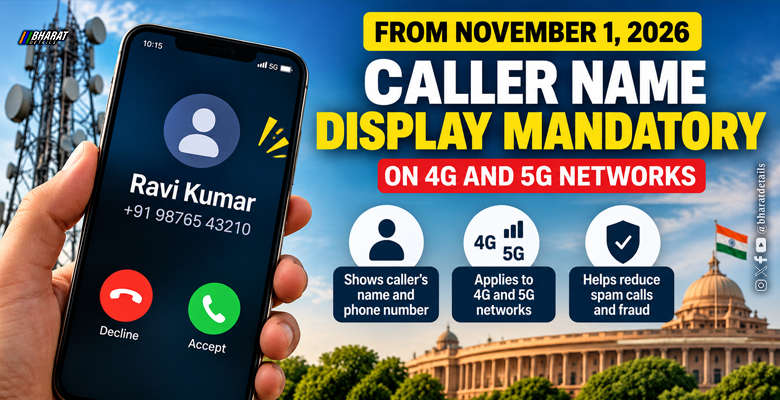
India will introduce mandatory caller name display from November 1, 2026, allowing mobile users on 4G and newer networks to see the caller’s name alongside their phone number when receiving an incoming call. The Department of Telecommunications (DoT) has directed telecom service providers to roll out Calling Name Presentation (CNAP) by default, making it easier for people to identify calls from numbers that are not saved in their contacts.
The new system is intended to improve caller identification by using subscriber information maintained by telecom operators rather than relying entirely on contact lists or third-party caller identification applications. However, it does not mean every unknown call will automatically be identified as genuine or safe.
Under the DoT’s directive dated October 13, 2026, telecom operators must introduce CNAP across their service areas from November 1. The initial rollout will cover wireless networks using 4G and higher-generation technologies, including 5G. Implementation on 2G and 3G networks and public switched telephone networks, which include conventional landlines, will be examined separately.
Contents
How Will the New CNAP Caller ID System Work?
When someone calls a mobile user, the recipient’s phone will display the caller’s telephone number and a name associated with that number. The name shown will depend on whether the number is already saved in the recipient’s contacts.
If the number is saved, the name stored in the recipient’s phonebook will appear on the screen. If it is not saved, the system will use the caller’s name recorded in the originating telecom operator’s subscriber database for domestic calls.
For international calls, the display will show the words “International Call” under the prescribed rules.
To make this possible, telecom operators will need to maintain databases linking subscribers’ names with their telephone numbers. When a call arrives, the receiving operator will obtain the relevant identification information through the system and present it to the recipient.
Unlike conventional contact-based identification, CNAP is designed to make subscriber-record information available even when a caller’s number has never been saved on the receiving user’s phone.
Will CNAP Help Reduce Spam and Fraud Calls?
The introduction of CNAP could help users make more informed decisions about answering unfamiliar calls. Seeing a name alongside a number may make it easier to recognise expected callers, distinguish certain legitimate calls from unwanted ones and decide whether to answer.
However, the service should not be treated as a complete solution to spam calls, impersonation or cyber fraud. A displayed name is an identification aid, not a guarantee that the caller is trustworthy. Users should continue to be cautious when receiving unexpected requests for money, OTPs, banking details or other sensitive information.
The effectiveness of the system will depend on the accuracy of subscriber records, the reliability of the technical implementation and how well the service works across different networks and devices.
What Do the New Rules Say About Privacy?
The DoT’s directive includes safeguards intended to protect users’ information. Telecom service providers must follow a security-by-design approach while implementing the service.
Under the prescribed mechanism, the caller’s name retrieved for an incoming call must not be retained through the query-response process after the call has ended. Operators must also ensure that their databases, networks and connectivity infrastructure can process identification requests efficiently while meeting applicable service-quality and security requirements.
An important exception applies to subscribers who have activated Calling Line Identification Restriction (CLIR) in accordance with the applicable rules. The caller’s name must not be displayed for these users under CNAP.
These provisions are intended to balance wider caller identification with privacy protections. The practical experience will depend on how operators implement the safeguards and handle complaints from subscribers.
Can Businesses Display Their Brand Names Instead?
Yes. The guidelines allow eligible business and bulk connections to request the display of a preferred name instead of the name recorded in the telecom operator’s subscriber database.
The preferred name must meet specific registration requirements. It must either be a trademark registered in the user’s name with the relevant Trade Marks Registry or a trade name registered on the Goods and Services Tax (GST) portal.
Telecom operators must verify the proposed name and supporting documents before approving it. For new connections, the approved name must be recorded in the customer application form and subscriber records. Existing subscribers will be able to apply to update their records through a mechanism established by their service provider.
This provision could be useful for companies that want customers to recognise calls from their registered business identity. However, businesses cannot simply choose any name without meeting the prescribed verification requirements.
What Happens If a Caller Name Is Incorrect?
Telecom service providers must establish appropriate technical and organisational arrangements to receive, record and maintain complaints relating to CNAP. Such complaints will be handled through the operator’s grievance redressal mechanism within the applicable time frame.
Users who notice an incorrect or outdated name may need to contact their telecom operator to seek clarification or correction, depending on the circumstances. Business subscribers seeking a preferred display name will also have to follow the prescribed application and verification process.
The new rules place responsibility on operators to maintain the infrastructure and records required to deliver the service reliably.
Why Is the Government Introducing CNAP Now?
The rollout follows trials conducted on 4G and 5G wireless networks in recent months. It also draws on recommendations made by the Telecom Regulatory Authority of India (TRAI) in February 2024.
In October 2025, TRAI agreed with the DoT’s proposal to make CNAP available by default. This marked a change from its original recommendation, which had proposed activating the service only when a subscriber requested it.
The government’s latest directive moves the system towards wider adoption by making it a standard feature on eligible networks rather than an optional service that users must activate individually.
The framework also aligns with Rule 48(1) of the Telecommunications (Authorisation for Provision of Principal Telecommunication Services) Rules, 2026, which addresses the secure presentation of calling line identification to the recipient.
_________________________________
Also read | Jio Platforms IPO: Latest Roadshow Buzz, Expected Issue Size, Dates, Price Band And Key Details
_________________________________
What Mobile Users Should Expect from November 1
For users with 4G and 5G connections, the main change will be the appearance of caller identification information during incoming calls, without the need to submit a separate request for CNAP.
The rollout does not mean that all Indian mobile users, regardless of network technology, will receive the feature from the same date. The government has kept the implementation of CNAP on 2G and 3G networks and conventional landlines under separate consideration.
Users should also remember that the name displayed for an unsaved domestic number will come from the originating operator’s subscriber records. It may therefore differ from a person’s preferred name or the identity under which the recipient knows them.
From November 1, CNAP could make everyday calling more transparent for millions of mobile users. Its real impact, however, will depend on the accuracy of caller information, the quality of the rollout and how effectively the system complements existing measures against spam and fraudulent calls.