Maharashtra Removes Over 92 Lakh Women from Ladki Bahin Scheme After Verification Drive; eKYC Failure Emerges as Biggest Reason

Maharashtra Ladki Bahin Scheme: Verification Drive Removes Over 92 Lakh Beneficiaries, Majority Failed eKYC Process
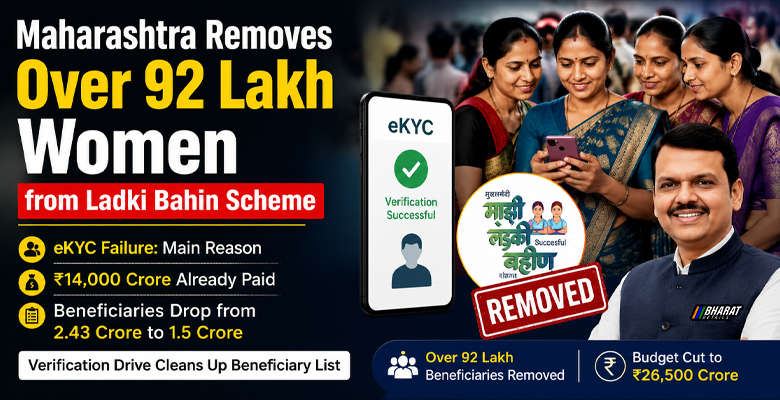
One of Maharashtra’s largest women-centric welfare programmes has undergone a major cleanup after a comprehensive verification exercise led to the removal of more than 92 lakh beneficiaries from the Maharashtra Ladki Bahin Scheme. Government records indicate that most of those excluded either failed to complete mandatory verification or were found ineligible under the scheme’s eligibility rules.
The large-scale verification marks one of the biggest beneficiary audits carried out for a direct benefit transfer programme in the state. Officials believe the exercise is intended to ensure that financial assistance reaches only genuinely eligible women while reducing irregularities that emerged during the initial implementation of the scheme.
The development has also resulted in a sharp reduction in the number of active beneficiaries and a corresponding decrease in the government’s financial commitment towards the programme.
Contents
Verification Drive Identifies Multiple Categories of Ineligible Beneficiaries
According to officials associated with the verification process, the government reviewed beneficiary records across Maharashtra to identify cases where eligibility conditions were not met.
The exercise found that many beneficiaries had either failed to complete mandatory electronic Know Your Customer (eKYC) verification or no longer qualified under the scheme’s prescribed norms.
Officials estimate that the beneficiaries who have now been removed collectively received financial assistance worth nearly ₹14,000 crore before payments were discontinued. Since beneficiaries were verified at different stages, the duration for which they received assistance varied, although many had received benefits for close to ten months.
The verification exercise is being viewed as part of the state’s effort to improve transparency and strengthen the delivery mechanism of welfare schemes funded through public money.
eKYC Non-Compliance Accounted for the Largest Share
Government data shows that incomplete eKYC was by far the biggest reason behind beneficiary removal.
Nearly 62 lakh women, representing approximately two-thirds of all deleted beneficiaries, were removed because they did not complete the mandatory authentication process despite multiple reminders from authorities.
The eKYC process was introduced to verify the identity of beneficiaries and eliminate duplicate, fraudulent or inactive records. Officials believe the exercise has significantly improved the accuracy of the beneficiary database.
Apart from eKYC-related deletions, several other eligibility violations were also identified during scrutiny.
Income Criteria Led to Thousands of Removals
The scheme is designed to support women belonging to economically weaker families. One of the primary eligibility conditions is that the annual family income should not exceed ₹2.5 lakh.
During verification, around 16 lakh beneficiaries were found to belong to households earning above the prescribed income limit. As a result, they were declared ineligible and removed from the scheme.
Officials said income verification formed an important component of the audit to ensure that government assistance remains focused on families requiring financial support.
Government Employees and Other Ineligible Beneficiaries Identified
The verification exercise also revealed several categories of beneficiaries who were not eligible under the scheme guidelines.
Authorities found that more than 4.4 lakh women belonged to families where either they or another family member was employed in government service. Since government employees are excluded from the scheme, these beneficiaries were removed.
In addition, around 3.6 lakh women were already receiving assistance under the Sanjay Gandhi Niradhar Yojana, making them ineligible to receive benefits simultaneously under the Ladki Bahin Scheme.
Officials also identified cases where more than two members from the same family were receiving financial assistance despite scheme rules restricting such benefits.
Further scrutiny revealed beneficiaries above the prescribed upper age limit, applications rejected during district-level verification, and even cases involving male beneficiaries and government employees who had wrongly received financial assistance.
The findings highlight the scale of discrepancies that emerged after the scheme’s rapid expansion.
Beneficiary Numbers Witness Sharp Decline
The Mukhyamantri Majhi Ladki Bahin Yojana was introduced before the 2024 Maharashtra Assembly elections as a flagship welfare initiative aimed at supporting eligible women through direct monthly financial assistance.
Under the scheme, women between 21 and 65 years of age belonging to families with an annual income below ₹2.5 lakh receive ₹1,500 every month.
Government employees, income-tax payers and beneficiaries already covered under certain other welfare programmes are excluded from the scheme.
Following the completion of the verification drive, the number of beneficiaries has reduced substantially.
From a peak of approximately 2.43 crore beneficiaries, the scheme now covers a little over 1.5 crore women, reflecting the extensive impact of the verification process.
Officials believe the updated beneficiary database will make future fund disbursement more accurate while preventing duplicate or ineligible claims.
Also read | WhatsApp Usernames: Meta Introduces Phone Number-Free Chat Feature To Strengthen User Privacy
Massive Public Spending Comes Under Greater Scrutiny
Since its launch, the Ladki Bahin Scheme has become one of Maharashtra’s largest welfare initiatives in terms of financial commitment.
Government allocations and supplementary budget provisions for the programme have crossed ₹60,000 crore, making financial oversight particularly important.
With such significant expenditure involved, officials say continuous verification is necessary to maintain transparency and ensure public funds are utilised efficiently.
The latest verification exercise is expected to become a reference point for future audits of large-scale welfare programmes across the state.
CAG Raises Questions on Financial Management
The verification exercise comes against the backdrop of observations made by the Comptroller and Auditor General (CAG) in its audit of Maharashtra’s finances.
The audit highlighted concerns regarding budget estimation, expenditure planning and financial management in relation to government spending.
Among the observations were excess expenditure running into several thousand crore rupees and large sums remaining parked in government accounts despite not being immediately required.
The audit also recommended more realistic assessment of beneficiary numbers while preparing budgets for major direct benefit transfer schemes.
Experts believe accurate beneficiary databases are essential for improving budget planning and ensuring efficient utilisation of public resources.
Minister Explains Why eKYC Was Delayed
Responding to questions surrounding the verification exercise, Women and Child Development Minister Aditi Tatkare said the government could not immediately begin mandatory eKYC after launching the scheme because the Model Code of Conduct came into force ahead of the Maharashtra Assembly elections.
According to the minister, although the scheme was announced in mid-2024 and the first instalments were released shortly thereafter, the election process delayed implementation of beneficiary verification.
She said the government later initiated the statewide eKYC exercise and repeatedly informed beneficiaries that failure to complete the process would eventually lead to suspension of payments.
Officials also provided multiple opportunities and extensions to complete authentication before payments were stopped.
The government maintains that eligible beneficiaries continued receiving financial assistance until verification requirements were enforced.
Recovery to Focus on Specific Categories
The state government has clarified that recovery proceedings will not be initiated against every beneficiary whose payments have stopped.
Instead, recovery will primarily target beneficiaries who clearly received payments despite being ineligible, particularly male beneficiaries and government employees.
District administrations have reportedly been instructed to recover amounts paid to such recipients under the applicable revenue recovery mechanism.
The decision seeks to distinguish between procedural lapses, such as delayed eKYC completion, and cases involving clear violations of eligibility conditions.
Budget Allocation Reduced
The verification exercise has also influenced the government’s financial planning for the scheme.
The budget allocation for the Mukhyamantri Majhi Ladki Bahin Yojana has been reduced from ₹36,000 crore in the previous financial plan to ₹26,500 crore for the current year.
The reduction reflects the decline in the number of eligible beneficiaries following verification.
Meanwhile, the government’s earlier electoral promise to increase the monthly assistance from ₹1,500 to ₹2,100 has not yet been implemented.
No official timeline has been announced regarding any revision in the benefit amount.
What Beneficiaries Should Do Next
Officials have advised women who believe they remain eligible to ensure that all required documents and authentication formalities are completed correctly. Those who have not yet finished the mandatory eKYC process may need to contact the concerned authorities to understand their current status.
The government is expected to continue monitoring beneficiary records periodically to prevent future irregularities and maintain the integrity of the scheme.
As Maharashtra strengthens verification mechanisms across welfare programmes, the Ladki Bahin Scheme is likely to remain under close administrative and financial scrutiny in the coming months.