Maharashtra FDA Raids Bollywood Cafe, Inspects 86 Quick-Commerce Hubs Over Food Safety Violations

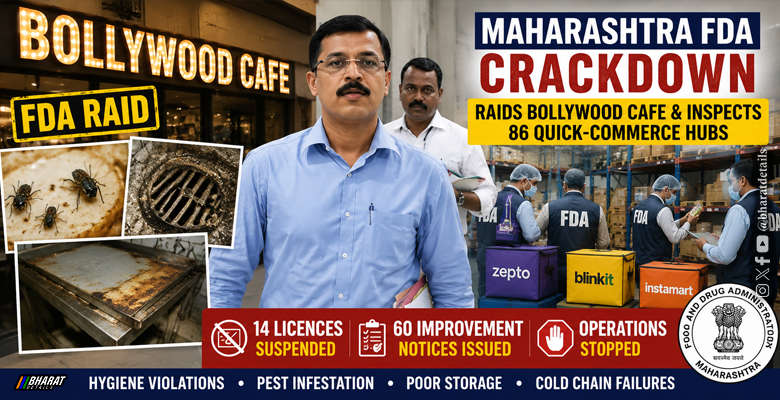
Maharashtra FDA crackdown has intensified across the state, with food safety officials inspecting restaurants, hotels and quick-commerce facilities and taking action against several establishments over alleged hygiene and food safety violations.
The Maharashtra Food and Drug Administration (FDA), under Commissioner Tukaram Mundhe, stepped up enforcement this week as part of a wider drive to check compliance among food businesses and online grocery delivery facilities.
One of the prominent actions took place on Friday, August 14, at Bollywood Café in Film City, Goregaon East, Mumbai. FDA officials reportedly found several serious hygiene concerns during the inspection, including a heavy fly infestation, dirty drains and food being prepared on rusty and unclean surfaces.
The regulator has initiated penal proceedings against the café under Section 69 of the Food Safety and Standards Act.
The action against Bollywood Café was part of a larger statewide enforcement exercise. Officials inspected 109 hotels and restaurants and conducted 15 raids focused on suspected adulteration and the use or sale of banned substances.
During these operations, authorities seized banned gutkha, adulterated dairy products and expired food items valued at more than ₹46.89 lakh. The licences of four hotels and restaurants were also suspended.
Contents
FDA turns focus to quick-commerce warehouses
The enforcement drive also extended to the rapidly expanding quick-commerce sector, where food and grocery products are stored, handled and dispatched from warehouses and fulfilment centres.
FDA teams inspected 86 facilities associated with Zepto, Blinkit and Instamart. According to officials, the inspections led to 14 licence suspensions, 60 improvement notices and one order directing an establishment to immediately stop operations.
The findings indicate that regulators are examining not only the condition of food products but also cold-chain management, employee health documentation, pest control, storage practices and segregation of different categories of goods.
At a Blinkit facility in Malad West, Mumbai, the FDA suspended the licence after reportedly finding cold storage temperatures at around 6°C, disorganised storage and inadequate segregation between vegetarian and non-vegetarian products.
Inspectors also found that medical fitness records were unavailable for 40 food handlers, raising concerns about compliance with mandatory food-handling requirements.
Another Blinkit facility in Ghatkopar was issued a non-compliance notice following observations including cockroach infestation, damaged ceilings and flooring, and inadequate segregation of food products.
Delivery operations stopped in Karad
The FDA also took action in Karad, Satara district, where delivery operations were ordered to stop after officials reportedly found 125 two-wheeler delivery riders without identity cards, valid medical fitness records or the required FSSAI registration displayed on their delivery bags.
The action highlights the regulator’s broader approach to food safety, which extends beyond restaurants and warehouses to the systems involved in handling and delivering food products.
Zepto facilities face regulatory action
Several Zepto facilities were also flagged during the inspections.
The licence of Zepto’s Lohegaon facility in Pune was suspended after officials reportedly found problems involving cold-storage temperatures, unhygienic conditions and food products that had gone beyond their “Use By” dates.
At a Zepto facility in Lokhandwala, Andheri West, inspectors raised concerns over hazardous chemicals being stored close to food products. The facility was also found to be lacking required infrastructure related to cold-chain operations.
Other Zepto facilities were flagged for issues including inadequate waste disposal, poor temperature management, unhygienic entry areas, unsuitable food-handling spaces and insufficient lighting.
The findings are significant because quick-commerce platforms increasingly handle perishable foods, dairy products, frozen goods and other temperature-sensitive items. Any breakdown in storage or cold-chain management can potentially affect product quality and consumer safety.
Instamart warehouse licence suspended
An Instamart facility at Warje Jakat Naka in Pune also faced strong regulatory action.
The FDA suspended the facility’s licence after inspectors reportedly found an active cockroach infestation, problems with the cold-chain system and serious hygiene deficiencies.
The action comes as quick-commerce companies continue to expand their network of local fulfilment centres to provide increasingly faster deliveries. With more food products passing through such facilities, maintaining proper storage, pest control and temperature standards has become an important regulatory concern.
Four Domino’s outlets also face action
The Maharashtra FDA has separately suspended the food business licences of four Domino’s Pizza outlets following inspections that reportedly identified food safety and hygiene deficiencies.
Three of the affected outlets are in Mumbai — Vile Parle West, Borivali West and Ghatkopar West — while the fourth is located in Malkapur, Satara district. All four outlets are operated by Jubilant FoodWorks Ltd.
_______________________________________
Also read | Zomato Hyperpure Warehouse Inspected In Bengaluru After Zepto Facility Sealed Over Food Safety Concerns
_______________________________________
At the Vile Parle West outlet, officials identified concerns related to the display of the FSSAI licence, drinking water safety, food storage, pest control and general hygiene.
The outlet was directed to improve monitoring of frozen-food temperatures, maintain proper separation between food and non-food materials, strengthen pest-control measures and ensure appropriate hand-washing and sanitation facilities.
What the Maharashtra FDA action means
The latest inspections show that Maharashtra’s food safety regulator is widening enforcement across both traditional food businesses and newer food-delivery infrastructure.
For restaurants, hotels and food-service establishments, the inspections underline the importance of basic hygiene, pest control, safe food preparation, proper storage and compliance with licensing requirements.
For quick-commerce companies, the scrutiny places greater attention on warehouse-level food handling, cold-chain systems, employee documentation and the condition in which products are stored before reaching consumers.
The FDA’s latest actions are likely to be followed by compliance checks and further regulatory proceedings against establishments that fail to address the violations identified during inspections. For consumers, the crackdown also reinforces the importance of checking food labels, expiry or “Use By” dates and the condition of perishable products received through delivery services.