Dahi Handi Tragedy: Two Dead, Over 200 Injured During Janmashtami Celebrations

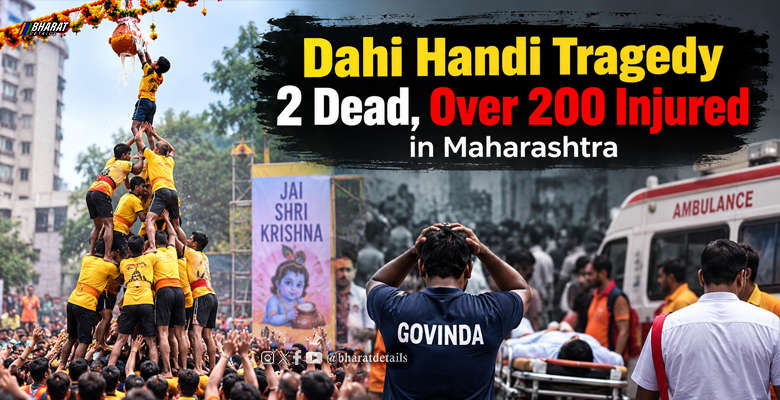
Dahi Handi celebrations in Maharashtra turned tragic as two people lost their lives and more than 200 participants were injured during Janmashtami festivities, with Mumbai reporting a large number of casualties among Govindas.
The incidents occurred during celebrations across Mumbai and neighbouring areas, where thousands of participants gathered to form human pyramids and break the traditional clay pots suspended at a height.
One of the victims was seven-year-old Rudra Kadam, who died after a brick column collapsed during a Dahi Handi celebration in Mumbai’s Malvani area.
The incident took place at Ekta Welfare Society in Chikuwadi on Malad-Marve Road at around 3 pm. According to officials, a group of children had organised their own small Dahi Handi celebration.
One end of the rope holding the handi had reportedly been tied to a tree, while the other was secured to a brick column belonging to a ground-floor structure.
As the children attempted to break the pot, the brick column suddenly collapsed. Rudra was trapped under the debris and suffered severe head injuries.
People present at the spot immediately pulled the child out and rushed him to Malvani General Hospital. However, doctors declared him dead on arrival.
Other children involved in the celebration escaped with minor injuries.
Local residents said the column was part of a partially demolished structure. Civic sources indicated that the structure had been demolished earlier as part of action against illegal constructions, and the circumstances surrounding the collapse are being examined.
Rudra was a Class 2 student at a civic school. His death cast a shadow over the festival celebrations in the Malvani area.
Contents
Another Festival-Related Death Reported in Maharashtra
A second death was reported in Maharashtra during the Janmashtami celebrations.
In Pune, Salma Salauddin Pathan, a resident of the Old Sangavi area in Pimpri Chinchwad, died after a temporary iron structure collapsed on her, officials said.
The structure had been erected to support a stack of loudspeakers during a Dahi Handi programme. Workers were reportedly dismantling the iron frame after the event when a heavy section of the structure fell on Pathan.
She suffered a serious head injury and was rushed to a hospital, where doctors declared her dead.
Police registered an accidental death report and began examining the circumstances that led to the collapse. According to officials, the victim’s family did not seek action against the organisers.
Human Pyramid Collapse Claims Another Life in Navi Mumbai
Separately, a 34-year-old Govinda from Ghansoli in Navi Mumbai died after a human pyramid collapsed during a Dahi Handi event.
The deceased was identified as Swapnil Sadanand Nawar, a resident of the Ghansoli koliwada area.
The incident occurred at around 8.30 pm during celebrations organised by a local Dahi Handi mandal. Nawar was injured when the human pyramid collapsed and was taken to a nearby hospital, where he was declared dead on arrival.
The incident once again highlighted the risks associated with the multi-tier human pyramids that are a major part of Maharashtra’s Dahi Handi tradition.
More Than 200 Govindas Injured
Apart from the fatalities, a large number of Govindas suffered injuries during celebrations across Mumbai, Thane and neighbouring areas.
According to information from civic and government hospitals, at least 168 participants were injured in Mumbai, while another 44 were reported injured in Thane, taking the total number of injured Govindas to at least 212.
Of the injured participants in Mumbai, several required hospitalisation, while others received treatment for injuries sustained during the formation and collapse of human pyramids.
The highest number of injured participants was reported at KEM Hospital in Parel, followed by Rajawadi Hospital in Ghatkopar and Nair Hospital in Mumbai Central.
Civic authorities had made advance preparations for the festival, including reserving hospital beds and deploying additional medical staff. Hospitals were also instructed to maintain sufficient stocks of medicines, injections and surgical supplies to deal with emergencies.
Leaders Stress Safety During Celebrations
Dahi Handi celebrations have grown into major public events in Mumbai and other parts of Maharashtra, attracting large crowds, professional Govinda teams, political leaders, celebrities and organisers offering significant prize money.
However, the growing scale of the events has also raised concerns about the safety of participants.
Chief Minister Devendra Fadnavis attended several Dahi Handi programmes in Mumbai and urged young people to stay away from addiction while highlighting the cultural importance of the festival.
Deputy Chief Minister Eknath Shinde also emphasised that safety should remain more important than setting records or building increasingly taller human pyramids.
The message from political leaders and civic authorities was clear: the traditional celebration should continue, but not at the cost of human life.
________________________
Also read | Maharashtra Wrestler Ashwini Paul Dies After Fort Gorge Fall With Three Children, Two Children Dead
________________________
A Celebration That Demands Greater Safety
Dahi Handi is one of Maharashtra’s most popular Janmashtami traditions and symbolises teamwork, courage and collective effort. Participants form human pyramids to reach and break clay pots filled with curd and other items suspended high above the ground.
But the deaths and injuries reported during this year’s celebrations underline the need for stricter safety measures, particularly at smaller local events where structures, ropes and other equipment may not always be properly inspected.
The tragedies have once again brought attention to the importance of trained teams, protective equipment, secure event structures and adequate emergency medical arrangements.
As Maharashtra continues to celebrate its festivals with enthusiasm and large public participation, the incidents serve as a reminder that tradition and celebration must go hand in hand with safety and responsible planning.