Mumbai Ring Road Expansion: MMRDA Plans 307-km Network Across Mumbai, Thane and Navi Mumbai

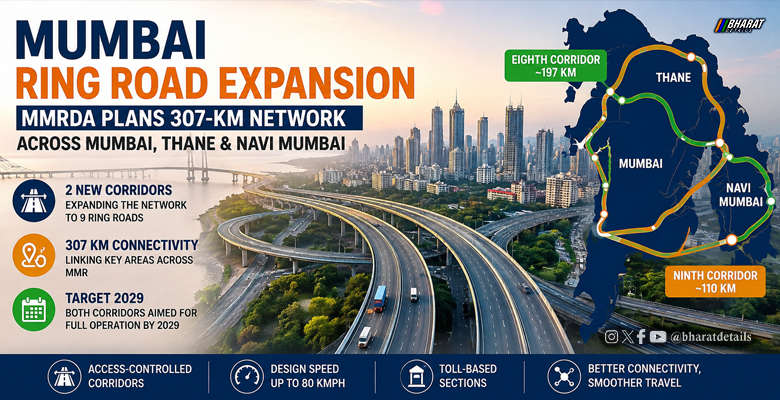
Mumbai ring road expansion is set to take a major step forward as the Mumbai Metropolitan Region Development Authority (MMRDA) plans to add two new corridors to its proposed network, increasing the total number of ring routes from seven to nine.
The expanded network is planned to cover around 307 km across Mumbai, Thane, Navi Mumbai and the northern suburbs. However, the figure does not represent 307 km of entirely new road construction. Instead, MMRDA intends to connect existing roads with several major infrastructure projects that are already under construction or in the planning stage.
The larger objective is to create interconnected road loops across the Mumbai Metropolitan Region (MMR), giving motorists alternatives to some of the city’s busiest internal routes.
The two new corridors are being identified as the eighth and ninth rings. The eighth ring is expected to cover approximately 197 km, while the ninth will be around 110 km long. Both are planned as access-controlled corridors with a design speed of up to 80 kmph.
MMRDA is targeting 2029 for the two routes to become fully operational, although their completion will depend on the progress of several individual road, tunnel, sea-link and interchange projects that form part of the proposed network.
Contents
Eighth ring to connect Sewri, Thane and Navi Mumbai
The proposed eighth ring will establish a major loop between Sewri, Thane and Navi Mumbai.
The corridor is planned to begin at Sewri, close to the Mumbai end of the Mumbai Trans Harbour Link (MTHL), and move towards Thane through the Eastern Freeway and its extension. From Thane, the route is expected to use the Anand Nagar-Saket elevated road before continuing towards Navi Mumbai.
The alignment will then connect with the Mumbai-Vadodara Expressway and NH-4B towards Chirle. From there, the Mumbai Trans Harbour Link will provide the connection back to Sewri, completing the wider loop.
The corridor could be particularly important for traffic moving between Thane, Navi Mumbai and Bhiwandi. It is also expected to improve access towards the Jawaharlal Nehru Port area and emerging freight and development zones in the region.
For commercial vehicles and other long-distance traffic, such a connection could reduce dependence on more congested city roads and provide a more direct route between important economic centres.
Ninth ring to form a wider circuit around Mumbai
The ninth proposed ring will create a broader circuit around Mumbai, covering approximately 110 km.
The route is planned to start from Nariman Point and head north through Mumbai’s coastal road network. It will incorporate major links such as the Bandra-Worli Sea Link, Versova-Bandra Sea Link and the northern coastal road before reaching Borivali.
From Borivali, the proposed Thane-Borivali Twin Tunnel will provide the connection towards Thane. The route will then continue through Thane Coastal Road 1 and the Anand Nagar-Saket elevated road.
Further south, the corridor is expected to connect with the Eastern Freeway extension and the existing Eastern Freeway. The proposed Orange Gate tunnel would then provide the final link towards Nariman Point.
Once the required projects are completed, the route could effectively create a large circuit connecting South Mumbai, the western suburbs, Borivali, Thane and the eastern side of the city.
Multiple infrastructure projects to work as one network
One of the important aspects of the expanded plan is that MMRDA is looking at these projects as parts of a larger transport system rather than isolated road developments.
The proposed network will bring together infrastructure being developed by different agencies, including MMRDA, the Brihanmumbai Municipal Corporation (BMC), Maharashtra State Road Development Corporation (MSRDC) and the National Highways Authority of India (NHAI).
Several projects associated with the earlier seven-ring concept are expected to become links within the expanded network. These include the Sewri-Worli Connector, Orange Gate tunnel, Goregaon-Mulund Link Road and Thane-Borivali Twin Tunnel.
Existing corridors such as the Jogeshwari-Vikhroli Link Road (JVLR) and Santacruz-Chembur Link Road (SCLR) could also form part of the interconnected system.
The approach is intended to make better use of roads and major infrastructure that are already operational while ensuring new projects fit into a larger regional connectivity plan.
Interchanges and connecting roads will be crucial
Creating a continuous ring network will involve more than simply joining existing roads. Several corridors will converge at key locations, requiring carefully designed ramps, connectors, junction improvements and interchanges.
MMRDA is expected to assess traffic patterns and engineering requirements at these locations before finalising how different roads will connect.
The authority is also examining whether some existing corridors may eventually require additional capacity. Roads such as the Eastern Freeway and Sewri-Worli Connector currently have two lanes in each direction in certain sections. Future widening could be considered depending on traffic demand, available right of way and engineering feasibility.
Access-controlled roads may include tolls
The two proposed rings are expected to operate as access-controlled corridors, meaning vehicles would enter and leave at designated points rather than through unrestricted roadside access.
The proposed design speed is up to 80 kmph. Some sections could also be tolled, although the final arrangements would depend on the individual infrastructure projects and the operating model adopted by the authorities.
For motorists, the biggest potential benefit would be improved travel continuity across the MMR. Instead of passing through heavily congested central areas, vehicles travelling between distant parts of the metropolitan region could use the interconnected ring corridors.
_______________________________
Also read | India Ends Boarding Pass Stamping At Immigration Counters From September 1
_______________________________
2029 target depends on several projects
The 2029 target represents the broader goal for making the two proposed rings operational. However, several of the infrastructure links required to complete the loops are still being constructed, proposed or awaiting further development.
That makes coordination between different agencies particularly important. A delay in one critical tunnel, road or connector could affect the ability of an entire ring to function as a continuous route.
If the planned links are delivered as intended, Mumbai’s ring-road network could significantly change how long-distance traffic moves through the metropolitan region.
Rather than relying predominantly on roads passing through the city, the expanded system aims to create multiple interconnected routes around Mumbai and its surrounding urban centres. For a region facing growing traffic volumes and rapid development, the success of the plan will ultimately depend on how effectively these individual infrastructure projects are integrated into one functioning network.