Delhi Govt Ends Further Legal Action in NEET Protest Cases, Exempts Those With Criminal Antecedents

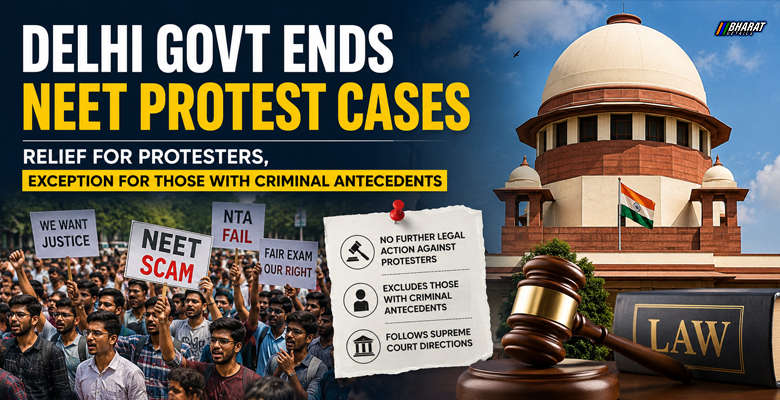
The Delhi government has announced that no further adverse legal action will be taken against people involved in the NEET protests, while making an important exception for those with criminal antecedents.
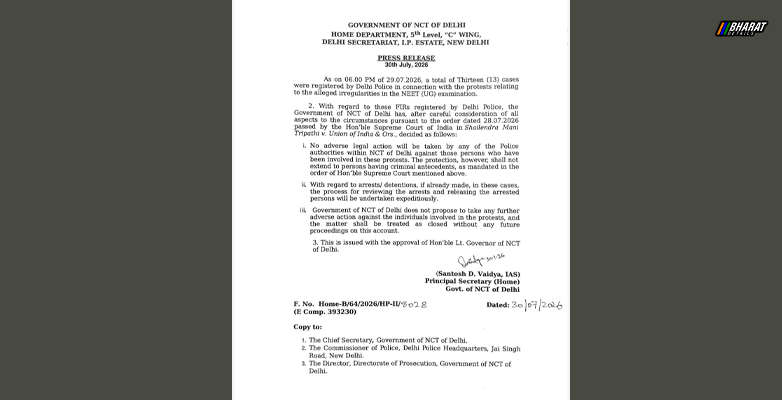
The Delhi Home Department issued the order on Thursday, July 30, 2026, covering cases registered in connection with demonstrations held in the national capital over alleged irregularities in the NEET (UG) examination. The government said the decision was taken in line with the Supreme Court’s recent interim directions concerning the protests.
According to the Home Department, 13 cases had been registered by Delhi Police in connection with the protests. The latest order states that people who participated in the demonstrations will not face further adverse police action in connection with the protest cases, subject to the exception for individuals with criminal antecedents.
The government has also directed authorities to speed up the review of arrests and detentions already made in these cases. Where the review finds that a person falls within the protection, the process for release is to be undertaken expeditiously.
Contents
What the Delhi government order means
The decision does not amount to a blanket cancellation of every investigation or FIR connected with the protests.
The Delhi government has said that no further adverse action will be pursued against protesters covered by the order and that the matter will be treated as closed without future proceedings on that account. However, the protection does not apply to people with criminal antecedents.
That distinction mirrors the Supreme Court’s July 28 interim order. The court allowed Delhi and other states to continue investigating FIRs arising from the protests but directed that no coercive measures be taken against protesting students. It specifically excluded people with criminal antecedents from that protection.
The Supreme Court also directed states to release children below 18 who had been arrested or detained in connection with the protests, provided they did not have criminal antecedents. The court has scheduled the matters for further consideration on August 3.
Why criminal antecedents have become a key issue
The exception comes amid a police review of people identified in connection with violence during the July 20 march towards Parliament.
Delhi Police said it had examined CCTV footage and identified 2,873 people allegedly connected with the incidents. Police officials said 989 of those identified had previous criminal records, including cases involving serious offences. These claims have been attributed to police officials and should not be read as proof that every person identified was involved in violence during the protest.
The police assessment has become a significant part of the legal and political debate surrounding the protests. The Supreme Court order itself records competing allegations: petitioners have alleged excessive use of force by police, while the Union government’s side told the court that criminal and undesirable elements had entered the protest site and that police personnel were seriously injured.
July 20 march led to clashes
The immediate backdrop to the Delhi government’s decision is the July 20 “Chalo Sansad” march from Jantar Mantar.
The protest movement had focused on alleged irregularities in the NEET (UG) examination and demands for changes to the examination system. The march towards Parliament was stopped by police, after which clashes and allegations of excessive force became central to the subsequent legal proceedings.
The Supreme Court has taken note of allegations involving lathi-charge, tear gas and pellet guns, while also recording the government’s position that protesters and other elements were responsible for violence against police personnel. The court said the allegations warranted consideration of an independent and impartial investigation and sought responses from the Union government, Delhi and several states.
Supreme Court’s intervention changed the legal position
The Supreme Court’s July 28 order is particularly important because it established an interim framework while the larger petitions remain pending.
The court directed authorities to preserve CCTV, drone footage, body-camera recordings, videography and other relevant records connected with the protests. It also ordered that personal information and digital data collected during the demonstrations should not be disclosed publicly for the time being.
At the same time, the court permitted investigation of existing FIRs. The restriction was on coercive action against protesting students, with an explicit exception for those with criminal antecedents.
______________________________________
Also read | Anti-Paper Leak Bill 2026 Passed In Lok Sabha Amid Rahul Gandhi-Amit Shah Row Over Student Protest
______________________________________
What happens next
For protesters covered by the Delhi government’s order, the immediate focus will be on the review of arrests and detentions and the implementation of the promised relief.
The broader legal questions, however, remain unresolved. The Supreme Court is still considering allegations of police excesses as well as the government’s claims about violence by protesters and the presence of people with criminal backgrounds at the demonstrations.
The court has asked the Union government and the affected states to place their responses on record before it considers the next course of action. The matter is listed for further consideration on August 3, meaning the legal framework around the NEET protest cases could see further developments in the coming days.
For now, Delhi’s order provides relief to protesters who fall within its scope, but the criminal-antecedent exception ensures that the decision does not operate as a blanket shield against ongoing legal scrutiny.