Dabur Challenges FSSAI ‘100% Claims’ Ban in Delhi High Court: What It Means for Food Labels

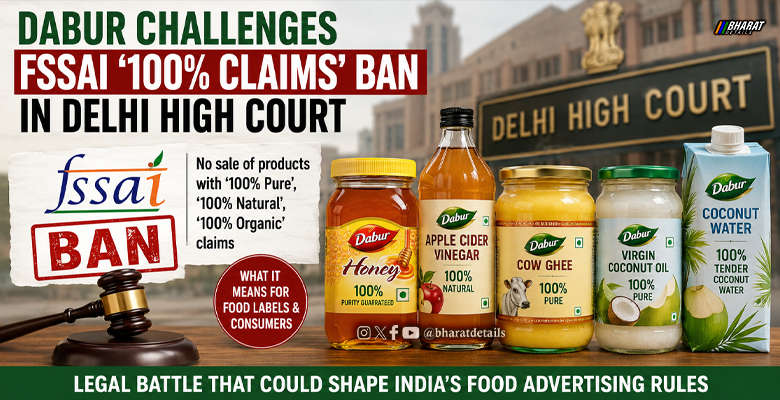
Dabur FSSAI 100% claims ban has now become a legal issue, with the consumer goods company approaching the Delhi High Court against a regulatory order restricting the sale of food products carrying absolute “100%” claims.
The dispute centres on how food companies can describe products using terms such as “100% Pure”, “100% Natural” and “100% Organic”. The case could also provide greater clarity on how far the Food Safety and Standards Authority of India (FSSAI) can go while enforcing advertising and labelling regulations.
Dabur approached the Delhi High Court after the FSSAI issued a prohibition order covering several products marketed with such claims. The matter was mentioned for urgent listing and is scheduled to come up before the court.
Contents
Why did FSSAI object to Dabur’s claims?
The FSSAI’s action covers a range of food products, including honey, apple cider vinegar, virgin coconut oil, sesame oil, cow ghee, coconut water and coconut milk.
According to the regulator, claims containing absolute expressions such as “100% Pure”, “100% Natural”, “100% Organic”, “100% Purity Guaranteed” and “100% Tender Coconut Water” can be ambiguous or difficult to substantiate in the manner presented to consumers.
The regulator has taken the position that such wording may create an exaggerated impression about the nature, composition or quality of a food product and could therefore fall foul of the Food Safety and Standards (Advertising and Claims) Regulations, 2018.
The company was also directed to submit an Action Taken Report within 15 days.
The action follows earlier regulatory concerns involving some of Dabur’s products and their labelling or marketing claims. The FSSAI had previously raised objections over the use of the Jaivik Bharat logo on certain products without what it said was the required organic endorsement.
It also questioned the description used for Dabur Hommade Coconut Milk, particularly the use of an absolute purity claim for a compound food product.
What is Dabur’s argument?
Dabur has challenged the prohibition order primarily on procedural and legal grounds.
The company has argued that the regulator issued the order without first serving a show-cause notice or giving Dabur an adequate opportunity to present its case. The company has described the order as legally unsustainable and has questioned the authority under which the prohibition was issued.
Dabur has also maintained that the expression “100%” is commonly used by food businesses and has argued that the regulatory action has caused reputational damage.
The company’s earlier response to the regulator also stated that it had already begun moving certain product labels, advertisements and website material away from the disputed “100%” wording.
Importantly, Dabur has said the regulatory notice concerns the interpretation and presentation of product descriptions and does not allege that the affected products are unsafe or of inferior quality.
What happens to the affected products?
The FSSAI’s prohibition order relates specifically to products carrying the disputed claims. The company has said that the operational and financial impact is limited to the food products covered by the regulatory action.
Dabur has also indicated that the transition to revised labels and advertising material was already underway for products referred to in the regulator’s communication.
That distinction is important for consumers. The dispute is primarily about how products are described and advertised, rather than an allegation that the affected products are unsafe to consume.
Why the Delhi High Court case matters
The case goes beyond one company because “pure”, “natural”, “organic” and similar words are widely used in India’s packaged food market.
A decision or significant observation from the Delhi High Court could influence how food companies formulate marketing claims in the future. Businesses may need to reassess packaging, advertisements, e-commerce listings and website descriptions where absolute claims are used.
The case could also clarify the procedural safeguards that regulators must follow before imposing restrictions on the sale or marketing of food products.
For consumers, the issue has another dimension. Food labels are often a major source of information when people compare products. Regulators therefore face the difficult task of allowing meaningful product descriptions while preventing marketing language that could give consumers an inaccurate impression.
____________________________
Also | FCRA Amendment Bill 2026 Explained: What The Proposed Changes Mean For NGOs, Foreign Funding And The Political Debate
____________________________
A larger regulatory push
The Dabur dispute comes amid increased regulatory attention on food advertising and labelling in India.
The FSSAI has been scrutinising claims that it believes could mislead consumers, particularly where words suggesting absolute purity, naturalness or quality are used without sufficient basis.
The broader objective is to make food advertising more transparent and ensure that claims made on packaging and promotional material can withstand regulatory scrutiny.
For companies, that could mean greater emphasis on evidence-backed claims and more careful review of labels before products reach the market.
What could happen next?
The immediate focus will be on the Delhi High Court proceedings and the arguments raised by Dabur against the FSSAI order.
The court may examine whether the regulator followed the required procedure, whether the prohibition order falls within its statutory powers and how the relevant advertising regulations should be interpreted.
The proceedings could eventually offer guidance to both regulators and food manufacturers over the use of absolute claims on food products.
For now, the dispute remains a legal and regulatory disagreement rather than a finding that Dabur’s affected products are unsafe. The court’s consideration of the matter could determine whether the FSSAI’s approach to “100%” claims stands, requires modification or needs to be examined further under the applicable law.
