Meerut Blue Drum Murder Case: Muskan Rastogi and Sahil Shukla Sentenced to Death

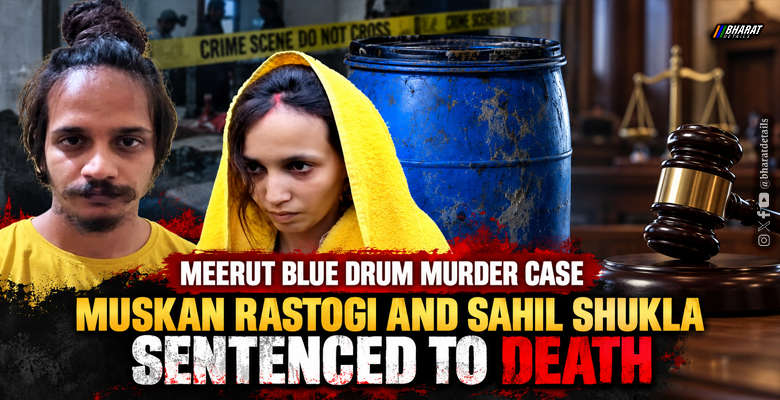
A Meerut court has sentenced Muskan Rastogi and Sahil Shukla to death in the Meerut Blue Drum murder case, in which merchant navy officer Saurabh Rajput was murdered and his dismembered remains allegedly concealed inside a cement-filled plastic drum in March 2025. The verdict was delivered on October 14, 2026, following their conviction earlier this month.
The case drew widespread attention because of the brutality of the crime and the alleged efforts to conceal the victim’s remains. The sentencing marks a significant development in a trial that lasted around 13 months and involved the examination of 22 prosecution witnesses.
According to the prosecution, the court considered the nature and severity of the offence before imposing capital punishment on both convicts. However, the death sentences are subject to judicial scrutiny through the applicable appeal and confirmation process.
Contents
How the Blue Drum Murder Case Unfolded
The murder took place in Meerut, Uttar Pradesh, in March 2025. Saurabh Rajput, 35, had reportedly returned from London in late February, shortly before his death.
Investigators alleged that Muskan, his wife, and Sahil, who was reportedly in a relationship with her, planned and carried out the killing. According to the prosecution’s account, Rajput was drugged before being stabbed to death. His body was then dismembered, and the remains were placed inside a blue plastic drum.
The accused allegedly used cement and other materials to seal the remains inside the container in an attempt to conceal the crime. Investigators also reportedly found that the accused had considered using a suitcase to dispose of the body before turning to the drum.
The crime came to light in mid-March 2025 after a foul smell reportedly drew attention to the container. Rajput’s remains were recovered on March 17, and Muskan and Sahil were arrested on March 18.
The two had allegedly travelled to Himachal Pradesh following the murder. Police examined information about their movements and accommodation as part of the investigation.
Court Convicts Both Accused Before Sentencing
On September 30, 2026, the Meerut district court found Muskan Rastogi and Sahil Shukla guilty of murder and related offences involving the concealment of evidence. The court subsequently fixed October 14 for sentencing.
The prosecution had sought the death penalty for both accused, arguing that the severity of the crime warranted the maximum punishment available under the law.
Prosecution lawyer K.K. Chaubey said the judge referred to the Mahabharata while explaining the importance of punishing offenders in proportion to the seriousness of their crimes. The court then awarded the death sentence to both convicts.
Reports of the verdict also stated that the court imposed fines of ₹50,000 each for murder and ₹20,000 each for the offence relating to the disappearance of evidence. The accused appeared before the court through video conferencing when the sentence was pronounced.
The prosecution relied on documentary, forensic and circumstantial evidence to establish its case. Police had filed a chargesheet running to more than 1,000 pages in May 2025.
Forensic Evidence and Witness Testimony Played a Key Role
According to investigators, there was no eyewitness to the murder. The prosecution therefore relied on the evidence collected during the investigation to establish the sequence of events and the involvement of the accused.
The chargesheet reportedly included forensic findings, call detail records, CCTV footage and statements from people connected to different stages of the investigation.
Among those questioned were members of both families, a cab driver, a medical store owner, sellers connected with the purchase of the knife and drum, and a cement shop owner. Investigators also recorded statements from hotel owners in Shimla, Manali and Kasauli, where the accused allegedly stayed after the killing.
The prosecution examined 22 witnesses during the trial. Evidence relating to the purchase of materials and the alleged efforts to dispose of the body formed part of the case presented before the court.
The trial’s outcome highlights the importance of establishing a reliable chain of circumstantial evidence in cases where investigators do not have a direct eyewitness to the crime.
Saurabh Rajput’s Family Welcomes the Verdict
Rajput’s mother, Renu Devi, was present when the court announced the sentence. She expressed relief at the decision, saying that the punishment could help prevent other families from experiencing similar trauma.
She also acknowledged that no court verdict could bring her son back. Her reaction reflected the grief experienced by the victim’s family throughout the investigation and trial.
The family had been seeking strict punishment for the accused. Its lawyer, Vijay Bahadur, reportedly referred to previous cases in which courts had awarded the death penalty while presenting arguments in favour of capital punishment.
For the family, the sentencing represents an important stage in the pursuit of justice, although the legal proceedings may continue through the appellate process.
__________________________________
Also read | Saurav Das And Ashutosh Ranka Sent To 5-Day Judicial Custody After Jantar Mantar Protest
__________________________________
What Happens Next? The Legal Process After a Death Sentence
Although the trial court has awarded the death penalty, the sentence does not mean that the convicts will be executed immediately. Under India’s criminal justice system, a death sentence passed by a Sessions Court must be confirmed by the High Court before it can be carried out. The convicts can also pursue the available appeal and review remedies under the law.
The case is also likely to draw attention to the legal standards governing capital punishment, particularly the Supreme Court’s “rarest of rare” doctrine. Courts must assess the circumstances of the offence and other relevant factors before deciding whether the death penalty is justified.
For Muskan Rastogi, the sentence is especially significant because death sentences imposed on women in India are uncommon. However, the final outcome will depend on the subsequent judicial proceedings rather than the trial court’s decision alone.
The Meerut Blue Drum murder case has now reached a crucial stage, but the legal process is not necessarily over. The High Court’s consideration of the death sentence and any further appeals will determine what happens next.