India’s First Hydrogen Train Begins Journey with Fares Starting at Just ₹5 on Jind–Sonipat Route

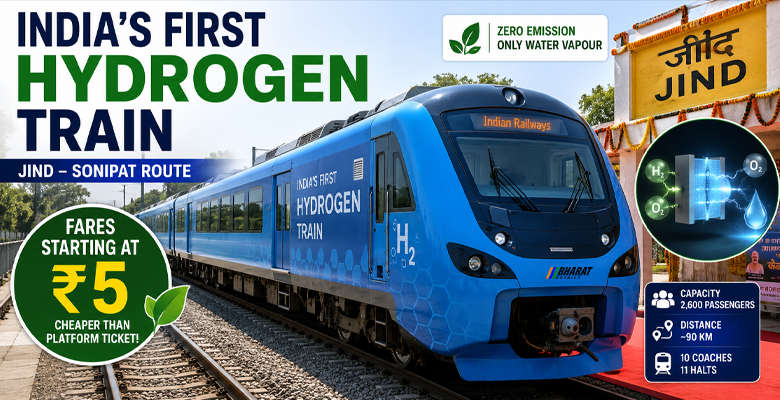
India’s First Hydrogen Train has officially entered service, marking a significant milestone in the country’s transition towards cleaner and more sustainable transportation. Operating between Jind and Sonipat in Haryana, the newly introduced train combines zero-emission technology with one of the most affordable ticket prices in the Indian Railways network, with fares beginning at just ₹5.
The service was inaugurated by Prime Minister Narendra Modi during his visit to Haryana on July 17, where several railway and public infrastructure projects were also launched. Railway officials described the hydrogen-powered train as an important step towards reducing dependence on fossil fuels while modernising India’s rail transport system.
Unlike conventional diesel-powered locomotives, the new train runs on hydrogen fuel cell technology, producing electricity through a chemical reaction between hydrogen and oxygen. The only by-product of this process is water vapour, making it an environmentally friendly alternative with no direct carbon emissions.
Contents
Affordable Travel for Daily Commuters
Apart from its clean-energy technology, the train has generated considerable public interest because of its low ticket prices.
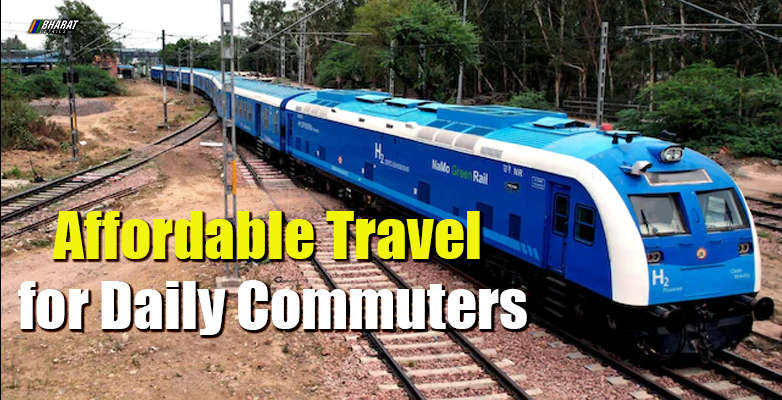
Passengers travelling on the route will pay between ₹5 and ₹25, depending on the distance travelled. The minimum fare is even lower than the platform ticket price charged at many railway stations, making the service attractive for daily commuters, students and local travellers.
Railway authorities believe affordable pricing will encourage greater public adoption while showcasing the benefits of green transportation.
Route, Timings and Passenger Capacity
The hydrogen train operates between Jind and Sonipat, covering approximately 90 kilometres in nearly two hours.
The train consists of 10 coaches, including driving power cars and passenger coaches, and is capable of accommodating nearly 2,600 passengers. It offers around 682 seats while also providing standing capacity for additional travellers.
The service will halt at multiple stations along the route, improving connectivity between towns across Haryana.
Officials said the train is expected to complete two round trips every day, making it a practical transport option for passengers travelling regularly between the two cities.
How Hydrogen Fuel Cell Technology Works
Instead of using diesel engines, hydrogen-powered trains rely on fuel cells that convert hydrogen into electricity.
Hydrogen stored onboard reacts with oxygen from the atmosphere inside the fuel cell stack. This chemical reaction generates electrical energy that powers the train’s traction motors. Any excess electricity is stored in batteries and can be used during acceleration or sections requiring higher power.
Because the system produces only water vapour, it eliminates harmful exhaust emissions commonly associated with diesel locomotives.
The project also uses green hydrogen supplied from a dedicated production facility established in Jind, further strengthening its environmental credentials.
Advanced Safety Measures Installed
Hydrogen is a highly efficient fuel but requires specialised handling. To ensure passenger safety, Indian Railways has equipped the train with multiple monitoring systems.
These include hydrogen leak detectors, automatic fire detection equipment, continuous fuel monitoring systems and several additional safety mechanisms designed to identify any abnormal condition at an early stage.
Officials said the train has undergone extensive testing before entering passenger service.
Also read | Mumbai Pink E-Rickshaw Scheme: Dedicated Routes, 40% Subsidy And GPS Safety Features Planned Across MMR
India Joins a Select Group of Nations
Hydrogen-powered rail technology has already been introduced or tested in countries including Germany, France, Italy, the United Kingdom and the United States.
With the launch of this service, India joins a limited group of nations investing in hydrogen-powered railway operations, highlighting the country’s growing focus on cleaner transport technologies.
The initiative also aligns with India’s broader environmental goals, including reducing greenhouse gas emissions and promoting alternative energy sources across public infrastructure.
Wider Railway Development Announced
During the same visit, Prime Minister Narendra Modi also inaugurated the redeveloped Jalandhar Cantonment Railway Station under the Amrit Bharat Station Scheme and dedicated dozens of upgraded railway stations across the country through virtual ceremonies.
He also flagged off the Sant Ravidas Express connecting Amritsar and Varanasi and inaugurated new healthcare facilities at PGIMER in Chandigarh.
These projects form part of the government’s broader effort to modernise transport infrastructure while improving public services.
Why the Hydrogen Train Matters
Hydrogen-powered trains are viewed as one of the most promising alternatives to diesel locomotives, particularly on routes where full electrification may not be immediately practical.
Apart from reducing pollution, these trains generate significantly less noise, improve energy efficiency and support India’s long-term objective of adopting cleaner mobility solutions.
The successful operation of the Jind-Sonipat service could pave the way for similar hydrogen-powered trains on additional routes in the coming years, helping Indian Railways move closer to a more sustainable future.