N Chandrasekaran Resignation: Tata Sons Chairman Won’t Seek Reappointment After February 2027

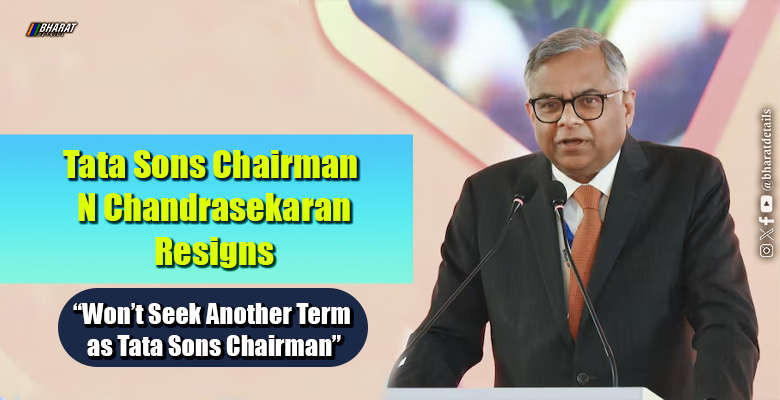
The N Chandrasekaran resignation decision has put the future leadership of Tata Sons in focus after the group chairman announced that he will not seek another term when his current tenure ends on February 20, 2027.
Chandrasekaran, 63, communicated his decision to the Tata Sons board on Wednesday, bringing an end to months of uncertainty over whether he would continue as chairman of the holding company of the Tata Group.
Importantly, Chandrasekaran is not leaving the chairmanship immediately. He will continue in his current role until the completion of his second five-year term in February 2027. He has, however, removed himself from consideration for another term and has asked the board to begin the succession process without further delay.
Contents
Why Chandrasekaran decided against another term
In his communication to the board, Chandrasekaran said the Sir Dorabji Tata Trust and Sir Ratan Tata Trust had unanimously recommended extending his tenure for another five years.
The proposal had also received support from the Tata Sons Nomination and Remuneration Committee and was placed before the Tata Sons board on February 24, 2026.
However, the proposal did not receive unanimous support from the board. Chandrasekaran said that, in the absence of unanimous backing, he chose to defer the decision.
Six months later, there was still no final resolution on his reappointment.
Chandrasekaran said Tata Sons is a large and strategically important institution, with several major projects at critical stages. According to him, uncertainty over the leadership beyond February 2027 could affect employees, investors, business partners and other stakeholders.
He therefore asked the board to settle the succession question early enough to allow an orderly transition.
Tata Trusts hold majority ownership in Tata Sons
The leadership issue is particularly significant because Tata Sons is the principal investment holding company of the Tata Group and is majority-owned by Tata Trusts.
The Sir Dorabji Tata Trust and Sir Ratan Tata Trust hold substantial stakes in Tata Sons, while several other Tata-related charitable trusts also own shares. Together, the trusts control roughly two-thirds of the holding company.
Tata Sons, in turn, sits at the centre of the wider Tata Group and has interests across technology, automobiles, aviation, consumer products, power, financial services and other sectors.
The next chairman will therefore inherit responsibility for a conglomerate that includes major businesses such as Tata Consultancy Services, Tata Motors, Air India, Titan and Tata Consumer Products.
Who will choose the next Tata Sons chairman?
The Tata Sons Articles of Association provide for the appointment of the next chairman through a five-member selection committee.
Three members will be nominated jointly by the Sir Dorabji Tata Trust and Sir Ratan Tata Trust. One member will be nominated from the Tata Sons board, while another independent outside member will be selected by Tata Sons.
The chairperson of the selection committee will be chosen by the two principal Tata Trusts from among their three nominees.
The succession process is therefore expected to be closely watched, particularly because of the importance of Tata Trusts in the ownership and governance structure of Tata Sons.
Chandrasekaran’s four-decade Tata Group journey
Chandrasekaran has spent around four decades with the Tata Group.
He joined Tata Consultancy Services as an intern in 1987 and eventually became its chief executive officer in 2009. He led TCS for several years before moving to Tata Sons and becoming chairman in 2017.
During his tenure at the top of the group, Tata expanded its presence in areas including aviation, electronics, electric vehicles, semiconductor-related manufacturing and digital businesses, while also pursuing restructuring and consolidation across several companies.
He was given a second five-year term as Tata Sons chairman in 2022.
His departure from consideration for a third term marks a significant change for the group and comes roughly a decade after the removal of Cyrus Mistry as Tata Sons chairman in 2016.
Also read | Har Ghar Tiranga 2026: How To Register, Upload Selfie And Download Certificate
What happens next at Tata Sons?
The immediate priority will be identifying Chandrasekaran’s successor well before his current term expires.
The board will have to work with the prescribed selection mechanism to identify a candidate capable of managing the group’s diverse businesses while also navigating its ownership and governance structure.
The timing is important because Tata Group companies are involved in several large, long-term investments and strategic projects. A clear leadership plan could help reduce uncertainty among investors, employees and business partners.
The development is also likely to keep attention focused on the broader relationship between Tata Sons and Tata Trusts, as well as issues surrounding the group’s ownership and capital structure.
For now, Chandrasekaran is expected to remain at the helm until February 20, 2027. His decision means the Tata Group has several months to complete what could become one of its most closely watched leadership transitions in recent years.