FSSAI Bars Sale of Select Old Monk, McDowell’s, Royal Challenge and Other Liquor Variants Over Flavouring Norm Violations

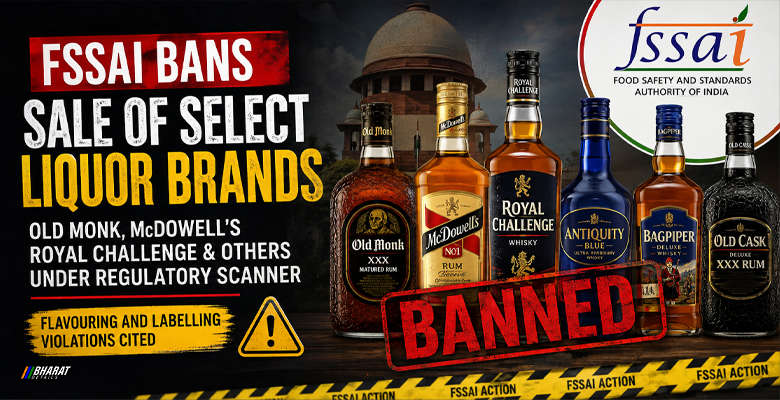
FSSAI bans liquor brands: Select Old Monk, McDowell’s and Royal Challenge variants barred over flavouring concerns
India’s food safety regulator has intensified its scrutiny of alcoholic beverages, with the FSSAI bans liquor brands action affecting several well-known rum and whisky variants sold across the country. The move follows laboratory examinations that allegedly found certain products did not comply with prescribed standards related to flavouring and labelling.
According to officials, the Food Safety and Standards Authority of India (FSSAI) has directed that the sale of selected products manufactured by different companies be stopped after investigations indicated the use of external flavours that could misrepresent the nature and ageing of the beverages.
The action is part of a broader regulatory drive aimed at ensuring food and beverage manufacturers comply with quality standards and provide accurate information to consumers.
Contents
Which liquor brands have been affected?
The regulatory action covers products manufactured by multiple companies across different states.
Among the affected products are three variants of Old Monk Rum—Old Monk The Legend, Old Monk Gold Reserve and Old Monk XXX Matured Rum.
Other products named in the action include:
- McDowell’s No. 1 Rum
- McDowell’s Celebration Rum
- Antiquity Blue Whisky
- Royal Challenge Whisky
- Bagpiper Deluxe Whisky
- Old Cask Deluxe XXX Rum
- Central Province Whisky
Officials said some of these products are manufactured at facilities in Maharashtra and Madhya Pradesh, while inspections have also been carried out at manufacturing units in Goa. Notices have reportedly been issued to additional manufacturers, indicating that further regulatory action could follow.
Why did FSSAI take action?
According to the regulator, laboratory testing found that some manufacturers allegedly added rum flavour to rum or whisky flavour to whisky instead of relying solely on traditional maturation and production methods.
FSSAI stated that internationally accepted manufacturing practices do not recognise the addition of rum flavour to rum or whisky flavour to whisky. It argued that such practices could mislead consumers by creating the impression that products have naturally developed flavour through ageing.
The regulator further said laboratory reports suggested the presence of artificial or nature-identical flavours that masked the beverages’ natural characteristics, making them non-compliant with prescribed standards.
Officials also indicated that products containing such flavouring may need to be marketed as flavoured alcoholic beverages rather than standard rum or whisky.
_____________________________
Also read | LIC Bima Sakhi Yojana 2025: Class 10-Pass Women Can Receive Up To ₹7,000 Monthly Stipend, Check Eligibility And How To Apply
_____________________________
Concerns over Old Monk labelling
FSSAI has also raised objections regarding the labelling of certain Old Monk products.
According to the regulator, one of the products marketed as “7 Years’ Blended” allegedly contains only a small proportion of matured rum spirit, while the majority consists of neutral spirit. Officials said existing regulations require age statements on blended spirits to accurately reflect the youngest spirit used in the blend.
The regulator clarified that natural flavourings such as coffee or vanilla may be permitted in alcoholic beverages under applicable regulations. However, adding rum flavour to rum or whisky flavour to whisky was described as a different issue because it could misrepresent the product’s composition.
Industry response
Meanwhile, Diageo India has challenged a related regulatory order before the Bombay High Court. The company has maintained that its manufacturing and labelling practices comply with applicable laws and established industry norms.
The legal proceedings are expected to determine how the relevant food safety regulations should be interpreted for alcoholic beverages.
Wider regulatory crackdown
The latest action comes amid increased enforcement by FSSAI across the food and beverage sector.
In recent weeks, the regulator has taken action against products carrying allegedly misleading claims and has issued directions involving several packaged food and beverage categories. Officials say the objective is to strengthen consumer protection by ensuring products meet prescribed safety, quality and labelling standards.
As inspections continue, manufacturers may face additional scrutiny, while consumers can expect stricter enforcement of food safety regulations across multiple product categories.