Maharashtra Bans Junk Food Near Schools: No Vada Pav, Samosas, Chips or Soft Drinks Within 50 Metres

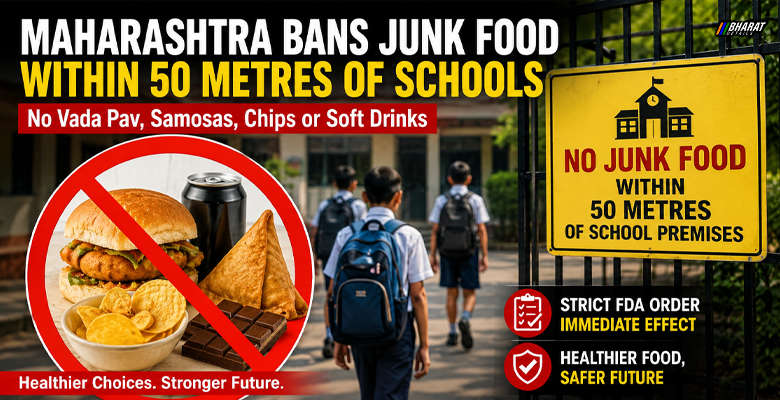
Maharashtra junk food ban rules are now being enforced across the state, with the Food and Drug Administration (FDA) ordering schools and food sellers to keep items such as vada pav, samosas, chips, chocolates and soft drinks away from school premises.
The directive, issued by Maharashtra FDA Commissioner Tukaram Mundhe, covers food sold inside schools as well as within a 50-metre radius of school campuses. The restriction applies to the sale, distribution, display and advertising of foods classified as high in fat, sugar or salt, or otherwise falling under the prescribed nutrition restrictions.
The order covers government, aided and private schools, along with pre-primary, primary, secondary and residential institutions. Schools affiliated with the Maharashtra State Board, CBSE, ICSE and other recognised education boards are also covered.
For students and parents, the most visible change could be around school gates, where snacks such as vada pav and samosas are commonly available. The FDA has made it clear that the objective is not limited to what is sold inside a school canteen. The 50-metre restriction extends the compliance zone beyond the school boundary.
Contents
Why Maharashtra has moved to stricter enforcement
The action is not based on a completely new food-safety framework. It builds on the Food Safety and Standards Authority of India’s Safe Food and Balanced Diets for Children in School Regulations, 2020.
Those regulations were notified in 2020 and required food business operators to comply with the provisions from July 1, 2021. The Maharashtra FDA has now moved to stronger implementation after finding that such requirements have not been consistently followed.
The rules focus on limiting children’s exposure to foods high in saturated fat, trans-fat, added sugar and sodium while encouraging healthier options. The FDA has also directed schools to promote foods such as fruits, vegetables, whole grains, pulses and dairy products.
Mundhe has indicated that schools have already had several years to comply with the regulatory framework. The latest direction therefore does not provide a fresh transition period and takes effect immediately.
What exactly is restricted?
The FDA’s order covers a broader category than just street snacks.
Products and foods that fall under the high-fat, sugar and salt category are not to be sold, distributed, displayed or advertised in schools or within the specified 50-metre area.
That includes commonly consumed products such as chips, chocolates, soft drinks, ice creams and certain fried or processed foods. Vada pav and samosas have received particular attention because of their widespread availability around school areas.
The restriction also means that food businesses cannot simply shift the same sales activity from inside a school canteen to a location immediately outside the gate.
Mundhe has also indicated that foods prepared using ingredients such as ajinomoto would not be permitted where they fall within the prohibited category under the applicable food-safety requirements.
Healthier food is expected to replace junk food
The FDA wants the enforcement drive to result in more than the removal of popular snacks.
Schools have been directed to ensure that meals and food supplied to students follow dietary standards and provide appropriate macronutrients, micronutrients and hydration.
The emphasis is on making healthier choices easier for students rather than simply taking away familiar snacks. School food operators and canteens are expected to consider fruits, vegetables, whole grains, pulses and dairy products as alternatives.
The directive also covers food business operators, school canteens, tuck shops, hostel kitchens and meal providers working in or around educational institutions.
Schools will have to appoint food-safety nodal officers
One of the more important administrative requirements is the appointment of a trained nodal officer at every school.
The designated officer will be responsible for coordinating food-safety compliance and ensuring that the institution follows the applicable requirements.
Schools have also been asked to display appropriate warning boards at their entrances and prominently show the relevant food business operator licences.
Another important requirement concerns advertising. Digital systems and other school infrastructure should not be used to promote products falling under the restricted high-fat, sugar and salt category.
Food suppliers associated with government nutrition schemes such as PM POSHAN and Shaloshan Aahar Yojana have also been brought into the compliance framework, with the school education authorities directed to ensure that the relevant operators hold the required licences.
___________________________________
Also read | Delhi Govt Ends Further Legal Action In NEET Protest Cases, Exempts Those With Criminal Antecedents
___________________________________
Food inspections to become part of routine school monitoring
The order gives Food Safety Officers a more regular inspection role.
According to the directive, schools are to be inspected at least twice a year to check food licences, hygiene standards, warning boards, the appointment of nodal officers and compliance with the 50-metre restriction.
Food samples are also to be collected at least once a year, with inspection reports to be submitted within the prescribed timeframe.
District-level officials will monitor compliance, issue improvement notices where necessary and take further action in cases where violations continue.
This creates a system in which food safety is expected to become part of routine school inspections rather than an issue addressed only after complaints.
Repeat violations could create problems for school affiliation
The consequences could extend beyond a fine or an improvement notice.
Education authorities and boards have been directed to treat compliance with the food-safety requirements as part of school affiliation and renewal processes.
Schools that repeatedly fail to meet the requirements could face show-cause notices and, in serious or continuing cases, action affecting their affiliation.
That provision is particularly significant because it places responsibility on school management to ensure that food operators on or near the campus comply with the rules.
FDA’s school action comes amid a wider food-safety crackdown
The school order is part of a broader enforcement drive by the Maharashtra FDA under Commissioner Tukaram Mundhe.
In Mumbai, the regulator recently suspended food business licences of five prominent clubs after inspections reportedly identified multiple hygiene and food-safety shortcomings. The establishments included the Cricket Club of India, MIG Cricket Club, RK Juhu Gymkhana, Aparna Juhu Gymkhana and Willingdon Club.
At CCI, inspectors reported issues including pest infestation, improper food storage, expired food items, poor kitchen practices and other deficiencies. The FDA also flagged licensing concerns involving the club’s caterer.
Other inspections reportedly found problems such as inadequate pest control, poor sanitation, deteriorating infrastructure, rusty equipment, incomplete temperature monitoring and gaps in food and water testing records.
The enforcement campaign has also extended to other food establishments in Mumbai, indicating that the FDA is taking a more active approach to food-safety compliance across different categories of businesses.
Why the 50-metre rule could be difficult to enforce
The biggest challenge may not be identifying what constitutes unhealthy food. It will be ensuring that the restriction is followed consistently outside school boundaries.
Many schools operate in crowded neighbourhoods where food carts, small eateries and other vendors are located close to the entrance. Monitoring such businesses across thousands of schools will require sustained inspections and coordination between food-safety and education authorities.
The FDA’s decision to make inspections part of a twice-yearly routine is intended to address precisely this enforcement gap.
The presence of a nodal officer inside every school also gives the administration a local point of responsibility rather than relying entirely on periodic government inspections.
What happens next?
For schools, canteens and food operators, the immediate priority is compliance. Existing food menus, licences, advertisements and food-selling arrangements around school campuses will have to be reviewed against the FDA’s requirements.
Parents and students are likely to notice the change most clearly in the availability of snacks around school gates.
For the FDA, the larger test will be whether the order can be implemented consistently across urban and rural Maharashtra. The success of the policy will depend not only on removing prohibited foods but also on ensuring that healthier and affordable alternatives are actually available.
Maharashtra’s latest move therefore goes beyond a ban on a few popular snacks. It represents an attempt to make food safety and nutrition a more visible part of the school environment, while putting greater responsibility on school management, food operators and enforcement officials.
The coming months will show whether the state’s strict new enforcement approach can turn regulations that have existed for years into everyday practice around Maharashtra’s schools.