Delhi Parliament Protest Turns Tense as Police Use Tear Gas, Lathicharge During CJP’s ‘Chalo Sansad’ March

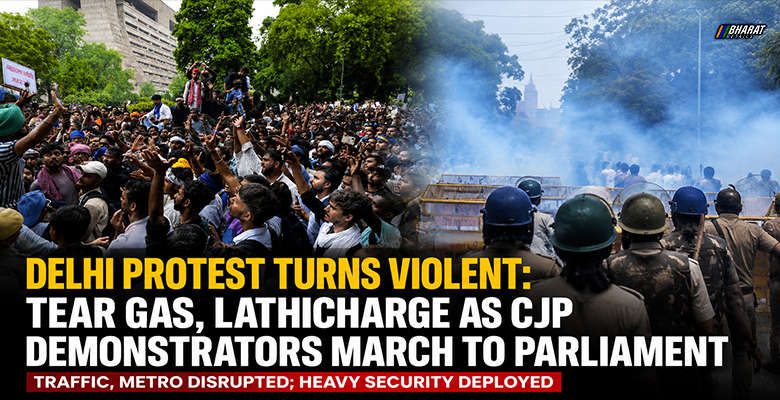
Delhi Parliament Protest turned volatile on Monday after police used tear gas and batons to stop hundreds of demonstrators attempting to march towards Parliament, triggering disruptions across central Delhi and prompting one of the largest security deployments in the national capital in recent months.
The protest, organised by the Cockroach Janta Party (CJP), began as a march from Jantar Mantar towards Parliament on the opening day of the Monsoon Session. Authorities had already imposed strict security measures in the area, citing restrictions on demonstrations near Parliament. As groups of protesters advanced towards high-security zones, clashes broke out with security personnel at multiple locations, leading to a tense standoff.
Witnesses reported that police repeatedly appealed to demonstrators to halt before resorting to crowd-control measures. However, as sections of the gathering attempted to move past barricades, security forces used tear gas shells and carried out a lathicharge to disperse the crowd. Officials said a few protesters and police personnel sustained minor injuries during the confrontation.
The unrest quickly spread beyond Jantar Mantar, affecting several prominent areas including Rail Bhawan, Shastri Bhawan, Janpath, Connaught Place and roads surrounding Parliament. Large groups of protesters were seen raising slogans while police maintained a heavy presence to prevent further movement towards the Parliament complex.
Authorities deployed water cannons, anti-riot vehicles and rapid response teams at strategic junctions across central Delhi as part of an extensive security operation. Multiple layers of barricades were installed, while senior police officers supervised crowd management on the ground.
The protest also disrupted daily life for commuters. Traffic movement slowed significantly in several parts of New Delhi after roads were blocked and vehicles diverted as a precaution. Commuters travelling through Connaught Place and nearby government offices experienced long delays as security arrangements intensified throughout the day.
Metro services were also affected after entry and exit gates at several stations were temporarily restricted for security reasons. While interchange facilities at some stations were restored later, passengers faced inconvenience during the peak hours. Protesters were also seen gathering near some Metro stations before police dispersed the crowds.
The CJP has organised the “Chalo Sansad” march to press for education reforms and demand accountability over alleged irregularities in the NEET examination process. The protest coincided with the beginning of Parliament’s Monsoon Session, drawing heightened attention from both political observers and security agencies.
According to officials, permission had not been granted for a march towards Parliament because prohibitory orders under Section 163 of the Bharatiya Nagarik Suraksha Sanhita (BNSS) remain in force across the New Delhi district. These restrictions prohibit large public gatherings, processions and protest marches outside designated locations in the high-security zone.
Police sources said more than 5,000 Delhi Police personnel, supported by Central Armed Police Forces (CAPF), were deployed across central Delhi to maintain law and order. The New Delhi district was divided into multiple security sectors, each overseen by senior officers responsible for monitoring crowd movement and coordinating emergency responses.
As the situation unfolded, demonstrators claimed that internet and mobile connectivity had become unreliable in parts of the protest area. However, officials did not immediately confirm whether any communication restrictions had been imposed.
The protest gained further attention after CJP leaders stated that the Union government had initiated contact for discussions regarding their demands. According to the organisation, two of its representatives were expected to meet Union Minister J. P. Nadda later in the day. No official confirmation of these talks had been issued by the government at the time of reporting.
Meanwhile, activist Sonam Wangchuk, who has been associated with the campaign, said he was prepared to end his hunger strike if the government accepted responsibility for addressing concerns related to the education system or if Members of Parliament agreed to raise the issue during the ongoing Monsoon Session. His remarks added another dimension to the protest, which has increasingly focused on demands for greater transparency and accountability in public examinations.
During the day, several groups of students and youth activists attempting to reach Jantar Mantar from nearby locations were intercepted by police. Eyewitnesses said security personnel stopped marchers near Sansad Marg and other entry points leading towards Parliament. Some protesters received first aid after sustaining minor injuries during the dispersal operation.
As videos and photographs of the confrontation circulated online, political reactions began emerging from different quarters. Protest organisers criticised the use of force, alleging that demonstrators were participating in a peaceful march when police intervened. Security officials, however, maintained that the restrictions were enforced to prevent an unauthorised procession from entering one of the country’s most sensitive security zones.
The Parliament complex remained under heightened security throughout the day, with access routes closely monitored by Delhi Police and paramilitary personnel. Authorities also restricted vehicle movement around key government buildings, including Rail Bhawan, Shastri Bhawan and surrounding administrative offices, resulting in traffic congestion across parts of central Delhi.
Officials said the security plan had been prepared well in advance because the Monsoon Session traditionally attracts demonstrations by various organisations seeking to highlight public issues. Intelligence teams, local police units and specialised security personnel coordinated real-time monitoring of crowd movement to prevent any breach of the Parliament security perimeter.
According to officials, more than 25 battalions of the Central Armed Police Forces (CAPF), including women personnel, were deployed alongside Delhi Police. Senior officers supervised operations from different security zones to ensure quick response to any escalation.
The protest organisers also alleged that internet services had been disrupted in some areas around the demonstration site, making it difficult to communicate with supporters and share updates. However, government authorities had not officially confirmed any suspension of internet or mobile connectivity by the time this report was published.
By late evening, security personnel had largely dispersed the crowds from the immediate vicinity of Parliament, although police remained deployed across sensitive locations to prevent fresh gatherings. Traffic movement gradually resumed on several roads, while Metro services returned to normal operations after temporary restrictions were eased.
The developments are likely to keep the spotlight on education-related concerns as Parliament begins its Monsoon Session. Whether discussions between government representatives and protest leaders materialise, and whether the demands raised during the march receive parliamentary attention, will be closely watched in the coming days.
As investigations into the day’s clashes continue, authorities are expected to review security arrangements and examine reports of injuries and public property damage, if any. The events underline the challenge of balancing the right to peaceful protest with maintaining security around India’s highest legislative institutions.