Mumbai Auto, Taxi Fare Hike From September 1: Check New Rates and What Changes

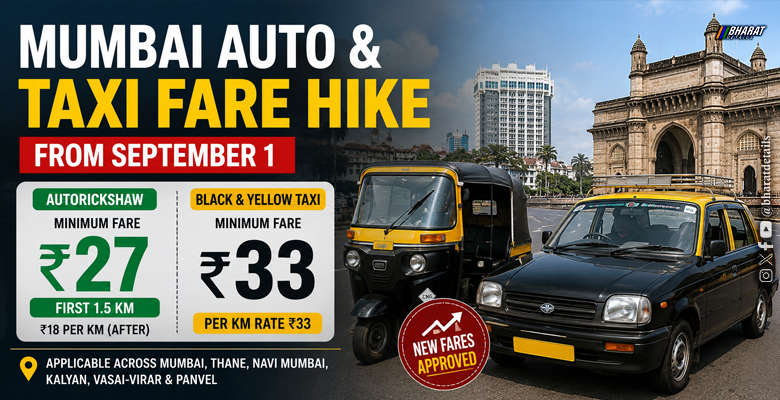
Mumbai auto taxi fare hike will come into effect from September 1, 2026, bringing higher travel costs for commuters across the Mumbai Metropolitan Region (MMR). The Mumbai Metropolitan Region Transport Authority (MMRTA) approved the revised fares at its meeting on August 20.
Under the new structure, the minimum autorickshaw fare will increase from ₹26 to ₹27, while the minimum fare for black-and-yellow taxis will rise from ₹31 to ₹33. The revised rates will apply across Mumbai and several other parts of the MMR, including Thane, Navi Mumbai, Kalyan, Vasai-Virar and Panvel.
For autorickshaws, the revised minimum fare covers the initial 1.5 km. The subsequent per-kilometre charge is expected to be around ₹18.22 under the revised tariff calculation. For black-and-yellow taxis, the revised per-kilometre rate is around ₹21.90. The final amount shown on the meter will depend on the distance travelled and applicable tariff rules.
The fare revision comes roughly 18 months after the previous major increase, which took effect in February 2025. Maharashtra’s Motor Vehicle Department currently lists the February 2025 auto tariff at a minimum fare of ₹26, providing the baseline from which the latest revision has been made.
Contents
Why are auto and taxi fares increasing?
Transport unions have been seeking a revision in fares, pointing to higher operating expenses faced by drivers and vehicle owners. Fuel costs, maintenance, insurance and other vehicle-related expenses have all contributed to pressure on daily earnings.
CNG is particularly important for Mumbai’s autorickshaw and taxi operators. The price of CNG in the MMR was raised to ₹86 per kg in May 2026, following another increase earlier that month. Higher fuel costs have added to the financial pressure on commercial vehicle operators.
The latest increase, however, is lower than what some transport unions had sought. Taxi representatives had reportedly demanded a larger increase in the starting fare, while the authority ultimately approved a ₹2 rise in the minimum taxi fare.
Which areas will see the new fares?
The revised tariff will apply across the Mumbai Metropolitan Region, covering major urban areas such as:
- Mumbai
- Thane
- Navi Mumbai
- Kalyan
- Vasai-Virar
- Panvel
This means the change will affect a large number of residents who depend on autos and traditional taxis for short-distance journeys, station connectivity and last-mile travel.
The MMR has a large base of registered commercial three-wheelers and taxis, so even a relatively small increase in the minimum fare can have a noticeable impact on frequent commuters.
What does the fare hike mean for commuters?
For a single short trip, the increase may appear modest — ₹1 for the minimum autorickshaw fare and ₹2 for the minimum black-and-yellow taxi fare. However, the additional expense can become significant for people who use these services several times a day.
The impact is likely to be more noticeable for daily commuters who use autorickshaws or taxis to reach railway stations, metro stations, offices, schools and other public transport connections.
Commuter groups have therefore called for a balance between the financial concerns of drivers and the broader cost-of-living pressures faced by residents.
Also read | Maharashtra FDA Raids Bollywood Cafe, Inspects 86 Quick-Commerce Hubs Over Food Safety Violations
Marathi-language row not linked to the fare decision
The source material also refers to the ongoing debate over Marathi-language requirements for commercial passenger vehicle drivers. That issue has generated protests and disagreements involving sections of the transport sector in Mumbai.
However, there is no reliable evidence that the approved fare hike was introduced because of the Marathi-language controversy. Available reports attribute the fare revision to representations from transport unions and rising operating costs. The two developments should therefore not be presented as causally connected.
What happens next?
The revised fares are scheduled to take effect on September 1. Commuters will need to check the updated meter readings and tariff information once the new rates are implemented.
The fare revision is intended to provide some relief to operators facing higher costs while keeping the increase relatively limited for passengers. Whether the new rates are sufficient for drivers — and whether they remain affordable for commuters — will become clearer after implementation.
For Mumbai’s heavily used autorickshaw and taxi network, the challenge remains the same: maintaining viable earnings for drivers without adding excessive pressure to the household budgets of millions of daily passengers.