E20 Petrol Mandatory in India from April 1: What It Means for Vehicles, Fuel Costs, and the Environment

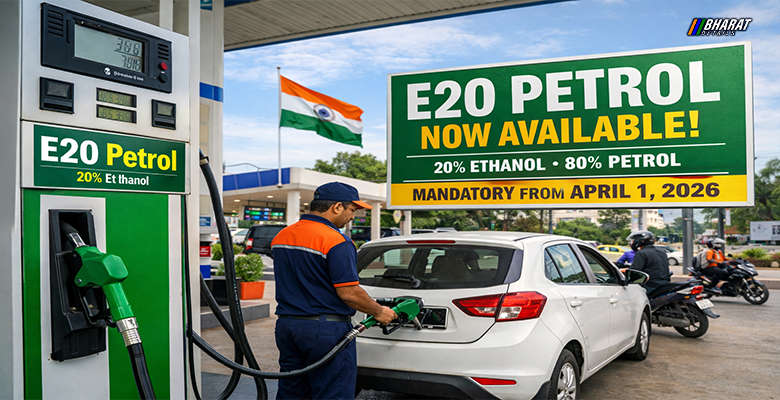
E20 petrol mandatory in India has officially come into effect from April 1, 2026, marking a significant shift in the country’s fuel policy. The government has directed all petrol pumps nationwide to supply petrol blended with 20% ethanol, replacing the earlier standard fuel mix.
This move, implemented by the Ministry of Petroleum and Natural Gas, is part of a broader strategy to reduce pollution, cut fuel imports, and strengthen India’s energy independence.
What is E20 Petrol?
E20 petrol is a blend consisting of 20% ethanol and 80% conventional petrol. Ethanol is a biofuel produced mainly from crops like sugarcane and corn—both widely cultivated in India.
Unlike fossil fuels, ethanol is renewable and cleaner-burning. Officials say blending ethanol with petrol helps lower harmful emissions while also promoting domestic fuel production. The government has already indicated that higher blends, such as E50, may be considered in the future as part of long-term energy planning.
Why Has India Made E20 Petrol Mandatory?
India imports a large portion of its crude oil requirements, making the country vulnerable to global price fluctuations and supply disruptions. Events such as geopolitical conflicts often lead to sharp fuel price increases, affecting both consumers and the economy.
By introducing E20 petrol, India aims to reduce its dependence on imported crude oil by up to 20%. Since ethanol is produced locally, it offers a more stable and cost-effective alternative. Officials believe this shift will not only improve fuel security but also help manage economic pressures during global crises.
Another key factor is environmental impact. Vehicles running on E20 fuel produce lower emissions compared to pure petrol. While electric and hybrid vehicles are also gaining traction, ethanol blending provides an immediate and scalable solution to reduce pollution from existing internal combustion engines.
How Will It Affect Your Car?
For most modern vehicles, especially those manufactured in recent years, E20 petrol is generally compatible. Automakers have already started designing engines that can handle higher ethanol blends.
Ethanol has a higher octane rating, which can improve combustion efficiency and may result in smoother engine performance. However, it comes with a trade-off. Since ethanol contains less energy than petrol, users may notice a slight drop in fuel efficiency.
Older vehicles, particularly those not designed for ethanol blends, may face issues over time. These include potential wear and tear in rubber components and fuel system parts. Experts advise owners of older vehicles to check compatibility before regular use.
Economic and Agricultural Impact
The shift to E20 petrol is also expected to benefit India’s agricultural sector. Increased demand for ethanol will boost the production of crops like sugarcane and maize, creating additional income opportunities for farmers.
From an economic perspective, reducing crude oil imports can significantly lower the country’s fuel import bill. This becomes especially important during periods of high global oil prices.
Union Minister Nitin Gadkari has been a vocal advocate of ethanol blending, often highlighting its dual benefits for the environment and rural economy.
What Should Consumers Do?
Vehicle owners are advised to check their car or bike manuals to confirm E20 compatibility. Most vehicles manufactured after 2020 are expected to support E20 fuel, but older models may require caution.
Regular servicing and maintenance can help prevent long-term issues, especially for vehicles transitioning to ethanol-blended fuel for the first time.
Are India’s Vehicles Ready for E20 Fuel?
India’s transition to E20 petrol has been planned over several years, with automakers gradually preparing for the change. According to industry estimates, a large percentage of vehicles sold in the last few years are already E20-compliant or compatible.
However, a section of older vehicles on the road may not be fully equipped to handle the higher ethanol blend. This creates a mixed scenario where readiness depends largely on the age and type of the vehicle.
To address this, manufacturers have been upgrading engine components, fuel systems, and materials to ensure durability with ethanol blends. Moving forward, all new vehicles are expected to be fully compatible with E20 and even higher blends.
FAQs
1. What is E20 petrol?
E20 petrol is a blend of 20% ethanol and 80% petrol, designed to reduce emissions and fuel imports.
2. Is E20 petrol safe for all vehicles?
It is safe for most modern vehicles, but older vehicles may face compatibility issues.
3. Will mileage reduce with E20 petrol?
Yes, a slight drop in mileage is possible because ethanol has lower energy content than petrol.
4. Why is ethanol used in fuel?
Ethanol is renewable, cleaner-burning, and can be produced domestically, reducing dependence on crude oil.
5. Will petrol prices reduce with E20?
While it may not directly lower prices, it can help stabilize costs by reducing import dependency.
Conclusion
The rollout of E20 petrol marks a major step in India’s transition towards cleaner and more sustainable mobility. While there are short-term adjustments for consumers, the long-term benefits—ranging from reduced pollution to stronger energy security—are expected to shape the future of transportation in the country.