Iran Rejects Trump’s ‘Stone Age’ Threat, Says US Underestimates Its Military Strength

Iran US tensions escalated sharply after Tehran issued a strong rebuttal to recent remarks by Donald Trump, dismissing claims that its military strength has been significantly weakened and warning of continued retaliation.
In a pointed response, senior Iranian military officials said the United States has a limited understanding of Iran’s defence capabilities. The statement came shortly after Trump, in a televised address, claimed that Iran’s missile infrastructure had been “dramatically curtailed” and that only a few launchers remained operational.
Iran’s Khatam al-Anbiya Central Headquarters, the country’s top operational military command, rejected these assertions. A spokesperson said key strategic assets — including missile production facilities, long-range drones, air defence systems, and electronic warfare capabilities — remain fully functional.
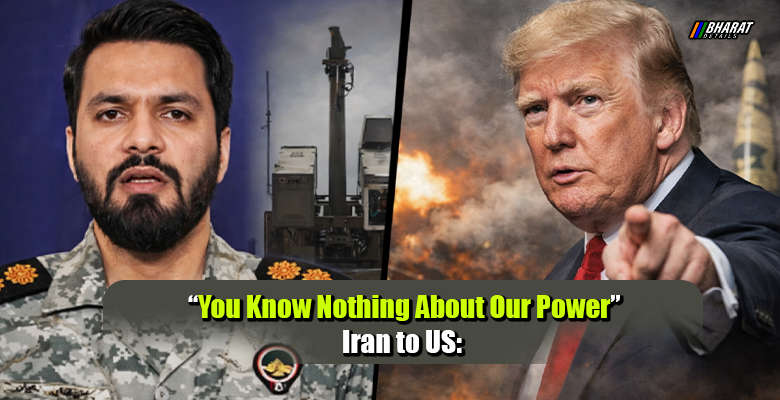
“Your intelligence on our military power is incomplete. You know nothing of our strategic capabilities,” the spokesperson said, signalling a clear challenge to Washington’s assessment.
The remarks were also in response to Trump’s warning that the US could push Iran “back to the Stone Age,” a statement that has triggered sharp reactions across Iran’s military leadership. Officials described such claims as misleading and accused the US of underestimating both Iran’s preparedness and its technological advancements.
Iranian authorities further claimed that recent US strikes targeted only “insignificant” sites, insisting that critical military infrastructure remains undisclosed and beyond the reach of foreign attacks. According to officials, much of Iran’s strategic production takes place in locations unknown to adversaries.
Military leaders also accused the United States and Israel of initiating hostilities in the region, vowing continued and intensified responses. They warned that any further aggression would be met with “stronger, wider, and more destructive” attacks.
Separately, a senior commander from the Islamic Revolutionary Guard Corps (IRGC) criticised US rhetoric, suggesting that American leadership is misjudging the situation. He remarked that historical and geopolitical realities are being overlooked in Washington’s approach toward Iran.
The exchange highlights a deepening standoff in the Middle East, with both sides projecting confidence in their military capabilities. Analysts note that such rhetoric, combined with ongoing military actions, raises concerns about a broader escalation in the region.
For now, both nations appear firmly entrenched in their positions, with neither side signalling a willingness to de-escalate. The coming weeks could prove critical in determining whether the conflict intensifies further or shifts toward diplomatic engagement.