Reservation Hatao Movement Gains Momentum Online After CJP Wave, Calls for Equality and End to Caste-Based Quotas

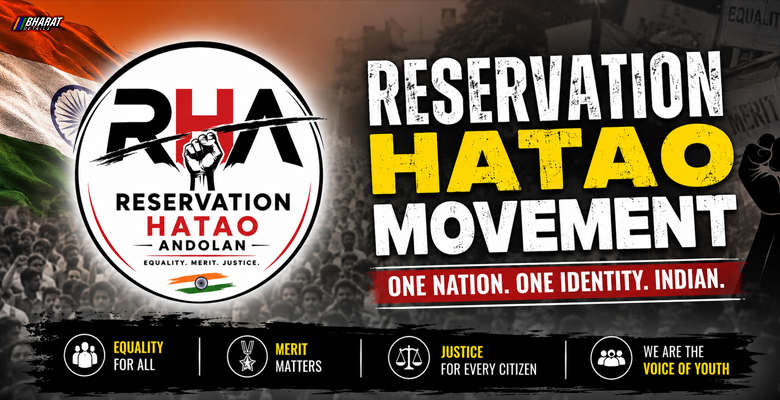
Reservation Hatao Movement is rapidly gaining attention across Indian social media, with a youth-driven campaign calling for an end to caste-based reservation and a broader shift towards what its supporters describe as equal treatment for every citizen.
The campaign has emerged in the wake of the recent Gen-Z-led political and student mobilisation associated with the Cockroach Janta Party (CJP), but the new movement says it is not affiliated with any political party. In a statement shared on its social-media channels, the group describes itself as a citizen-led initiative focused on reservation policy rather than party politics.
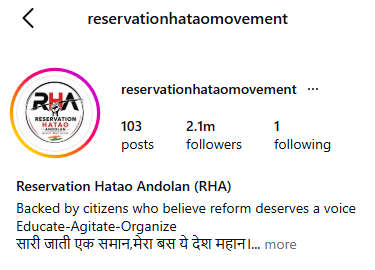
Its rapid growth has made the campaign one of the latest online debates around India’s reservation system. Social-media posts and discussions indicate that the movement’s Instagram account crossed the one-million-follower mark very quickly, with supporters claiming growth of around 1.5 million followers within 24 hours and other online posts putting the figure closer to two million. These figures could not be independently verified from Instagram, and should therefore be treated as claims circulating online rather than confirmed membership numbers.
Contents
A movement, not a political party
One of the most important points emerging from the campaign’s own posts is that it currently presents itself as a movement rather than a political party.
In one of the posts shared on its official Instagram account, the organisation says it is not affiliated with any political party. It also argues that the reservation debate should not be reduced to party politics and says its focus is on policy.
The post specifically refers to disappointment among some supporters who had expected major reforms from the BJP-led government, arguing that reservation policies instead continued to evolve and expand. The movement says its position is independent of political parties and describes itself as a citizen-led campaign.
This distinction is important because the campaign has appeared online at a time when the CJP movement has brought a significant amount of youth political activity onto social media. However, available public material does not establish that Reservation Hatao Movement is a new registered political party, nor does it identify a formally registered political organisation behind the campaign.
Who founded the Reservation Hatao Movement?
The question of who founded the campaign remains unclear.
Despite searches across publicly accessible web results and social-media discussions, no independently verifiable founder has been identified in the material currently available. The campaign’s public-facing social-media content also does not clearly name an individual as its founder.
This is particularly notable because some posts circulating online refer to a “first person” who started the Reservation Hatao movement, while others ask who is actually leading it. At present, there is not enough reliable public information to attribute the creation of the movement to a particular individual.
For that reason, claims naming a founder should not be presented as established fact unless the organisers themselves formally identify that person.
What does the movement want?
At the centre of the campaign is a demand to remove caste-based reservation from education and government employment and replace it with a system that supporters say should focus on merit, skills, economic circumstances and equal opportunity.
Supporters argue that students should not face different selection standards because of caste identity. Some of the campaign’s social-media messaging focuses heavily on competitive examinations and the frustration felt by students who believe that reservation affects their chances of admission or recruitment.
The movement also frames its argument as a fight against caste itself.
One of its recurring messages is that caste-based discrimination and caste-based reservation are connected, and that ending caste distinctions in public life should ultimately remove the basis for caste-based quotas.
The campaign has used slogans including “Remove Reservation, Remove Casteism” and “One Nation. One Identity. Indian.”
Another message circulating through the campaign is “Dharam bada hai jaati se”, alongside calls for equality across caste groups.
Policy proposal: stop recording caste identity in everyday public life
The movement’s policy proposal goes beyond simply asking the government to abolish reservation.
In one of the two posts reviewed by BharatDetails, the campaign argues that if the objective is to eliminate caste-based discrimination, the government should stop requiring or recognising caste identity in ordinary public life.
The proposal says citizens should not be required to declare or record whether they are Brahmin, Jaat, Gurjar, SC, ST or another caste in routine government forms, educational admissions, employment applications or other public-facing processes.
The campaign presents its long-term objective as “One Nation. One Identity. Indian.”
The accompanying slogan is direct: “Remove Reservation, Remove Casteism.”
That proposal would represent a much broader change than simply altering quota percentages. India’s current reservation framework is constitutionally linked to provisions that allow the State to make special provisions for socially and educationally backward classes, Scheduled Castes and Scheduled Tribes, while separate provisions allow reservation for Economically Weaker Sections. Article 15(4) and Article 16(4) are among the constitutional provisions underpinning affirmative-action policies.
Why reservation remains a complicated constitutional issue
The campaign’s rise is taking place against a long-running national argument over the purpose and future of reservation.
Supporters of reservation generally argue that the policy is not simply an economic assistance programme. They point to historical exclusion, social discrimination and inadequate representation as reasons for maintaining affirmative action.
Those supporting the Reservation Hatao campaign, meanwhile, argue that caste should not determine access to education or employment and that economic disadvantage should receive greater weight.
India’s legal framework has also evolved over decades. The Supreme Court’s 1992 Indra Sawhney judgment established a general 50% ceiling for reservations under Articles 15(4) and 16(4), although the legal position has developed further since then. The 103rd Constitutional Amendment introduced a separate 10% EWS reservation under Articles 15(6) and 16(6), and the Supreme Court subsequently upheld its constitutional validity. The Union government has stated that the EWS quota is legally distinct from reservations for SCs, STs and OBCs.
The Supreme Court has also continued to examine how affirmative action should operate within reserved categories. In 2024, a seven-judge Constitution Bench in State of Punjab v. Davinder Singh upheld the constitutional validity of sub-classification within the Scheduled Caste category, illustrating how the reservation framework continues to develop through constitutional litigation and policy changes.
“Some students lose hope after seeing the cut-offs”
A significant part of the campaign’s online messaging comes from students and examination aspirants.
Supporters claim that some students from the unreserved category become discouraged when they see the difference between category-wise cut-offs and believe that their academic performance does not translate into a comparable opportunity.
That sentiment is visible across social-media discussions surrounding the movement. Some users have argued for economic criteria, scholarships and stronger educational support instead of caste-based quotas. Others have countered that economic disadvantage and caste discrimination are different problems and that reservation was designed primarily to address social and representational inequalities rather than poverty alone.
This disagreement is likely to remain central to the movement’s future.
_____________________________
Follow BharatDetails on Instagram for more such updates
_____________________________
The movement invokes “Educate, Agitate, Organize”
The campaign has also adopted the phrase “Educate-Agitate-Organize” in its messaging.
The slogan has historical associations with Dr B.R. Ambedkar’s political and social thought. Its use by an anti-reservation movement has already become a subject of debate online, with some supporters saying the words are being used to emphasise civic mobilisation, while critics question whether the slogan is consistent with the movement’s position on affirmative action.
The campaign also promotes the broader idea that caste identity should eventually lose its relevance in public life.
A rapidly growing but still largely digital campaign
For now, the movement’s strongest presence is online.
Reddit discussions appearing on July 26 show multiple communities discussing the campaign and reporting that the Instagram page had crossed one million followers within its first day. Some users claimed that the number was approaching two million shortly afterwards.
However, social-media followers should not automatically be interpreted as active members, physical supporters or future voters. A viral account can attract followers from across the country without necessarily translating into an organised ground movement.
That is likely to be the next major test for the campaign.
What happens next?
The campaign’s own messaging suggests that it wants to remain a public social movement rather than become a conventional political party. Online discussions, meanwhile, have already begun asking whether the movement will eventually organise demonstrations or other forms of physical mobilisation.
If it moves from Instagram posts to large-scale demonstrations, its demands will face a much wider political and constitutional test.
The biggest challenge will also be building a policy framework that addresses the concerns of both sides. Ending caste-based reservation would require significant legal and constitutional changes, while simply replacing caste-based criteria with economic criteria would not automatically resolve questions surrounding historical discrimination and representation.
For now, the Reservation Hatao Movement is primarily a rapidly growing digital campaign, not an established political party. Its message of equality, merit and removal of caste identity has found a substantial audience online, but its leadership structure, organisational base, ground presence and long-term political direction remain unclear.
The debate it has triggered, however, is anything but new. The latest campaign has brought an old and deeply contested question back into the spotlight: Can India achieve equality by removing caste from public policy, or does genuine equality first require affirmative action to address the inequalities created by caste?
That question is likely to determine whether the Reservation Hatao campaign remains a social-media phenomenon or develops into a sustained national movement.