Govt-CJP Talks on NEET Protest: Centre Agrees in Principle to Two Demands, Seeks More Time on Dharmendra Pradhan Resignation

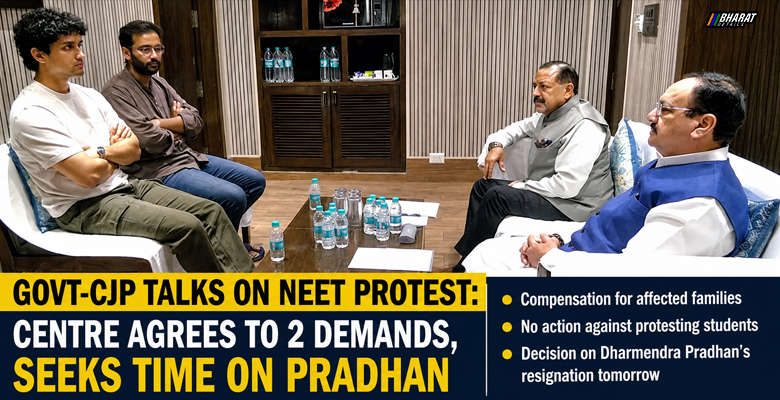
Govt-CJP Talks: Centre Signals Progress on Two Demands, Decision on Education Minister Yet to Come
A fresh round of Govt-CJP Talks has raised hopes of a possible breakthrough in the ongoing nationwide protest over the alleged NEET-UG examination irregularities. Representatives of the Centre and the Cockroach Janta Party (CJP) held an extended meeting in New Delhi on Friday, where discussions focused on the group’s key demands, including accountability for the controversy surrounding the examination process and reforms aimed at restoring confidence among students.
Although no final agreement emerged from the meeting, both sides described the discussions as constructive. According to officials and CJP representatives, the government expressed in-principle support for two major demands while requesting additional time to respond to the politically significant demand seeking the resignation of Union Education Minister Dharmendra Pradhan.
The next round of discussions is expected to take place on Saturday, making the coming hours crucial for both the government and the protesting organisation.
Contents
Nearly Two Hours of Discussions
The meeting lasted for almost two hours and brought together senior representatives from both sides. The government’s delegation included Union Health Minister JP Nadda and Minister of State in the Prime Minister’s Office Jitendra Singh, while CJP was represented by spokespersons Saurav Das and Ashutosh Ranka.
Following the discussions, both parties addressed the media separately. Government representatives maintained that the conversation remained cordial and that all issues raised by the protest group had been discussed in detail.
According to officials, the Centre considered not only the three principal demands raised by the CJP but also several long-term proposals related to examination reforms.
Centre Indicates Support for Two Demands
One of the most significant outcomes of Friday’s meeting was the government’s reported willingness to accept two humanitarian demands in principle.
The first concerns financial compensation for families of NEET aspirants who allegedly died by suicide following the examination controversy. Protest organisers have argued that many students and their families suffered immense emotional and financial hardship because of uncertainty surrounding the examination process.
The second concerns withdrawal of legal action against students participating in peaceful demonstrations. Protest leaders have repeatedly maintained that students exercising their democratic right to protest should not face criminal proceedings.
While formal implementation is still awaited, CJP leaders described the government’s response as a positive first step.
Resignation of Dharmendra Pradhan Remains Core Issue
Despite movement on two demands, the issue dominating political attention remains the demand for the resignation of Union Education Minister Dharmendra Pradhan.
According to CJP leaders, the government requested additional time until Saturday afternoon before communicating its decision on the matter.
The organisation continues to argue that ministerial accountability is essential for restoring public confidence after allegations surrounding the NEET examination process.
CJP spokespersons reiterated that the resignation demand remains central to their movement and indicated that protests would continue until concrete action is announced.
The Centre, however, has not publicly indicated whether any change in ministerial responsibility is under consideration.
Government Says Discussions Are Ongoing
Speaking after the meeting, Union Minister JP Nadda said the government had carefully heard all concerns raised by the delegation.
According to him, the discussions covered three principal demands alongside five broader suggestions aimed at strengthening India’s examination system.
He confirmed that another meeting would be held the following day after internal consultations within the government.
Officials have maintained that dialogue remains the preferred route for resolving the impasse.
Five Examination Reform Suggestions
Beyond immediate political demands, the CJP also submitted a broader reform agenda intended to prevent future examination controversies.
Among the proposals discussed were:
- Compensation mechanisms for students affected by cancelled or compromised examinations.
- Conducting backup examinations within a fixed time frame if an examination is disrupted.
- Greater transparency in evaluation processes.
- Automatic age relaxation when examinations are delayed because of administrative failures.
- Independent technology audits to improve security of examination systems.
These proposals are intended to address structural issues rather than only the present controversy.
Protest at Jantar Mantar Continues
Even after Friday’s discussions, demonstrations at Delhi’s Jantar Mantar continued.
CJP leaders stated that while dialogue with the government is welcome, the movement will remain active until written assurances and official decisions are announced.
Organisers have appealed to supporters across the country to remain peaceful while awaiting the outcome of Saturday’s meeting.
Several student groups have continued expressing solidarity, arguing that reforms are necessary to rebuild trust in competitive examinations.
Sonam Wangchuk Ends Hunger Strike
The latest developments come shortly after social activist Sonam Wangchuk ended his 26-day hunger strike.
His decision followed government assurances regarding several issues linked to student welfare.
Although Wangchuk welcomed the government’s willingness to engage, CJP leaders clarified that their own protest would continue independently until their principal demands receive formal approval.
The parallel developments have added further attention to the ongoing dialogue between protesters and the Centre.
Concerns Over Possible Detentions
Meanwhile, CJP founder Abhijeet Dipke claimed that organisers had received information suggesting that authorities might attempt to detain some protesters ahead of the weekend.
He alleged that increasing public participation over Saturday and Sunday may lead to stronger administrative measures.
No official confirmation regarding possible detentions had been issued at the time of writing.
Authorities have consistently maintained that law enforcement decisions are taken based on security assessments and public order requirements.
Why the Issue Matters
The controversy extends beyond one examination.
For lakhs of students across India, competitive entrance examinations determine admission into professional courses and shape future careers. Allegations of paper leaks or irregularities therefore have consequences that extend well beyond individual institutions.
Education experts have repeatedly argued that maintaining credibility in national examinations requires stronger technology systems, faster investigations and transparent communication whenever irregularities emerge.
The current discussions have therefore evolved into a wider debate about accountability, examination governance and student welfare.
What Happens Next?
Attention is now focused on the next scheduled meeting between government representatives and the CJP.
Several important questions remain unanswered:
- Will the Centre take a final decision on the demand for the Education Minister’s resignation?
- When will the two demands accepted in principle be implemented?
- Will the proposed examination reforms receive formal consideration?
- Can continued dialogue prevent further escalation of nationwide protests?
The answers are expected to shape both the future of the ongoing movement and the government’s response to concerns surrounding examination integrity.
For now, both sides appear committed to continuing negotiations. Whether those discussions produce a lasting resolution will become clearer after the next round of talks, which could prove decisive in determining the direction of one of the country’s most closely watched student movements.