Dharmendra Pradhan Says Some People Tried to Mislead Gen Z During NEET Protests

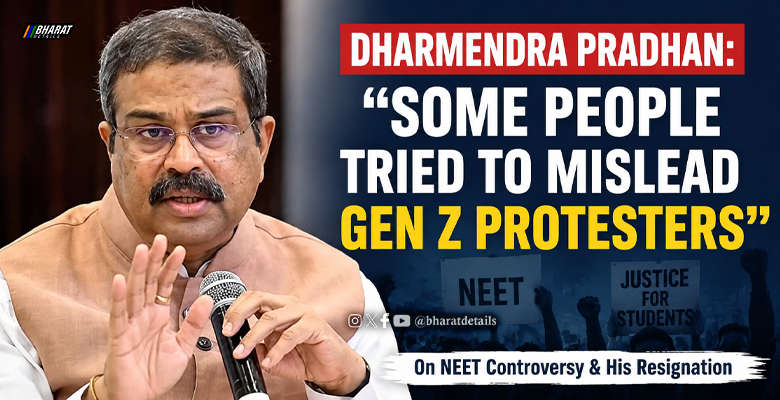
Dharmendra Pradhan resignation has returned to the spotlight after the former Union Education Minister said that some people attempted to mislead Gen Z during protests linked to the NEET-UG paper leak controversy.
Speaking at events in Odisha, Pradhan gave his first detailed public response after stepping down from the Union Council of Ministers. He said the ministerial post was never a matter of personal importance to him and claimed that he had himself approached Prime Minister Narendra Modi to offer his resignation.
Pradhan made the remarks while interacting with students and teachers at GM University in Bhubaneswar, as well as during a separate programme in Sambalpur. His comments come amid continued political debate over the handling of the NEET examination controversy and the student protests that followed.
Contents
Pradhan says Gen Z was misled during the protests
Pradhan said young Indians should not become victims of political manipulation and described Gen Z as a generation with significant aspirations for the country’s future.
According to Pradhan, India has a large and growing young population, with millions of children entering the country’s demographic pool every year. He argued that this generation would play a central role in India’s ambition to become a global leader.
He said the concerns of young people should be acknowledged rather than allowing their grievances to become part of a political confrontation.
Pradhan also said he did not consider his ministerial position more important than addressing the concerns of students.
The former minister’s comments are significant because the NEET controversy had triggered widespread anger among students and raised questions over examination security, fairness and accountability.
Why did Dharmendra Pradhan resign?
Pradhan resigned from the Union Council of Ministers on July 25 following weeks of controversy surrounding the NEET-UG examination and student protests.
Explaining his decision, he said he had met Prime Minister Narendra Modi and voluntarily offered to step down. According to Pradhan, his intention was to acknowledge the concerns of the younger generation and prevent the issue from being exploited for political purposes.
He maintained that personal prestige was not the reason behind his decision.
The resignation came after the government faced sustained criticism over alleged irregularities in the NEET-UG examination. The issue became particularly sensitive because the examination determines admission to medical colleges across India and is taken by millions of students.
What happened in the NEET paper leak controversy?
The NEET-UG controversy began after allegations of irregularities surrounding the examination surfaced. The government subsequently handed the investigation to the Central Bureau of Investigation (CBI).
The examination process also underwent major changes, including the cancellation of the affected test and a subsequent re-examination. Results of the re-examination were later declared.
Pradhan said the government had acted after irregularities were brought to its attention and insisted that he had accepted responsibility for dealing with the crisis from the beginning.
The controversy, however, continued to generate anger among sections of students and opposition parties, with questions being raised over examination management and the government’s response.
Pradhan takes aim at Naveen Patnaik
Alongside his comments on the student protests, Pradhan also responded to criticism from the Biju Janata Dal (BJD) and its leadership.
At a programme in Rairakhol, he referred to protests in which BJD workers had raised slogans asking him to leave. Pradhan said such demonstrations did not intimidate him and described himself as the son of a farmer.
He also criticised former Odisha Chief Minister and BJD president Naveen Patnaik over remarks directed at him.
Pradhan questioned whether his actions had brought any shame to Odisha and said he would not undertake any activity that damaged the reputation of the state.
He also referred to his political journey and said he had become a Union Minister with the blessings of Lord Jagannath and Goddess Samaleswari, the presiding deity of Sambalpur.
BJD rejects Pradhan’s allegations
The BJD strongly pushed back against Pradhan’s criticism.
BJD Sambalpur district president and former minister Rohit Pujari said Pradhan did not need to blame Naveen Patnaik for the criticism he faced during the student protests.
Pujari alleged that the BJP government had drawn criticism because of the manner in which the student agitation was handled, including claims of police action against protesters.
He argued that the political criticism faced by Pradhan was a consequence of the government’s handling of the controversy rather than an attempt by Patnaik to personally target the former Union minister.
The BJD leader also made serious claims about the impact of the NEET controversy on students. Those claims remain part of the political dispute surrounding the issue and should be viewed in that context.
____________________________
Also read | Ram Mandir Funds: Audit Accounts For ₹3,300 Crore, Govt Sources Reject Scam Claims
____________________________
Why Pradhan’s Gen Z remarks matter
The latest comments underline how important young voters and students have become in India’s political conversation.
The NEET controversy was not simply an examination-related dispute. For many students and families, it raised broader concerns about merit, transparency, competition and trust in national-level examinations.
Pradhan’s reference to Gen Z also reflects a wider effort by political leaders to engage with younger Indians, particularly at a time when social media has made student movements capable of spreading rapidly across the country.
For the government and political parties, addressing these concerns will require more than political messaging. Examination security, transparent investigations and confidence in the testing system are likely to remain important issues for students and parents.
What happens next?
The political debate surrounding Pradhan’s resignation is unlikely to end with his latest comments. His explanation has reopened discussion over the NEET controversy, the government’s handling of student protests and the role of young voters in Indian politics.
For students, however, the larger concern remains the credibility of competitive examinations. Any future reforms will be closely watched by aspirants and their families, particularly when millions of candidates depend on a single examination for admission to professional courses.
Pradhan’s remarks indicate that he sees India’s young population as a crucial force in the country’s future. Whether political leaders can translate that recognition into greater transparency and trust in the education system will remain an important question.
What did Dharmendra Pradhan say about Gen Z?
Dharmendra Pradhan said some people had attempted to mislead Gen Z during the protests linked to the NEET controversy. He said the concerns of young people should be acknowledged rather than politically exploited.
Why did Dharmendra Pradhan resign as Education Minister?
Pradhan said he voluntarily approached Prime Minister Narendra Modi and offered his resignation amid the controversy surrounding NEET-UG and student protests. He said the ministerial position was not personally important to him.
What action was taken after the NEET-UG controversy?
The government handed the investigation into alleged irregularities to the CBI. The affected examination process was also followed by a re-examination, with results subsequently declared.
What did the BJD say about Pradhan’s remarks?
BJD leaders rejected Pradhan’s allegations and argued that criticism of him stemmed from the government’s handling of the student protests and the wider NEET controversy.
Why are Pradhan’s comments on Gen Z significant?
His remarks highlight the growing political and social importance of India’s young population and the continuing debate over how governments respond to student concerns and examination-related controversies.