Dharmendra Pradhan Resigns as Education Minister Amid Nationwide Student Protests Over Exam Irregularities

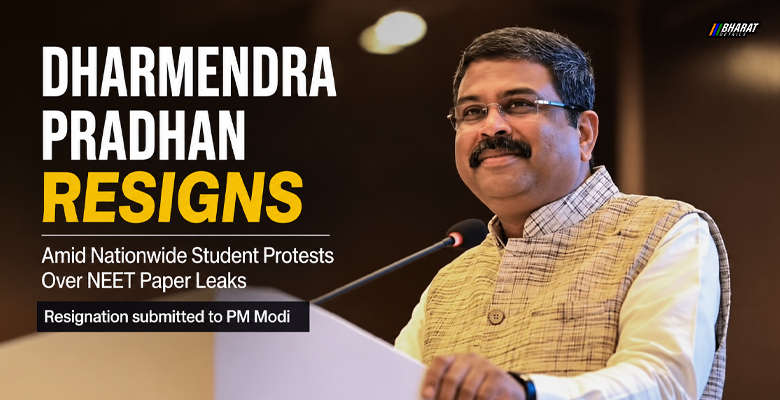
Dharmendra Pradhan has submitted his resignation as Union Education Minister to Prime Minister Narendra Modi amid weeks of student protests over alleged NEET paper leaks, examination irregularities and demands for greater accountability in India’s competitive examination system.
Pradhan announced his decision on Saturday, July 25, shortly before the scheduled third round of talks between the Centre and representatives of the Cockroach Janta Party (CJP), whose supporters had been protesting at Delhi’s Jantar Mantar. The resignation had emerged as the central point of disagreement in negotiations between the government and protest leaders.
The development marks a significant turn in a protest movement that had grown from concerns over examination integrity into a wider campaign seeking institutional reforms and accountability in the education system.
Contents
Why was Dharmendra Pradhan’s resignation demanded?
Student protesters had made Pradhan’s resignation one of their principal demands following a series of controversies surrounding national entrance examinations, including allegations of question-paper leaks and other irregularities.
The agitation gained momentum in Delhi and subsequently spread to other parts of the country. Protesters argued that repeated problems with competitive examinations had damaged students’ confidence in the system and demanded stronger safeguards, transparency and accountability.
The CJP had maintained ahead of the latest round of negotiations that Pradhan’s resignation was non-negotiable. Government representatives and protest leaders had already held earlier discussions, but the minister’s future remained a major sticking point.
What did Pradhan say about his resignation?
In a statement posted on X, Pradhan said his decision was guided by concerns about students and the wider situation surrounding the protests.
He said he wanted to ensure that the unrest did not create circumstances that could be exploited by anti-national forces and that students were not drawn into legal complications at the expense of their education and careers. He also expressed gratitude to Prime Minister Narendra Modi for the opportunity to serve the country.
Pradhan also indicated that stepping down was not about personal prestige. His resignation came after sustained criticism of the government’s handling of examination-related controversies and growing pressure from student groups.
What were the other demands of the protesters?
The resignation was not the only issue raised during negotiations.
The protesters had also sought assurances that students involved in the demonstrations would not face legal action and demanded compensation for families of students who died by suicide in the aftermath of the examination controversies.
The Centre had reportedly given assurances concerning the latter demands during earlier discussions, while the question of Pradhan’s resignation remained unresolved until Saturday.
The wider movement has also called for reforms in the examination system, greater transparency in the functioning of the National Testing Agency (NTA), stronger mechanisms to prevent paper leaks and accountability when examination failures occur.
Celebrations at Jantar Mantar
News of Pradhan’s resignation triggered celebrations at the protest site in Delhi.
CJP founder Abhijeet Dipke addressed supporters from the Jantar Mantar stage and described the development as a victory for the movement. Protesters had remained at the site for weeks, making the minister’s resignation a central focus of their campaign.
The development came after tensions had risen sharply around the demonstrations. Protesters had faced police action during attempts to march towards Parliament, while the movement continued to attract attention beyond Delhi.
Sonam Wangchuk’s role in the wider education debate
The protests also unfolded alongside a hunger strike by Ladakh-based educationist and activist Sonam Wangchuk at Jantar Mantar.
Wangchuk’s protest focused on education reforms and wider concerns affecting students and young people. His detention and hospitalisation during the fast added another dimension to the growing public debate around education policy and the government’s handling of protests.
The developments helped keep attention focused on the broader question of how India’s education and examination institutions respond when large numbers of students challenge the system.
What does the resignation mean for India’s examination system?
Pradhan’s resignation addresses one of the protesters’ most visible political demands, but it does not by itself resolve the underlying examination concerns.
The larger challenge now lies in restoring confidence among students and parents. That will require more than a change in ministerial leadership. Questions surrounding examination security, paper-leak prevention, testing agency accountability, grievance redressal and timely communication with candidates remain important.
The controversy has also highlighted the high stakes attached to national entrance examinations. For millions of students, a single examination can influence years of education, career plans and financial decisions. Any failure in the system therefore carries consequences well beyond the examination hall.
What happens next?
Pradhan has submitted his resignation to Prime Minister Modi, but the political and administrative consequences will depend on what happens next at the government level. The resignation should therefore be distinguished from formal acceptance until an official confirmation is issued.
The immediate focus is also likely to remain on the government’s commitments to protesting students and on whether the negotiations lead to concrete changes in examination policy.
For the student movement, the resignation represents a major development after weeks of demonstrations. But the longer-term test will be whether the government can translate assurances and political decisions into reforms that make national competitive examinations more secure, transparent and credible.
The episode has once again placed examination integrity at the centre of India’s education debate. The next phase will determine whether the current political crisis results in lasting institutional changes or remains limited to a change in leadership.