Bhopal Farmer Protest Intensifies as 2,000 Growers March Over Moong Procurement

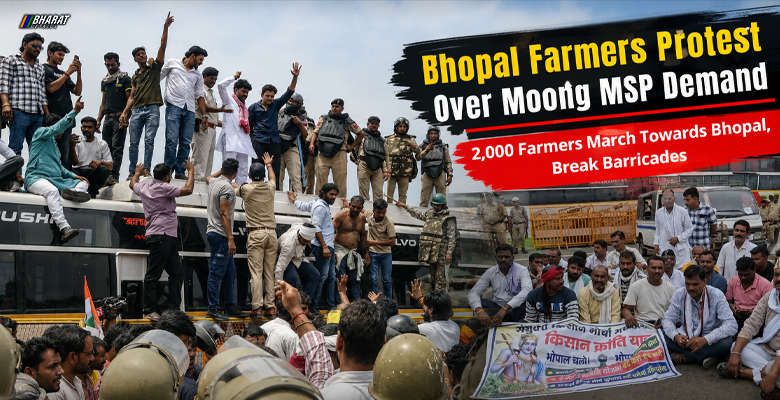
The Bhopal farmer protest intensified as nearly 2,000 farmers marched towards the Madhya Pradesh capital carrying bedding, food grains, cooking utensils and other supplies, signalling that they were prepared for a prolonged agitation over moong procurement and other agricultural issues.
The farmers, associated with 19 organisations under the banner of the Samyukt Kisan Morcha (SKM), have been demanding procurement of the entire moong crop at the Minimum Support Price (MSP), along with action on fertiliser availability, procurement procedures and other problems faced by cultivators.
The mobilisation began in Narmadapuram, where farmers gathered at Sethani Ghat before setting out for Bhopal. The march later moved through Obaidullaganj and Raisen district as the administration deployed police personnel and barricades at several points along the route.
Contents
Farmers break through barricades
The march gained momentum after farmers crossed multiple layers of police barricading while attempting to move closer to Bhopal and the Chief Minister’s residence.
Officials had urged farmer representatives to submit a memorandum rather than proceed towards the city. However, the protesters continued their march, saying previous representations had not resulted in a satisfactory response.
_________________________________________
Also read | Anti-Paper Leak Bill 2026 Passed In Lok Sabha Amid Rahul Gandhi-Amit Shah Row Over Student Protest
_________________________________________
At the protest site, some farmers were seen spending the night outdoors and preparing food on the roadside. Farmers also organised a havan, describing it as an effort to seek goodwill and a positive response from the government.
Some protesters resorted to semi-naked demonstrations as part of the agitation, while slogans were raised against the government over the farmers’ demands.
The mobilisation has also drawn support from some members of the younger generation, including people identified with Gen-Z, according to the information shared from the protest site.
Why moong procurement is at the centre of the dispute
At the heart of the confrontation is the question of how much moong the government will procure at MSP.
Farmer organisations argue that the existing procurement arrangement does not cover the entire crop, leaving growers vulnerable when market prices fall below the support price.
For the 2026-27 season, the MSP cited by the protesting farmers for moong is ₹8,768 per quintal. Their argument is that an assured procurement mechanism covering the full production would provide greater price security and reduce the possibility of distress sales.
The farmers are also raising concerns over the e-token system, registration and procurement-related procedures, besides fertiliser shortages that they say have repeatedly affected agricultural operations.
Farmer leader Santosh Patwari said the groups had been trying to raise their concerns with the government for more than 20 days and claimed that repeated representations had not produced a response satisfactory to the protesters.
The farmers have therefore indicated that they intend to continue the agitation until their key demands are addressed.
Protest creates traffic pressure around Bhopal
The escalating demonstration has also affected movement on roads connecting Bhopal with surrounding districts.
Police barricades and restrictions have been put in place at several locations as authorities attempt to prevent a large gathering from moving further into the capital. Areas around Hoshangabad Road and adjoining routes have experienced disruption, causing inconvenience to commuters.
The situation has also affected local administration. Schools in areas along Narmadapuram Road were reportedly closed as a precaution amid the continuing protest and movement restrictions.
The farmers’ organisations have alleged that barricades were also placed on roads leading out of villages in districts such as Raisen, Vidisha, Harda, Narmadapuram and Budhni to restrict supporters from joining the Bhopal mobilisation.
The administration has rejected the suggestion that the restrictions are intended to suppress the agitation, maintaining that police deployment is primarily aimed at maintaining law and order and preventing disruption.
Government says committee will engage with farmers
Chief Minister Mohan Yadav has said that the government has constituted a committee to examine farmers’ concerns. A group of ministers associated with the committee is expected to engage with representatives of the protesting farmers.
The Chief Minister has maintained that the government is open to constructive suggestions from farmers but has also stressed that any protest should not cause hardship to the general public.
The government’s response will now be closely watched, particularly on the demand for comprehensive moong procurement and the other issues being raised by the farmers.
The Opposition has criticised the government’s handling of the agitation. Leader of Opposition Umang Singhar said farmers were raising legitimate concerns and accused the government of failing to listen to them.
A larger test for the state government
The current agitation comes against the backdrop of wider rural discontent over procurement, input costs, fertiliser availability and the price realisation for farm produce.
For farmers, the issue goes beyond one crop cycle. They argue that when cultivation costs rise while market prices remain uncertain, production alone does not guarantee a viable return unless there is an effective procurement mechanism.
For the Mohan Yadav government, the immediate challenge is to prevent the confrontation from escalating while finding a workable response to the farmers’ demands.
The next phase of the protest is likely to depend on whether government representatives can establish meaningful negotiations with the farmer groups. Until then, the continued presence of farmers around Bhopal and their determination to stay on the roads suggest that the dispute is far from over.