DUSU Election Results 2026: ABVP Wins 3 of 4 Posts, Independent Candidate Takes VP Seat

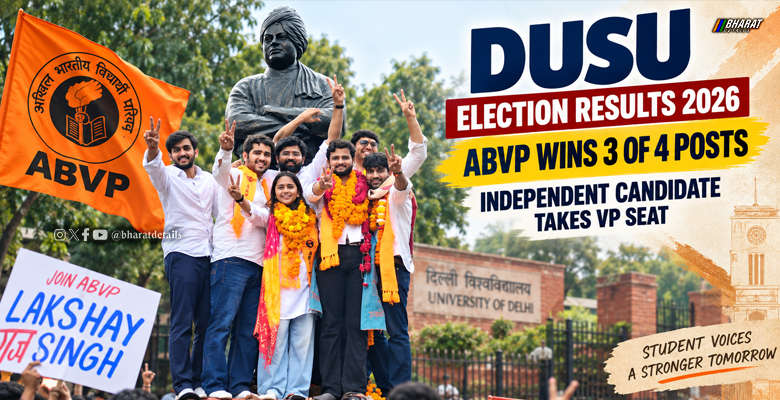
DUSU Election Results 2026 have given the Akhil Bharatiya Vidyarthi Parishad (ABVP) three of the four key posts in the Delhi University Students’ Union, while independent candidate Deepanshu Shokeen won the Vice President’s position.
The results were announced on September 19 after counting votes polled on September 18. ABVP’s Yash Dabas won the President’s post, Riya Chhawdi secured the Secretary position and Lakshya Raj Singh was elected Joint Secretary. Shokeen emerged victorious in the Vice President contest as an independent candidate.
The presidential contest was closely watched as Dabas faced NSUI candidate Vijay Shankar Meena. After 20 rounds of counting, Dabas received 24,576 votes against Meena’s 22,523, giving the ABVP candidate a margin of 2,053 votes. AISA-SFI candidate Ananya Raturi finished behind the two leading candidates.
The other central panel contests produced clearer margins. Riya Chhawdi won the Secretary post with 21,650 votes, while Lakshya Raj Singh secured the Joint Secretary position with 16,615 votes. The Joint Secretary contest was relatively close, with independent candidate Vishesh Yadav receiving 15,778 votes and NSUI’s Gopal Choudhary polling 15,206.
Contents
Deepanshu Shokeen’s Independent Victory
One of the most notable aspects of the DUSU results was Deepanshu Shokeen’s victory in the Vice President election.
Shokeen secured 30,615 votes, considerably ahead of ABVP’s Ishu Maurya, who received 16,910 votes. NSUI candidate Vir Chatrath finished further behind with 4,313 votes. Shokeen had previously been associated with NSUI but contested the election independently this year, making his victory particularly significant in the central-panel contest.
His result also shows that the DUSU election was not simply a four-post contest between ABVP and NSUI. Candidate-level factors and independent campaigns continued to influence voting patterns, particularly in the Vice President race.
What the DUSU Result Says About Campus Politics
ABVP’s three wins give the organisation a majority of the four central DUSU positions. At the same time, the independent victory means the entire central panel is not controlled by a single student organisation.
The result comes against a backdrop of student concerns over accommodation, campus safety, public transport and other day-to-day issues. During the campaign, accommodation emerged as a major concern for candidates and voters, particularly following the Satya Niketan building collapse that had raised questions about student housing and safety.
The election recorded a voter turnout of 40.46% across 52 polling stations. More than 1.5 lakh students were eligible to vote, according to election-related reports.
Where Does Rahul Gandhi’s ‘Chhatron Ki Goonj’ Fit Into the Result?
The DUSU outcome has also triggered political debate over Rahul Gandhi’s student outreach programme, ‘Chhatron Ki Goonj’.
The Congress campaign was launched in June 2026 around issues including paper leaks, examination irregularities, education costs and employment. The initiative invited students to share their concerns and participate in a broader campaign for education reform.
However, the DUSU election result alone cannot establish whether the campaign succeeded or failed among Delhi University students. ‘Chhatron Ki Goonj’ was a broader national education campaign, while DUSU voting involved specific candidates, student organisations and campus-level issues.
The result does show that NSUI, the Congress-affiliated student organisation, did not secure any of the four central DUSU posts. At the same time, the Vice President result demonstrates that students were willing to support an independent candidate over both major student organisations.
That distinction is important when interpreting the election. A student-union election reflects a mixture of organisational strength, candidate popularity, campus issues, local networks and wider political identities. It does not by itself provide a definitive measurement of support for a national political leader or a nationwide campaign.
ABVP Leaders Welcome the Results
The results prompted reactions from BJP leaders, who congratulated the winning ABVP candidates and the organisation’s workers.
Union Minister Kiren Rijiju congratulated the ABVP candidates and supporters after the results. BJP president J P Nadda also welcomed the performance, describing it as a reflection of support for the organisation among young voters. BJP spokesperson Pradeep Bhandari used the result to criticise Rahul Gandhi and the Congress.
Those statements represent the political interpretation of the result by BJP leaders and should be distinguished from the voting data itself.
___________________________
Also read | Who Is Deepanshu Shokeen? Independent Candidate Wins DUSU Vice-President Post In 2026
___________________________
NSUI Raises Allegations After the Poll
The election also saw allegations from the losing side regarding the voting process. NSUI presidential candidate Vijay Shankar Meena said after the result that he intended to approach the court over allegations of bogus and forced voting.
These remain allegations made by the candidate, rather than established findings. Any legal challenge or subsequent official inquiry would be required to determine whether there were violations affecting the election.
The ABVP winners, meanwhile, rejected the allegations and described them as claims that had been made in previous elections as well. They also raised concerns about people allegedly carrying fake identity cards during the election. These claims would likewise require verification by the relevant authorities.
What Happens Next for DUSU?
With the central panel now decided, attention will shift towards how the newly elected representatives address the issues raised during the campaign.
Accommodation is expected to remain a major concern, alongside campus safety, student facilities and access to affordable services. The elected representatives have also spoken about protecting democratic spaces on campus and responding to student concerns.
The 2026 DUSU result therefore presents two clear developments at the same time: ABVP has secured three of the four central positions, while an independent candidate has taken the remaining seat with a substantial vote tally.
For the student body, the significance of the result will ultimately depend less on campaign rhetoric and more on whether the elected representatives can turn their election promises into practical action on campus.