PM Modi Hails India’s 7.8% GDP Growth, Urges Citizens to Avoid Unnecessary Foreign Travel and Gold Purchases

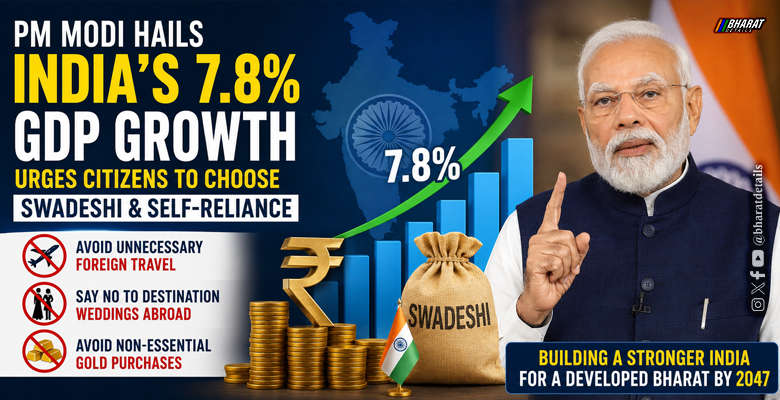
India’s 7.8% GDP growth in the April-June quarter has drawn praise from Prime Minister Narendra Modi, who has urged citizens to support the domestic economy by choosing Indian products, avoiding unnecessary foreign travel and limiting non-essential gold purchases.
The Prime Minister made the appeal in a video message on Tuesday, September 1, while in Bishkek, Kyrgyzstan, for the 26th Shanghai Cooperation Organisation (SCO) Summit. The government had released the latest GDP estimates on August 31, showing real GDP growth of 7.8% in the first quarter of financial year 2026-27.
Modi described the growth figure as a sign of India’s economic resilience at a time when the global economy continues to face uncertainty, supply-chain disruptions and geopolitical tensions.
His message, however, went beyond the GDP numbers. He asked Indians to think carefully about spending that sends money overseas, particularly leisure travel, destination weddings and unnecessary purchases of gold.
“Foreign trips, if you are going for leisure, you should not go,” Modi said, while also discouraging weddings held abroad. He further advised people against buying gold unless there is a genuine need.
The appeal is linked to the government’s broader emphasis on Swadeshi and self-reliance, with the Prime Minister arguing that greater domestic consumption can help strengthen India’s economic base.
Contents
Why Modi is asking Indians to choose Swadeshi
The Prime Minister’s argument centres on keeping more economic activity within India. Spending on domestic tourism, Indian-made products and local services can support businesses, employment and demand within the country.
Foreign travel and overseas weddings, on the other hand, involve spending in foreign markets. Gold purchases can also have implications for India’s import bill because the country relies heavily on imports to meet domestic gold demand.
Modi said Indians should adopt the principle of “Wed in India” rather than choosing foreign destinations for weddings. The broader message was that personal consumption choices can contribute to the country’s economic priorities.
He also connected the appeal with India’s long-term ambition of becoming a developed country by 2047, the centenary year of Independence.
India records 7.8% GDP growth in Q1 FY27
The latest official figures released by the Ministry of Statistics and Programme Implementation (MoSPI) showed real GDP growth of 7.8% during April-June 2026. The first-quarter estimates for FY 2026-27 were released on August 31.
The performance has been closely watched because economic growth influences investment, employment, government revenues and consumer confidence.
For Modi, the numbers also provide an opportunity to highlight India’s economic performance despite challenging international conditions.
In a post on X, the Prime Minister welcomed the 7.8% growth figure and said the result reflected stronger economic confidence.
The government’s assessment is that India’s growth momentum demonstrates resilience despite external pressures. However, sustaining that pace will depend on factors including domestic consumption, investment, inflation, global trade conditions and geopolitical developments.
Modi takes aim at critics over economic pessimism
In his remarks, Modi also criticised what he described as an atmosphere of pessimism within the country.
He said India was continuing to progress despite wars, crises and disruptions to global supply chains, while some people were allegedly spreading what he called “jhooth ki goonj”, or an “echo of lies”.
The remark was seen as a political swipe at critics of the government’s economic record. The Prime Minister did not name Rahul Gandhi directly in the statement.
Focus on self-reliance and 2047
Modi said the economic performance should be viewed alongside India’s longer-term development goals. He argued that stronger emphasis on self-reliance and locally produced goods could help build an economy capable of supporting the aspirations of the country’s younger population.
The government has increasingly used the Viksit Bharat 2047 framework to describe India’s goal of becoming a developed nation by the 100th anniversary of Independence.
The Prime Minister said today’s efforts would determine what kind of economy is handed over to the next generation.
Modi’s appeal comes during SCO visit
The Prime Minister’s comments came during his visit to Kyrgyzstan for the 26th SCO Summit in Bishkek. According to the government’s official itinerary, Modi is attending the summit from August 31 to September 1, following a bilateral visit to Uzbekistan.
The 2026 summit marks the 25th anniversary of the Shanghai Cooperation Organisation. India has been a full member of the grouping since 2017. Modi is also scheduled to engage with other SCO leaders during the summit.
His economic message from abroad therefore combined two themes: India’s performance in the global economy and the role of Indian consumers in strengthening domestic demand.
____________________________
Also read | India Ends Boarding Pass Stamping At Immigration Counters From September 1
____________________________
What the message means for consumers
The Prime Minister’s comments are not a ban on foreign travel, destination weddings or gold purchases. Instead, they are an appeal for citizens to reconsider spending that may be avoidable and to give greater preference to domestic alternatives.
For consumers, the message essentially translates into choosing Indian products and services where practical, travelling within India when possible and treating gold purchases as a need-based decision rather than an unnecessary expense.
For the wider economy, the bigger question will be whether the strong first-quarter growth can continue through the remaining quarters of FY 2026-27.
The 7.8% figure has strengthened the government’s confidence in India’s economic trajectory. But sustaining high growth will require continued investment, productive employment, strong domestic demand and resilience against external shocks. The coming quarters will show whether the latest GDP performance represents a temporary boost or part of a broader and durable growth cycle.