Ex-AAP leader Tahir Hussain, Four Others Get Life Imprisonment in Ankit Sharma Murder Case

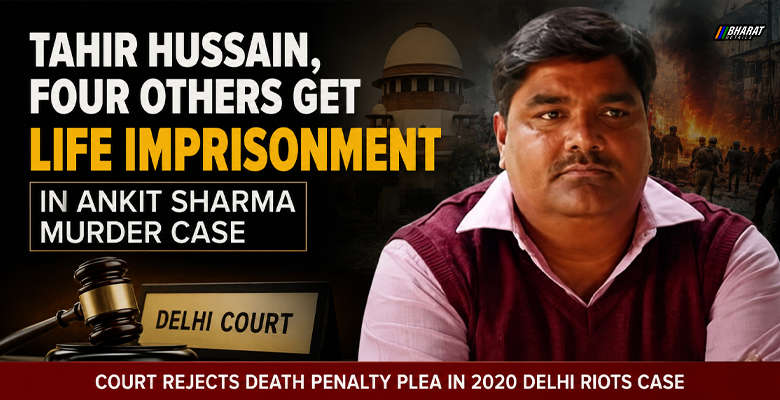
Ex-AAP leader Tahir Hussain and four others have been sentenced to life imprisonment in the Ankit Sharma murder case linked to the communal violence that broke out in Northeast Delhi in February 2020.
A Delhi court on Friday, July 31, awarded life terms to former Aam Aadmi Party councillor Tahir Hussain and co-convicts Javed, Anas, Nazim and Kasim for the murder of Intelligence Bureau (IB) staffer Ankit Sharma. Additional Sessions Judge Praveen Singh of the Karkardooma Courts rejected the prosecution’s request for the death penalty.
The sentencing followed a detailed hearing on whether the five convicts should receive capital punishment or imprisonment for life. Delhi Police had argued that the killing was exceptionally brutal and deserved the maximum punishment. The court, however, concluded that the prosecution had not established circumstances showing that the five men were beyond the possibility of reform.
The court described the manner of Sharma’s killing as extremely brutal. It noted that the crime took place amid communal violence and said the circumstances surrounding the killing were particularly disturbing. At the same time, the judge considered the absence of demonstrated previous violent criminal conduct and the possibility of rehabilitation while deciding the sentence.
The decision means the court has imposed life imprisonment rather than the death penalty sought by the prosecution. The sentencing order came after the court had earlier found Hussain and the four others guilty in the case.
Contents
What the court had decided earlier
On July 13, the Karkardooma Court convicted Hussain, Javed, Anas, Nazim and Kasim in connection with Sharma’s killing. Hussain was found guilty under provisions including those dealing with murder, rioting, unlawful assembly, promoting enmity and kidnapping or abduction with intent to wrongfully confine.
The court did not accept every allegation against Hussain. He was acquitted of the criminal conspiracy charge, among other charges that were not proved to the court’s satisfaction. This distinction is important because the conviction was based on the offences the prosecution successfully established during trial rather than on every charge originally brought against him.
The prosecution had subsequently sought capital punishment for all five convicts, describing Sharma’s killing as cold-blooded and exceptionally violent. Defence lawyers opposed the request and argued that the death penalty could be imposed only when a case met the legal threshold of the “rarest of rare” category.
How Ankit Sharma was killed
The case originated from a complaint filed by Sharma’s father, Ravinder Kumar, after his son went missing during the violence on February 25, 2020.
According to the case record, Sharma, who worked with the Intelligence Bureau, had left home to purchase groceries and other household items. He did not return for several hours. His body was later recovered from a drain near Chand Bagh Pulia.
The post-mortem examination recorded 51 injuries caused by sharp-edged weapons and blunt force. The prosecution relied on eyewitness accounts and other evidence while establishing the case against the five accused.
The FIR was registered at Dayalpur Police Station as FIR No. 65 of 2020 on the basis of the complaint made by Sharma’s father. The broader case initially involved a larger group of accused, with charges being framed in March 2023.
Why the death penalty was rejected
The prosecution’s demand for the death penalty was based largely on the brutality of the crime. The court acknowledged the seriousness of those circumstances but also examined whether the convicts could be reformed.
The judge noted that the prosecution had not placed sufficient material showing that the five convicts had a continuing violent disposition or previous involvement in violent crime. The court also considered their conduct while in custody and concluded that they could still be disciplined and rehabilitated.
This distinction explains why the court could strongly condemn the nature of the offence while still stopping short of capital punishment. Under Indian sentencing principles, the seriousness of a crime is considered alongside mitigating circumstances when deciding whether a case meets the “rarest of rare” threshold.
The 2020 Northeast Delhi violence
The murder took place during the communal violence that erupted in Northeast Delhi in February 2020 amid tensions surrounding protests over the Citizenship Amendment Act. The violence involved incidents of stone-pelting, arson and clashes and resulted in dozens of deaths and widespread injuries.
Sharma’s killing became one of the prominent criminal cases arising from the violence because of the circumstances surrounding his disappearance and the subsequent recovery of his body from a drain.
The latest sentencing marks a significant stage in the long-running prosecution. The case, however, is not necessarily at its final legal stage. After the sentence, Hussain indicated that he intended to challenge the outcome before the Delhi High Court.
For now, the Karkardooma Court’s ruling leaves Hussain and the four other convicted men with life sentences, while the court’s rejection of capital punishment reflects its finding that the possibility of their reform could not be ruled out.