D.Y. Patil Passes Away at 90: Former West Bengal Governor and Education Visionary Dies in Kolhapur

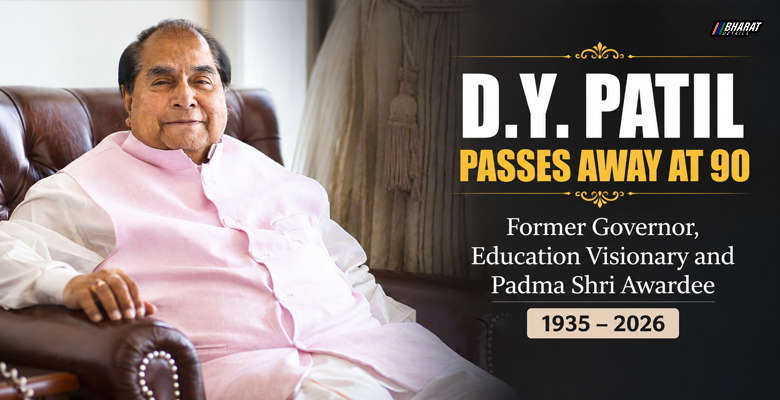
Maharashtra lost one of its most influential educationists and public figures on Tuesday after D.Y. Patil passes away following a prolonged illness at his residence in Kolhapur. The veteran politician, former Governor and Padma Shri recipient was widely respected for transforming higher education through a network of universities and professional institutions that now educate thousands of students across India.
Family members confirmed that Dr. Dnyandeo Yashwantrao Patil passed away peacefully at his home. He is survived by his sons, including former Maharashtra minister and senior Congress leader Satej Patil, along with Sanjay Patil and Ajinkya Patil.
His passing marks the end of a public life that spanned politics, education, healthcare, sports and rural development for several decades.
Contents
A life dedicated to public service
Born on October 22, 1935, in Ambap village of Maharashtra’s Kolhapur district, D.Y. Patil came from an agricultural family but went on to become one of the country’s most recognised names in higher education.
His political journey began at the grassroots level. He served as the Mayor of Kolhapur from 1957 to 1962 before entering the Maharashtra Legislative Assembly. He represented the Panhala constituency after winning Assembly elections in 1967 and again in 1972.
During his years in public life, Patil earned a reputation as a leader who balanced political responsibilities with long-term institution building. Rather than limiting his work to electoral politics, he focused on creating educational opportunities for future generations.
Served as Governor of three states
Dr. Patil later moved into constitutional responsibilities, serving as the Governor of Tripura and Governor of Bihar. He also held the additional charge of Governor of West Bengal during his tenure.
His experience in governance, coupled with his long political career, made him one of Maharashtra’s respected senior public figures. Although he spent many years with the Indian National Congress, he later joined the Nationalist Congress Party in 2018.
Built one of India’s best-known educational groups
While politics introduced him to public life, education became the field in which he left his biggest mark.
Over several decades, D.Y. Patil established educational institutions offering courses in medicine, engineering, dentistry, management, nursing, physiotherapy, pharmacy, architecture, law and several other professional disciplines.
Universities and colleges carrying the D.Y. Patil name today are spread across Maharashtra and attract students from different parts of India as well as overseas.
His efforts significantly expanded access to professional education at a time when quality institutions outside major metropolitan cities were limited. Many students from rural and semi-urban backgrounds benefited from these opportunities.
Education experts have often credited his vision with encouraging private investment in higher education while maintaining a strong emphasis on professional learning.
Contributions beyond education
Apart from universities, Patil also made notable contributions in healthcare and sports infrastructure.
Hospitals and medical institutions established under his guidance have provided healthcare services while also supporting medical education and research.
His contribution to Indian sports is equally well recognised. The D.Y. Patil Stadium in Navi Mumbai has hosted numerous international cricket matches, Indian Premier League fixtures and other major sporting events, becoming one of the country’s prominent sporting venues.
He also supported rural development initiatives through cooperative institutions, including the D.Y. Patil Cooperative Sugar Factory in Kolhapur district, which has contributed to employment generation and support for sugarcane farmers over the years.
Honoured with the Padma Shri
In recognition of his contribution to education and social service, the Government of India conferred the Padma Shri on D.Y. Patil in 1991.
He also received several honorary doctorates and academic recognitions from Indian and international institutions for his work in expanding educational infrastructure.
These honours reflected not only his administrative abilities but also the lasting impact his institutions have had on thousands of students pursuing professional careers.
Political leaders pay tribute
Leaders from across political parties expressed grief over his demise, remembering him as an educationist who combined public service with institution building.
Congress leader Rahul Gandhi described the news as deeply saddening and said D.Y. Patil’s contribution to education and public service would always be remembered. He also extended condolences to the bereaved family.
NCP (Sharad Pawar faction) president Sharad Pawar said Maharashtra had lost a visionary personality whose work in education, healthcare, sports and social welfare would continue inspiring future generations.
Several leaders from Maharashtra, educationists and former students also paid tributes, recalling his role in creating institutions that have benefited countless families over the years.
A legacy that extends beyond politics
Although D.Y. Patil served in important political and constitutional positions, many believe his greatest achievement lies in the educational ecosystem he created.
Thousands of doctors, engineers, lawyers, management professionals and healthcare workers have graduated from institutions founded under his leadership. These institutions continue to play a significant role in India’s higher education landscape.
His approach reflected the belief that education could become a powerful instrument for social and economic progress, particularly for students from smaller towns and rural communities.
Remembering a builder of institutions
The passing of D.Y. Patil closes an important chapter in Maharashtra’s public life. Few leaders have managed to leave an imprint across as many sectors as he did—from politics and governance to education, healthcare, sports and rural development.
As tributes continue to pour in from political leaders, former students and educational institutions, his life’s work stands as a reminder that lasting public service is often measured not only by political office but by the institutions created for future generations.
His universities, hospitals, sports facilities and social initiatives are expected to continue serving society for years to come, ensuring that his contribution remains relevant well beyond his lifetime.