Narendra Modi Turns 76: From Vadnagar to Prime Minister of India — A Detailed Journey, Achievements, Records, Lifestyle and Global Diplomacy

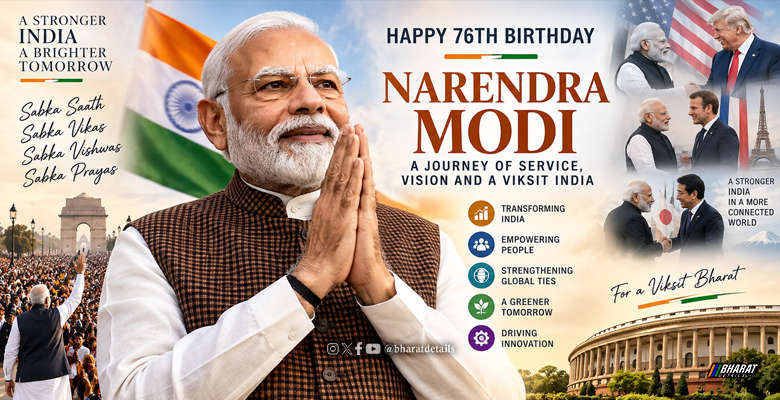
Narendra Modi 76th Birthday will be observed on September 17, 2026, marking another milestone in the political journey of one of India’s most prominent contemporary leaders.
Born on September 17, 1950, in Vadnagar, Gujarat, Narendra Damodardas Modi has travelled a long distance from his early years in a modest family to becoming Prime Minister of India. He entered the Prime Minister’s Office in May 2014, returned with another mandate in 2019 and took oath for a third consecutive term on June 9, 2024.
His political career has included work as a grassroots organiser, BJP functionary, Gujarat Chief Minister and, eventually, Prime Minister. Over more than two decades at the head of a government — first in Gujarat and later at the Union level — his tenure has been associated with large-scale welfare programmes, infrastructure expansion, digital public infrastructure, economic reforms, changes in taxation, foreign-policy initiatives and a stronger emphasis on India’s position in international forums.
As Prime Minister Narendra Modi completes 76 years, his journey offers a broad view of how an individual who began in a small town in Gujarat rose through organisational politics to occupy India’s highest elected executive office.
Contents
From Vadnagar to public life
Narendra Modi was born in Vadnagar, then part of Bombay State and now in Gujarat, on September 17, 1950. According to his official biography, he was the third child of Damodardas Modi and Heeraben Modi and grew up in a modest household.
His early years included helping his family and spending time at the family’s tea stall. His official biography also records his interest in reading, debates and public activities from a young age.
The Emergency period of the 1970s became an important phase in his political development. During this period, Modi became involved in activities connected with the movement opposing the Emergency. He subsequently took on organisational responsibilities within the Rashtriya Swayamsevak Sangh and later entered active BJP organisational work.
By the 1980s and 1990s, he had emerged as an important organiser in Gujarat and subsequently at the national level. His organisational responsibilities included work in Gujarat as well as assignments in Haryana and Himachal Pradesh.
The Gujarat years
Narendra Modi became Chief Minister of Gujarat in October 2001 and remained in the position until May 2014, making him the longest-serving Chief Minister of Gujarat.
His Gujarat years shaped much of the administrative and political style that he later brought to New Delhi. His government placed considerable emphasis on infrastructure, investment, industrial development, electricity, roads, water management and technology-driven administration.
The period also remained politically and socially contentious, particularly because of the 2002 Gujarat riots and the wider debates surrounding the state’s governance and communal relations. Any assessment of Modi’s Gujarat tenure therefore involves both the development narrative advanced by his government and the continuing political and historical debate surrounding that period.
The 2014 breakthrough
The 2014 Lok Sabha election transformed Narendra Modi from a state-level leader into a national political figure.
The BJP won 282 seats on its own, giving the party an outright majority in the Lok Sabha. Modi was sworn in as Prime Minister on May 26, 2014.
It was significant for another reason: Modi became the first Prime Minister of India born after the country’s independence in 1947.
His government began with a strong emphasis on financial inclusion, sanitation, manufacturing, digital governance, infrastructure and delivery of welfare benefits.
Among the early flagship programmes was the Pradhan Mantri Jan Dhan Yojana, launched in August 2014. The scheme was designed to expand access to bank accounts and connect people to formal financial services and government benefit transfers. By August 2026, official figures put the number of PMJDY accounts at 59.09 crore, with women accounting for 56% of account holders and 78% of accounts located in rural and semi-urban areas.
Swachh Bharat and the sanitation push
The Swachh Bharat Mission became one of the most recognisable programmes launched during Modi’s first term.
The campaign focused on toilet construction, sanitation and behavioural change. It was accompanied by a nationwide public campaign involving political leaders, celebrities, government institutions, schools and civil society organisations.
The programme became an important part of the government’s wider approach to linking basic amenities with public health and dignity.
Digital India and the transformation of payments
Digitalisation has been another defining feature of the Modi years.
Digital India, launched in 2015, sought to expand digital infrastructure and government services. Over time, this ecosystem became closely connected with Aadhaar, mobile connectivity, Direct Benefit Transfer and digital payments.
The Unified Payments Interface, developed through India’s digital public infrastructure ecosystem, subsequently became one of the most visible examples of India’s rapid transition toward real-time digital payments.
In July 2026, the government marked 11 years of Digital India and highlighted the expansion of digital public infrastructure, digital payments and technology-based public service delivery.
GST and changes to India’s tax system
One of the most significant economic changes during Modi’s first term was the implementation of the Goods and Services Tax in July 2017.
GST replaced a number of central and state indirect taxes with a common tax framework. Its introduction was presented as an effort to create a more integrated national market and simplify indirect taxation.
The implementation also generated criticism and concerns among sections of businesses, particularly small enterprises, regarding compliance requirements and the transition to the new system.
Over subsequent years, GST rates, procedures and compliance mechanisms have been modified.
Demonetisation
On November 8, 2016, the government announced the withdrawal of legal tender status for ₹500 and ₹1,000 notes.
The stated objectives included tackling unaccounted cash, counterfeit currency and financing of illegal activities. The decision caused substantial disruption because a large share of India’s currency in circulation was affected.
It remains one of the most debated economic decisions of the Modi era, with differing assessments of its economic costs and benefits.
Infrastructure and connectivity
Infrastructure has become another major element of the Modi government’s development agenda.
Road construction, highways, railways, airports, ports, freight corridors, metro systems and rural connectivity have received substantial policy attention.
Government data presented in 2026 highlighted major expansion in rural housing, roads, tap-water connections and digital connectivity. The government reported that 3.70 crore rural houses had been completed under PM Awas Yojana-Gramin over the preceding 11 years, while about 15.74 crore rural households had been covered under the Jal Jeevan Mission.
The expansion of Vande Bharat trains and airport infrastructure has also become a visible part of India’s transport modernisation.
_____________________
Also read | Narendra Modi: A Journey Of Leadership, Achievements, And Transformation
_____________________
Welfare programmes and the focus on last-mile delivery
The Modi government’s welfare architecture has included programmes covering banking, cooking fuel, housing, health insurance, drinking water, electricity, sanitation and social security.
Some of the better-known initiatives include:
- Pradhan Mantri Jan Dhan Yojana
- Pradhan Mantri Ujjwala Yojana
- Pradhan Mantri Awas Yojana
- Ayushman Bharat
- Jal Jeevan Mission
- PM SVANidhi
- PM-KISAN
- Digital India
- Swachh Bharat Mission
- Make in India
- Skill India
- Startup India
- Mudra Yojana
The government’s own assessment has linked these programmes with poverty reduction and improved access to basic services. NITI Aayog data cited by the PMO has said nearly 25 crore people moved out of multidimensional poverty between 2013-14 and 2022-23. Such figures are government/NITI Aayog assessments and should be understood in that context.
Ayushman Bharat and healthcare
Ayushman Bharat became one of the government’s principal healthcare initiatives.
The programme was designed to provide health insurance coverage to eligible economically vulnerable families through the Pradhan Mantri Jan Arogya Yojana, alongside a broader primary healthcare component through Health and Wellness Centres.
The government describes Ayushman Bharat as the world’s largest government-funded healthcare programme, with coverage running into tens of crores of beneficiaries.
In later years, the programme was expanded to include senior citizens aged 70 and above, irrespective of their socioeconomic status, subject to the applicable scheme framework.
Women’s welfare and empowerment
Women’s participation has featured prominently in several programmes introduced or expanded during the Modi years.
Ujjwala expanded access to LPG connections among women in poorer households. Jan Dhan accounts increased women’s access to formal banking, while schemes involving housing, sanitation and drinking water have also been framed around reducing the everyday burden on women.
The government has also promoted women’s participation in entrepreneurship, self-help groups, financial inclusion and political representation.
The passage of the Nari Shakti Vandan Adhiniyam in 2023, providing for reservation of one-third of seats in the Lok Sabha and state legislative assemblies subject to the constitutional framework and delimitation process, became another major legislative development associated with the period.
Make in India, manufacturing and self-reliance
The “Make in India” programme was launched in 2014 with the objective of increasing manufacturing, attracting investment and strengthening India’s industrial base.
The policy approach later expanded into “Atmanirbhar Bharat”, with greater emphasis on domestic manufacturing, supply-chain resilience, electronics, defence production, semiconductors and strategic industries.
In his 2026 Independence Day address, Modi highlighted government figures showing significant increases over the preceding 12 years in defence production, electronics manufacturing, mobile-phone production and railway coach manufacturing.
Space and scientific ambitions
The Modi years have also coincided with several major milestones in India’s space programme.
The Chandrayaan-3 mission successfully landed near the Moon’s south polar region in August 2023, making India the first country to achieve a successful soft landing in that region.
The Aditya-L1 mission subsequently reached its designated halo orbit around the Sun-Earth L1 point, beginning long-duration observations of the Sun.
India’s human-spaceflight programme, Gaganyaan, has also remained a major national project.
G20 Presidency and India’s international profile
India’s G20 presidency in 2023 was another important diplomatic milestone.
The New Delhi G20 Summit produced the New Delhi Leaders’ Declaration and saw the African Union admitted as a permanent member of the G20.
The summit also highlighted India’s diplomatic focus on the Global South, digital public infrastructure, climate finance, development and connectivity.
The India-Middle East-Europe Economic Corridor was also announced during the summit involving India, the United States, Saudi Arabia, the UAE and European partners.
Modi and the global stage
Foreign policy has become one of the most visible components of Modi’s premiership.
Rather than limiting engagement to one geopolitical bloc, India’s diplomacy under Modi has sought simultaneous relationships with the United States, Russia, France, Israel, Gulf countries, Japan, Australia, Europe, African countries and partners across the Global South.
This approach is often described by Indian officials as strategic autonomy or multi-alignment.
India’s relationship with the United States has developed into what the Ministry of External Affairs describes as a “Comprehensive Global Strategic Partnership.” Modi has interacted with both Democratic and Republican administrations in Washington. His 2023 US state visit under President Joe Biden included meetings at the White House and an address to the US Congress.
Relationship with Russia
Russia has remained an important partner for India in defence, energy, nuclear cooperation and strategic affairs.
Modi’s meetings with Russian President Vladimir Putin have been a recurring feature of India’s diplomacy. His 2015 visit to Russia, for example, focused on security, trade, energy, science and technology, with 16 agreements signed during the visit.
The relationship has required India to balance its traditional defence and energy links with Russia while simultaneously expanding strategic cooperation with Western countries.
France and Emmanuel Macron
France has emerged as one of India’s major European strategic partners.
Modi and French President Emmanuel Macron have maintained frequent contact on defence, civil nuclear cooperation, space, technology and strategic issues.
During Modi’s February 2025 visit to France, the two leaders co-chaired the AI Action Summit in Paris. Modi also visited Marseille, where India inaugurated its Consulate General and the two countries continued discussions on bilateral and global issues.
United Arab Emirates and the Gulf
Relations with the Gulf have received considerable attention during Modi’s tenure.
The UAE has become an important partner for India in investment, energy, trade, technology and diaspora-related issues.
In May 2026, Modi undertook a five-nation European and Gulf tour that included the UAE, Netherlands, Sweden, Norway and Italy. The Ministry of External Affairs recorded the visit as one of his major overseas engagements of 2026.
Israel
India-Israel relations have expanded considerably in areas including defence, agriculture, water technology, innovation and security.
Modi became the first Indian Prime Minister to make a standalone visit to Israel in 2017.
His February 25-26, 2026 state visit to Israel included meetings with President Isaac Herzog and Prime Minister Benjamin Netanyahu. The two sides also announced cooperation in areas including geophysical exploration, with an emphasis on advanced technology and artificial intelligence.
Japan and the Indo-Pacific
Japan has been an important partner in India’s infrastructure, technology, investment and Indo-Pacific strategy.
India’s relationship with Japan also operates through the Quad, alongside the United States and Australia.
The partnership has included cooperation in high-speed rail, infrastructure, manufacturing, technology, maritime security and resilient supply chains.
Africa and the Global South
Modi’s government has increasingly sought closer relations with African nations.
India has used platforms such as the India-Africa Forum Summit, BRICS, the G20 and other multilateral institutions to strengthen engagement with developing countries.
The 2023 G20 presidency was particularly important because India positioned itself as a bridge between developed economies and developing nations.
Major foreign visits in recent years
The Ministry of External Affairs maintains an official database of the Prime Minister’s overseas visits. The record shows the breadth of Modi’s international travel. By 2025-26, these engagements covered Europe, North America, Asia, Africa, the Middle East and the Indo-Pacific.
Some notable visits and their broad objectives include:
| Period | Destination | Broad purpose |
|---|---|---|
| 2014 | Bhutan | Neighbourhood diplomacy and bilateral cooperation |
| 2014 | Japan | Strategic, economic and technology partnership |
| 2015 | United States | Strategic, economic and technology cooperation |
| 2015 | Russia | Annual summit, defence, energy and economic cooperation |
| 2017 | Israel | Strategic, agriculture, water and technology cooperation |
| 2019 | United States | UN and multilateral diplomacy, diaspora engagement |
| 2023 | United States | State visit, technology, defence and strategic partnership |
| 2023 | France | Strategic partnership and Bastille Day engagement |
| 2023 | South Africa | BRICS Summit |
| 2023 | Indonesia | ASEAN and East Asia Summit diplomacy |
| 2024 | Russia | India-Russia annual summit |
| 2024 | United States | Quad and UN-related diplomacy |
| 2025 | France | AI Action Summit and bilateral relations |
| 2025 | United States | Engagement with the Trump administration |
| 2025 | Japan and China | Bilateral engagement and multilateral diplomacy |
| 2025 | South Africa | G20 Summit |
| 2025 | UK and Maldives | Bilateral relations and Indian Ocean diplomacy |
| 2026 | Malaysia | ASEAN-related and bilateral engagement |
| 2026 | Israel | Strategic and technology cooperation |
| 2026 | UAE, Netherlands, Sweden, Norway and Italy | Gulf-European diplomacy and strategic/economic engagement |
The official MEA visit records confirm the 2025-26 sequence, including Modi’s visits to Malaysia, Israel, Jordan, Ethiopia, Oman, South Africa, Bhutan, Japan, China, the UK, Maldives, Ghana, Trinidad and Tobago, Argentina, Brazil, Namibia, Cyprus, Canada, Croatia and the five-country May 2026 tour.
Awards and international recognition
Modi has received a number of foreign state honours during his tenure.
Among them are France’s Grand Cross of the Legion of Honour, awarded in 2023, Brazil’s Grand Collar of the National Order of the Southern Cross in 2025 and Norway’s Grand Cross of the Royal Norwegian Order of Merit in May 2026. Sweden also awarded him the Royal Order of the Polar Star, Degree Commander Grand Cross, in May 2026.
These awards are decisions of the respective governments and are generally presented in recognition of bilateral relations or contributions to international cooperation.
Narendra Modi’s lifestyle and daily routine
Public interest in Modi’s personal routine has remained high, particularly because of his work schedule and frequent domestic and international travel.
However, it is important to separate documented statements from claims circulating on social media.
In an interview, Modi said that yoga and pranayama had been part of his life from an early age. He has repeatedly spoken about yoga, breathing exercises and meditation as elements of his approach to maintaining physical and mental balance.
He has also publicly encouraged people to make yoga part of their daily routine. In 2026, he again highlighted regular yoga practice as a way of supporting physical health and mental calm.
What does Narendra Modi eat?
Modi has described himself as a vegetarian.
There is a popular perception that he follows a highly rigid or specially designed diet. In a 2026 interaction with students, however, Modi specifically said that he does not follow a fixed diet system. He recalled eating vegetarian food in different households during his earlier years and said that he sometimes cooked simple food such as khichdi himself.
In an earlier interview, he similarly described himself as someone who prefers simple vegetarian food rather than being particularly focused on food.
Reports have sometimes attributed specific foods, meal timings or strict dietary rules to him. Such claims should be treated carefully unless they come directly from Modi or an official source.
Yoga, breathing and physical fitness
Yoga is perhaps the most publicly documented component of Modi’s personal health routine.
He has spoken about yoga and pranayama for many years and has repeatedly participated in International Day of Yoga events.
His public advocacy for yoga has also become part of India’s cultural diplomacy. The International Day of Yoga, observed globally every June 21, has developed into one of India’s most visible international soft-power initiatives.
Sleep and working hours
There have been different public accounts of Modi’s sleeping pattern.
In a 2018 interview, he said that he generally slept around four to six hours.
During the 2024 election campaign, another interview reported that he slept only around three to four hours. There have also been statements by people who have interacted with him suggesting extremely long working hours.
These figures should not be treated as a fixed official daily schedule. A Prime Minister’s routine changes substantially according to Parliament, Cabinet meetings, domestic travel, international summits, security requirements and emergencies.
Reading, newspapers and preparation
An earlier interview with Modi described a routine involving reading newspapers, checking emails, making telephone calls and reviewing feedback from citizens.
He also said that before going to bed he would review documents received during the day and prepare for the next day’s meetings and engagements.
This gives some insight into the administrative side of his routine, although the precise schedule of a serving Prime Minister is not publicly disclosed in full.
Protocol and security surrounding the Prime Minister
The Prime Minister of India operates under extensive security and constitutional protocols.
The Special Protection Group provides proximate security to the serving Prime Minister and eligible family members under the SPG Act. The legislation defines proximate security as close protection during travel, official engagements, residence and other locations, with arrangements involving access control, security rings and coordination with other agencies.
The SPG works alongside intelligence agencies and state and Union Territory police forces. Its stated operational philosophy includes a “Zero Error” approach to protecting its designated protectees.
During domestic visits, the Prime Minister’s movement therefore involves advance security planning, route arrangements, coordination with local authorities and multiple security layers.
Foreign travel requires another level of coordination involving the Ministry of External Affairs, host-country authorities, diplomatic missions, security agencies and the Prime Minister’s official delegation.
Because detailed operational security procedures are sensitive, the public record does not provide — and should not be expected to provide — every element of the Prime Minister’s protection arrangements.
Major political records
Narendra Modi’s political career has produced several notable records.
First Prime Minister born in independent India: Modi was born in 1950, three years after Independence.
Longest-serving Chief Minister of Gujarat: His Gujarat tenure ran from October 2001 to May 2014.
Three consecutive terms as Prime Minister: Modi became Prime Minister in 2014, returned in 2019 and took oath for a third consecutive term in June 2024.
Two consecutive BJP single-party majorities: The BJP secured an outright Lok Sabha majority in both 2014 and 2019 under Modi’s leadership. The PMO notes that this was the first time since 1984 that a party had achieved consecutive single-party majorities in the Lok Sabha.
Longest-serving elected Prime Minister for consecutive terms: According to a Union Cabinet resolution issued in June 2026, Modi completed 4,399 continuous days as an elected Prime Minister on June 10, 2026, surpassing Jawaharlal Nehru’s 4,398 continuous days from 1952 to 1964. This is the precise formulation of the record; it is more accurate than simply saying that Modi has served the longest total period as Prime Minister because the historical comparison involves different periods and definitions of service.
Three-time winner from Varanasi: Modi has represented Varanasi in the Lok Sabha since 2014 and won the constituency again in 2019 and 2024. His victory margin in 2019 was 4,79,505 votes, while the 2024 election produced a smaller margin of 1,52,513 votes.
The Modi era in perspective
More than a decade after he first became Prime Minister, the Modi period has produced significant changes across India’s economy, welfare architecture, infrastructure, technology, foreign policy and political communication.
Supporters point to expanded welfare delivery, digital payments, infrastructure construction, improved financial inclusion, India’s rising international profile and increased emphasis on manufacturing.
Critics and political opponents have raised concerns over issues including employment, economic disruption caused by demonetisation, social polarisation, institutional questions, civil liberties and the implementation of major policy decisions.
Both aspects form part of the public record and the debate around the Modi years.
What is less disputed is the scale and duration of his political presence. By September 2026, Modi has spent 25 years continuously heading a government — beginning with his appointment as Gujarat Chief Minister in October 2001 and continuing through his third term as Prime Minister.
A birthday that also marks a political milestone
September 17, 2026, is therefore more than Narendra Modi’s 76th birthday. It comes during a period in which he has crossed several unusual milestones in Indian political history.
From the lanes of Vadnagar to Gujarat’s Chief Minister’s Office, and from there to the Prime Minister’s residence and international summits, his journey has been shaped by organisation, electoral politics, administration and an increasingly global role for India.
His supporters view the period as one of transformation and national ambition, while critics continue to scrutinise the consequences of many of his government’s decisions. For students of Indian politics, however, the Modi era is already a defining chapter of the country’s 21st-century political history.
As India observes his 76th birthday, the next phase of his premiership will be watched closely — particularly the government’s plans for economic growth, employment, manufacturing, technology, infrastructure, national security and the long-term objective of building a developed India by 2047.
Bharat Details extends its birthday greetings to Prime Minister Narendra Modi on his 76th birthday and records this milestone as an overview of his public journey, governance record and international engagements.
When is Narendra Modi’s 76th birthday?
Narendra Modi’s 76th birthday is on September 17, 2026. He was born on September 17, 1950, in Vadnagar, Gujarat.
How old is Narendra Modi in 2026?
Narendra Modi turns 76 years old on September 17, 2026.
When did Narendra Modi become Prime Minister of India?
Narendra Modi first became Prime Minister on May 26, 2014.
Is Narendra Modi serving his third term as Prime Minister?
Yes. He took oath for his third consecutive term as Prime Minister on June 9, 2024.
Is Narendra Modi the longest-serving Prime Minister of India?
According to a Union Cabinet resolution in June 2026, Modi became the longest-serving elected Prime Minister for consecutive terms, completing 4,399 continuous days and surpassing Jawaharlal Nehru’s 4,398 continuous days from 1952 to 1964.
Was Narendra Modi the Chief Minister of Gujarat?
Yes. Modi served as Gujarat Chief Minister from October 2001 to May 2014, making him the state’s longest-serving Chief Minister.
Is Narendra Modi vegetarian?
Yes. Modi has repeatedly spoken publicly about yoga and pranayama and has promoted yoga as part of a healthy lifestyle.
What is Narendra Modi’s most famous health habit?
Yoga and breathing exercises are among the best-documented components of his publicly discussed health routine.
What are some major schemes launched under Narendra Modi?
Major initiatives include Jan Dhan Yojana, Swachh Bharat Mission, Make in India, Digital India, Ujjwala Yojana, Ayushman Bharat, PM Awas Yojana, PM-KISAN, Jal Jeevan Mission and Startup India.
11. Which constituency does Narendra Modi represent?
Narendra Modi represents Varanasi in Uttar Pradesh in the Lok Sabha. He has won the seat in the 2014, 2019 and 2024 general elections.
What countries has Narendra Modi visited as Prime Minister?
Modi has visited numerous countries across Asia, Europe, North America, Africa, the Middle East and the Indo-Pacific. The Ministry of External Affairs maintains the official record of his overseas visits.