UPI Charges From October 15: 0.4% MDR on Merchant Payments Above ₹2,000, Small Vendors Exempt

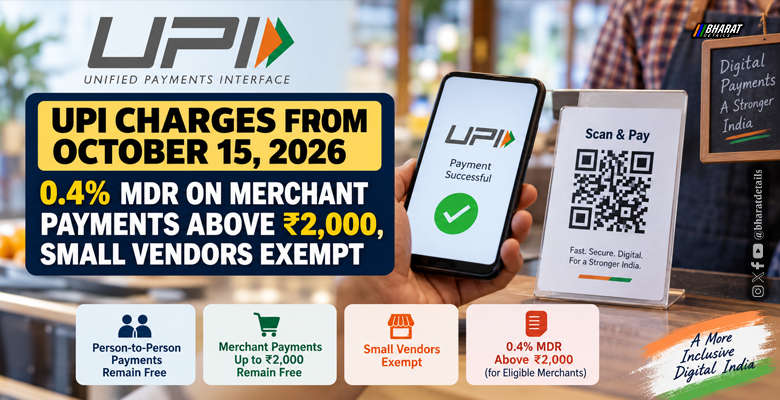
UPI charges are set to change for certain merchant transactions from October 15, 2026, after the National Payments Corporation of India (NPCI) introduced a new Merchant Discount Rate (MDR) framework for selected UPI payments above ₹2,000.
The change is aimed at merchant-side transactions rather than ordinary person-to-person payments. According to the government, individuals will continue to be able to send money to other individuals through UPI without paying a transaction charge, regardless of the amount involved.
Under the new framework, eligible person-to-merchant (P2M) UPI transactions above ₹2,000 will attract an MDR of 0.4%. The charge is part of the payment ecosystem and is payable by the merchant to participating banks and payment service providers. It is not a government tax imposed directly on the person making the payment.
The new structure will come into effect on October 15, 2026.
Contents
What changes for people using UPI?
For most everyday UPI users, the immediate impact is expected to be limited.
Payments between two individuals will remain free, even when the transaction value exceeds ₹2,000. Similarly, payments made to merchants up to ₹2,000 will continue without MDR.
For example, if a customer scans a shop’s UPI QR code and pays ₹500, ₹1,000 or ₹2,000, the payment will remain free under the new framework.
However, an eligible merchant transaction of ₹10,000 would fall within the new MDR framework. At 0.4%, the applicable MDR would be ₹40, subject to the prescribed rules and caps. The customer is not supposed to pay this amount separately.
Banks have also been advised to ensure that merchants do not pass the MDR cost on to customers.
Person-to-person UPI payments remain free
One of the key clarifications from the government is that the new MDR should not be interpreted as a charge on ordinary UPI transfers between individuals.
According to the Finance Ministry, person-to-person transactions account for around 37% of UPI transactions by volume and 70% by value. These transactions remain outside the MDR framework.
This means transferring money to a family member, friend or another individual through UPI will continue to be free, irrespective of the transaction amount.
Small merchants and street vendors get an exemption
Small businesses have been given a separate exemption under the new structure.
Merchants classified under the Person-to-Person Merchant (P2PM) category and receiving up to ₹1 lakh per month through UPI QR codes will continue to have zero MDR on their UPI transactions.
The framework is particularly relevant for neighbourhood shops, street vendors and other small businesses that rely heavily on QR-based digital payments.
The government has said the exemption is intended to support digital payment adoption among small and informal businesses.
How much will merchants have to pay?
For eligible P2M transactions above ₹2,000, the standard MDR is 0.4%.
There is also a maximum cap. For transactions of ₹75,000 or more, MDR will be capped at ₹300 per transaction.
The collected MDR will be distributed among participants in the payment ecosystem, including banks and payment service providers.
This is an important distinction because MDR is not the same as a tax or a direct fee collected by the government from UPI users.
Special rules for railways, fuel, telecom and insurance
Not every merchant category will follow the 0.4% rate.
Transactions above ₹2,000 in specified sectors such as railways, telecommunications, insurance, fuel and agricultural inputs will attract a flat MDR of ₹5 per transaction, according to the government’s framework.
The separate structure is intended to provide greater cost predictability for sectors where margins can be relatively thin or where digital payments have a significant role in public and essential services.
Lower MDR for capital-market payments
A separate, lower rate will apply to certain financial-market transactions.
Payments relating to mutual funds, securities, stockbrokers and dealers will attract an MDR of 0.02%, subject to a maximum cap of ₹300 per transaction.
The government has said the reduced rate is intended to support continued retail participation in formal financial markets.
Is there a monthly limit on free UPI transactions?
No new monthly quota for free UPI payments has been announced for individual users under this MDR framework.
The new rules do not mean that consumers will have to pay after making a certain number of UPI transactions in a month.
Banks and the UPI ecosystem can have transaction limits for security and risk-management purposes. Such limits are different from MDR and do not mean that users are being charged a fee for crossing a monthly free-payment quota.
Will a customer paying ₹10,000 through UPI be charged ₹40?
No, the government has clarified that the MDR is not meant to be added to the customer’s payment.
For an eligible ₹10,000 merchant transaction, 0.4% works out to ₹40. However, this amount represents the MDR within the payment ecosystem rather than an additional ₹40 that the customer should be asked to pay.
Banks have been advised to prevent merchants from passing the MDR cost on to customers.
Only a small share of merchant transactions expected to be affected
The government estimates that the vast majority of merchant UPI transactions will remain outside the new MDR framework.
According to its analysis, approximately 4% of merchant transactions will be affected because most transactions either fall at or below the ₹2,000 threshold or qualify for the zero-MDR P2PM framework.
The government’s stated objective is to introduce a revenue mechanism for the payment ecosystem while retaining free UPI payments for the overwhelming majority of everyday transactions.
Also read | UPI May Not Stay Free Forever: RBI Warns Of Future Charges For Digital Payments
Why is NPCI introducing MDR now?
UPI has grown into one of India’s most widely used digital payment systems. NPCI’s statistics show that UPI recorded more than 24.5 billion transactions in August 2026, with transaction value of nearly ₹29.82 lakh crore.
The government has described the new MDR framework as a measure intended to make the UPI ecosystem more financially sustainable and support further expansion, particularly in rural and semi-urban areas.
A dedicated fund will also be created for promoting UPI usage among small merchants, with 5% of total MDR collections earmarked for the initiative.
The broader objective is to maintain widespread UPI acceptance while creating a revenue stream within the payment ecosystem.
What UPI users should remember
The new framework does not mean that UPI has generally become a paid service.
From October 15, 2026:
- Person-to-person UPI payments remain free.
- Merchant payments up to ₹2,000 remain free.
- Eligible small merchants receiving up to ₹1 lakh per month through UPI QR remain under zero MDR.
- Selected merchant payments above ₹2,000 will attract MDR.
- The standard MDR for eligible transactions is 0.4%.
- MDR is capped at ₹300 for transactions of ₹75,000 or more.
- Selected sectors such as railways, fuel, telecom, insurance and agricultural inputs will have a flat ₹5 MDR above ₹2,000.
- Certain capital-market transactions will attract a 0.02% MDR, capped at ₹300.
- Customers are not supposed to be charged the MDR separately.
The changes therefore primarily affect the economics of selected merchant-side UPI transactions, rather than the everyday use of UPI for sending money between individuals.
As implementation begins in October, banks, payment apps and merchants will have to adapt their systems to the revised MDR structure. For consumers, the key distinction will remain whether a payment is being made to another individual or to a merchant, and, in the latter case, whether the transaction falls within an exempt category.
What is the new UPI charge from October 15, 2026?
Eligible person-to-merchant UPI transactions above ₹2,000 will attract a 0.4% Merchant Discount Rate (MDR) from October 15, 2026. The MDR is a merchant-side payment ecosystem charge, not a direct consumer fee.
Will I have to pay a fee when sending money to another person through UPI?
No. Person-to-person UPI transfers remain free regardless of the amount transferred.
Will UPI payments of ₹2,000 or less to shops remain free?
Yes. Eligible person-to-merchant UPI payments up to ₹2,000 remain exempt from MDR.
If I pay ₹10,000 to a shop through UPI, will I have to pay an extra ₹40?
No. Although 0.4% of ₹10,000 equals ₹40, the MDR is applicable within the payment ecosystem and customers are not supposed to be charged this amount separately.
Are small shops and street vendors exempt from UPI MDR?
Small merchants under the P2PM classification receiving up to ₹1 lakh per month through UPI QR codes will continue to have zero MDR on their UPI transactions.
What is the MDR for railway, fuel and telecom payments?
For specified sectors such as railways, telecom, insurance, fuel and agricultural inputs, transactions above ₹2,000 will attract a flat MDR of ₹5 per transaction.
What is the UPI MDR for mutual funds and stockbrokers?
Specified payments involving mutual funds, securities, stockbrokers and dealers will attract an MDR of 0.02%, subject to a ₹300 cap.
Is there a monthly limit for free UPI payments?
No new monthly quota has been introduced for individuals under this MDR framework. Existing bank or transaction-specific limits for security purposes are separate from MDR.
Does the new rule mean UPI is no longer free?
For individual users, UPI remains free for person-to-person transfers and eligible merchant payments. The new MDR applies only to specified merchant transactions above the prescribed threshold.
Source context: NPCI’s UPI framework and government clarifications. NPCI describes UPI as an instant payment system developed by NPCI and regulated by the RBI.


