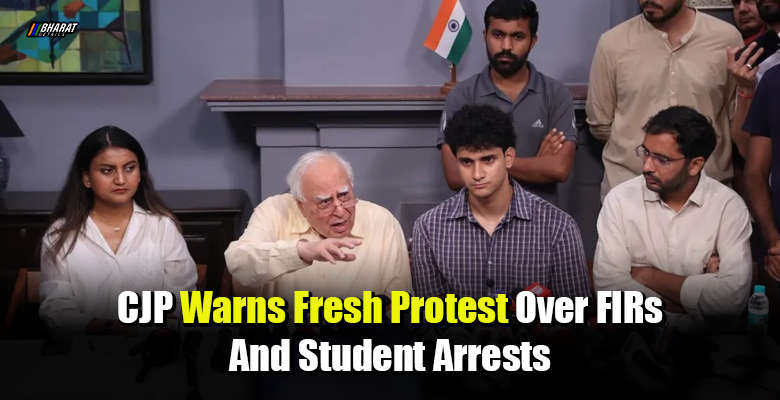
CJP Warns of Fresh Protest Over FIRs, Student Arrests; Ashutosh Ranka Says Govt Assurances Were Breached

CJP protest organisers have warned that they could return to the streets after alleging that student protesters are still being arrested, detained and harassed despite assurances given by the Centre when the nationwide agitation was called off.
Cockroach Janta Party (CJP) national spokesperson Ashutosh Ranka on Monday, July 27, accused the government of a “complete breach” of the understanding reached over police action against protesters. He demanded the immediate withdrawal of FIRs, the release of detained students and a written assurance that no fresh cases would be filed against protesters or organisers.
Ranka said the organisation would be “forced to sit on protest again” if the demands were not addressed. He specifically urged Union ministers JP Nadda and Jitendra Singh to ensure that the commitments made during negotiations are honoured.
According to Ranka, the CJP has received reports of hundreds of students being arrested in Bihar and Bengal, while protesters and volunteers in Delhi and other states were allegedly being subjected to surveillance or harassment. He also referred to reports of volunteers being detained in Delhi while providing logistical support to protesters.
The CJP has asked that all FIRs against protesters be withdrawn immediately, detained students be released and no future cases be registered by the Delhi Police, central investigative agencies or police forces in BJP- or NDA-governed states, in line with what the organisation says was agreed with the Centre.
Ranka has also sought the written agreement covering legal cases and the government’s timeline for implementing it. He said the document should be shared with the organisation by Tuesday, July 28.
Contents
Saurav Das says breach of trust will be unacceptable
CJP chief spokesperson Saurav Das separately raised concerns over reports of students and other protesters being detained or arrested in Assam, West Bengal and Bihar.
Das said the CJP had ended its nationwide protest only after receiving assurances from the Government of India that protesters would not face punitive action, either immediately or in the future, in BJP-ruled or NDA-ruled states.
He described the reports emerging from different states as a serious concern and said the organisation’s legal team had been coordinating with lawyers from the beginning to assist protesters facing detention or other legal action.
Das appealed to the Centre, particularly JP Nadda and Jitendra Singh, to ensure that detained protesters are released, coercive or retaliatory action is not taken against demonstrators and FIRs registered against them are withdrawn. He also reminded the government of its commitment to provide a written guarantee by Tuesday, July 28.
AISA also demands release of arrested students
The dispute has drawn support from student organisations as well.
All India Students’ Association (AISA) national president Neha Bora travelled to Patna on July 27 following reports of arrests in Bihar. She criticised the use of serious criminal charges against students accused of participating in protests and demanded that all cases against protesters be withdrawn.
Bora specifically objected to allegations that students were facing charges such as attempt to murder for their participation in demonstrations. She said the government should honour its assurance or Bihar could see protests similar to those witnessed in Delhi.
In Patna, Bora also said the movement would not stop until every arrested student protester was released and argued that the right to dissent is protected by the Constitution.
What was the agreement that ended the CJP protest?
The latest confrontation follows the CJP’s decision to withdraw its nationwide agitation on July 25 after weeks of demonstrations over alleged examination irregularities and the NEET paper leak controversy.
The protest began on June 20 and continued for more than a month. The Indian Express described it as a 36-day protest, while Hindustan Times’ July 25 live coverage referred to the agitation as a 37-day movement. The difference appears to relate to how the days of the protest are counted, but both reports place the end of the agitation on July 25.
The CJP’s campaign had several demands, including the resignation of then Union Education Minister Dharmendra Pradhan, compensation for families of NEET aspirants who died by suicide, protection for peaceful protesters and action against officials accused of excesses during demonstrations.
The movement became more prominent after educator and activist Sonam Wangchuk joined the agitation and undertook a 26-day hunger strike. The CJP credited Wangchuk’s intervention as an important part of the wider movement.
On July 25, Pradhan resigned as Union Education Minister following weeks of pressure surrounding examination irregularities and the protests. The CJP subsequently announced that it was withdrawing its agitation after discussions with the Centre. The organisation said it had received assurances that peaceful protesters would not face punitive action and that legal cases connected with the agitation would be withdrawn.
The current dispute is therefore focused on whether those assurances are being implemented, particularly in cases involving students and volunteers in different states.
CJP says it feared protesters could be targeted after agitation ended
At a press conference in Delhi on Monday, Saurav Das said the organisation had taken legal precautions throughout the movement.
Das said CJP representatives remained in contact with senior advocate and Rajya Sabha MP Kapil Sibal and sought legal guidance during the protest. He said the organisation was particularly concerned that individual protesters could be targeted after the larger movement had lost momentum.
According to Das, the CJP anticipated that people could be singled out once the agitation was called off and therefore maintained coordination with lawyers and arranged legal and medical assistance for students.
The CJP has now reiterated that it will continue monitoring the situation and assisting protesters facing legal action.
Kapil Sibal was also present at the press conference with CJP spokespersons on Monday. The legal dimension of the dispute has become increasingly prominent as the organisation seeks withdrawal of FIRs and release of detained protesters. Current reporting also indicates that a legal aid effort has been announced for students facing cases.
Bihar police action and the AK-47 controversy
The dispute over police action has intensified following an incident in Bihar’s Siwan district during a student protest on July 25.
A video circulated on social media appeared to show a police constable carrying an AK-47 and firing shots during the demonstration. Bihar Police subsequently suspended the constable. Police officials said the weapon had been used improperly and that no one was injured by the firing.
The incident has become a major political flashpoint. Opposition leaders have raised the matter in Parliament and demanded accountability over the alleged use of force against students.
The episode has also been cited by critics of the government’s handling of the wider protests as evidence of excessive police action. Authorities, however, have separately maintained that law-and-order concerns arose during some demonstrations and that specific incidents have to be investigated.
The CJP’s demand for withdrawal of all cases now sits against this wider backdrop of competing claims over protest conduct, police response and the scope of the assurances given during negotiations.
Parliament sees uproar over alleged police action
The controversy has also moved into Parliament, where Opposition MPs have questioned the alleged use of excessive force against students.
Members of the Samajwadi Party and Congress have raised allegations concerning police action during protests in Bihar, including reports surrounding the use of an AK-47. Opposition parties have sought a response from Union Home Minister Amit Shah.
The issue comes during the Monsoon Session, where the wider question of examination reform and paper leaks is already part of the political debate. The Centre has also moved legislation aimed at strengthening measures against unfair practices in public examinations, adding another layer to the continuing dispute over the country’s examination system.
Supreme Court stresses right to peaceful protest
The CJP’s renewed warning also comes on a day when the Supreme Court addressed the broader issue of police conduct during demonstrations.
A three-judge bench headed by Chief Justice of India Surya Kant was hearing petitions concerning alleged police excesses against NEET demonstrators in Delhi and elsewhere.
The court stressed that peaceful and lawful protest is protected under the constitutional framework and said an agitation by itself cannot justify police excesses or violence. At the same time, the court emphasised the importance of discipline and balance within the democratic process.
The observation assumes significance as the CJP and student groups accuse authorities in several states of acting against protesters despite the assurances that reportedly led to the withdrawal of the nationwide agitation.
CJP faces criticism over ‘resignation party’ videos
The latest dispute has unfolded alongside another controversy involving the CJP.
After Dharmendra Pradhan resigned and the protest was called off, videos circulated on social media showing CJP spokespersons Saurav Das, Ashutosh Ranka and others celebrating and dancing. The footage was described by critics as a “resignation party” or “victory party” following the end of the protest.
The videos attracted criticism, particularly because they surfaced soon after a prolonged student movement that had also seen clashes, detentions and allegations of excessive police action.
Das defended the celebrations by arguing that the younger generation does not necessarily follow traditional ideas about political activism. He said Gen-Z protesters could demonstrate, organise and celebrate without conforming to older expectations about how a movement should look.
The controversy has since become a separate debate around the style and image of the youth-led movement. It does not, however, change the CJP’s current demand regarding FIRs and detained protesters.
What happens next?
The immediate deadline for the CJP is Tuesday, July 28, when the organisation expects the Centre to provide the written assurance concerning legal cases.
The CJP has made three central demands: withdrawal of FIRs against protesters, release of detained students and a commitment that no fresh cases will be filed against peaceful protesters in line with the understanding reached during negotiations.
The government will now face pressure to clarify the status of the alleged agreement and distinguish between cases arising from peaceful participation in protests and cases involving specific allegations of criminal conduct.
For the CJP, the question is whether the assurances that led to the withdrawal of its prolonged agitation will be honoured. For the government, the challenge is to prevent the dispute over legal action from becoming the trigger for another round of nationwide student protests.
The events of the next few days could therefore determine whether the July 25 withdrawal marks the real end of the CJP movement or merely a temporary pause before the protesters return to the streets.