Netherlands Returns Chola-Era Anaimangalam Copper Plates to India During PM Modi’s Visit

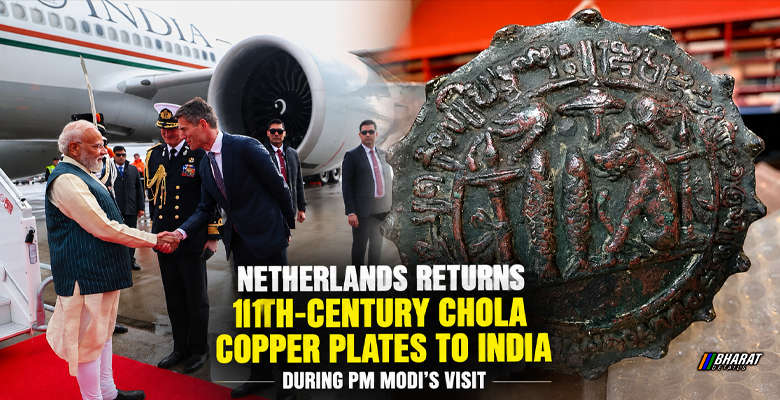
The return of the Anaimangalam Copper Plates to India has marked a significant moment in the country’s ongoing efforts to reclaim priceless cultural heritage taken abroad during the colonial era. The 11th-century copper inscriptions, closely linked to the powerful Chola dynasty, were formally handed back by the Netherlands during Prime Minister Narendra Modi’s visit to the European nation as part of his multi-country diplomatic tour.
For historians, archaeologists and Tamil heritage scholars, the development is far more than a ceremonial transfer of artefacts. The plates are considered among the most valuable surviving records from the Chola period and offer rare insight into South India’s maritime strength, religious inclusiveness and global trade links nearly a thousand years ago.
Known internationally as the Leiden Plates because they were preserved for decades at Leiden University in the Netherlands, the copper inscriptions had remained outside India for more than a century. Their return follows years of diplomatic dialogue involving the Indian government, Dutch authorities and academic institutions in Europe.
The Anaimangalam Copper Plates date back to the reign of Emperor Rajaraja Chola I, one of the greatest rulers in Indian history, who governed between 985 CE and 1014 CE. Historians say the inscriptions were later engraved during the reign of his son Rajendra Chola I to preserve royal orders and grants permanently on durable copper sheets.
The artefacts consist of 21 large copper plates and three smaller sheets weighing nearly 30 kilograms in total. These are held together by a circular copper ring carrying the royal Chola seal, symbolising imperial authority and administrative legitimacy.
What makes the inscriptions historically extraordinary is the story they preserve. The copper plates record grants of taxes and village revenues to the Chudamani Vihara, a Buddhist monastery established in Nagapattinam, a major port city on the Coromandel Coast of Tamil Nadu.
The monastery itself was built by Sri Mara Vijayotunga Varman, a ruler associated with the Srivijaya kingdom in present-day Indonesia and parts of Southeast Asia. This detail alone highlights the extensive international connections maintained by the Chola Empire during the medieval period.
Historians believe the inscriptions demonstrate how South India emerged as a thriving maritime and cultural hub connecting India with Southeast Asia through trade, religion and diplomacy. Ships from the Chola kingdom travelled across the Bay of Bengal, while scholars, merchants and monks moved between India, Indonesia and other Asian regions.
The copper plates also reveal an important social and political dimension of the Chola period — religious coexistence. Although Rajaraja Chola I was a Hindu ruler deeply associated with Shaivism, the inscriptions show that he supported a Buddhist institution established by a Southeast Asian ruler. Researchers often cite this as evidence of the inclusive and cosmopolitan nature of medieval South Indian governance.
Experts say the plates provide valuable historical references regarding taxation systems, land grants, trade networks, royal administration and cultural interactions of that era. They are therefore viewed not merely as administrative documents but as crucial records of India’s civilisational history.
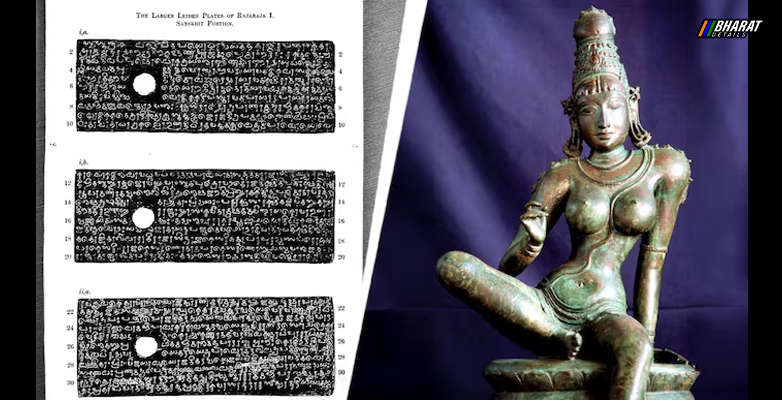
The inscriptions are written in both Sanskrit and Tamil. The Sanskrit section traces the genealogy of the Chola rulers and symbolically connects the dynasty to divine ancestry linked with Lord Vishnu. Meanwhile, the Tamil inscriptions describe the achievements of Rajaraja Chola I and detail the grants made to the Buddhist monastery.
According to scholars, the dual-language format reflects the sophisticated literary and administrative culture of the Chola Empire. Sanskrit was widely used for royal and ceremonial purposes, while Tamil carried detailed administrative and regional information.
The Chola dynasty itself occupies a legendary place in Indian history. Rising to prominence around the 9th century after ruler Vijayalaya Chola captured Thanjavur, the empire went on to become one of Asia’s most influential powers.
Under Rajaraja Chola I and Rajendra Chola I, the empire expanded dramatically across South India and beyond. Their naval campaigns and maritime influence extended into Southeast Asia, making the Cholas one of the few Indian dynasties to establish significant overseas military and trade dominance.
The period also witnessed remarkable advancements in architecture, art and temple construction. The Brihadisvara Temple in Thanjavur, commissioned by Rajaraja Chola I, remains one of India’s greatest architectural achievements and is recognised as a UNESCO World Heritage Site.
The Chola era also produced some of the world’s finest bronze sculptures, admired globally for their artistic detail and spiritual expression. Even today, Chola bronzes are considered masterpieces of Indian art history.
The journey of the copper plates from India to Europe dates back to the colonial period. Historians believe the artefacts were taken to the Netherlands during Dutch colonial activity on the Coromandel Coast in the 18th century.
At the time, Nagapattinam was under the influence of the Dutch East India Company, which had shifted its regional headquarters there from Pulicat in the late 17th century. Researchers suggest the plates eventually came into the possession of Dutch official Florentius Camper through missionary networks operating in the region.
Also read | PM Modi Netherlands Visit: PM Narendra Modi Receives Grand Welcome In Amsterdam After Key UAE Agreements
Later, the artefacts entered the collections of Leiden University in 1862 and remained preserved in the university library’s Asian archives. Over the decades, the plates became important research material for historians, epigraphists and Tamil scholars studying South Indian history.
The inscriptions also gained renewed public attention through popular Tamil literature, especially the celebrated historical novel Ponniyin Selvan, which revived global interest in the Chola period and its legendary rulers.
India had been pursuing the return of the copper plates for years as part of a broader effort to reclaim cultural artefacts taken abroad during colonial rule. The breakthrough came after the Netherlands adopted a new restitution policy in 2022 concerning colonial-era collections.
Detailed provenance studies carried out by experts and independent committees reportedly concluded that the plates should rightfully be returned to India. The repatriation has since been welcomed by historians and cultural heritage experts in both countries.
During his visit to the Netherlands, Prime Minister Narendra Modi also interacted with members of the Indian diaspora. Addressing the gathering, he thanked the community for its warm welcome and remarked that the atmosphere felt similar to a festive celebration in India.
Officials believe the return of the Anaimangalam Copper Plates could strengthen cultural cooperation between India and the Netherlands while also encouraging further discussions regarding other historically significant artefacts located overseas.
The development is also being viewed as part of a larger global conversation surrounding colonial-era collections and the ethical responsibility of museums and institutions holding culturally sensitive objects taken during periods of foreign rule.
For India, the return of the copper plates represents more than the recovery of ancient metal inscriptions. It symbolises the restoration of a historical memory deeply connected to Tamil identity, maritime heritage and one of the greatest chapters of Indian civilisation.
As the plates prepare to return home after centuries abroad, historians say they will once again become accessible not just to researchers, but to millions of Indians seeking to reconnect with the country’s rich and layered past.