Petrol and Diesel Prices Cross Key Milestones as Fuel Rates Rise Again Across India

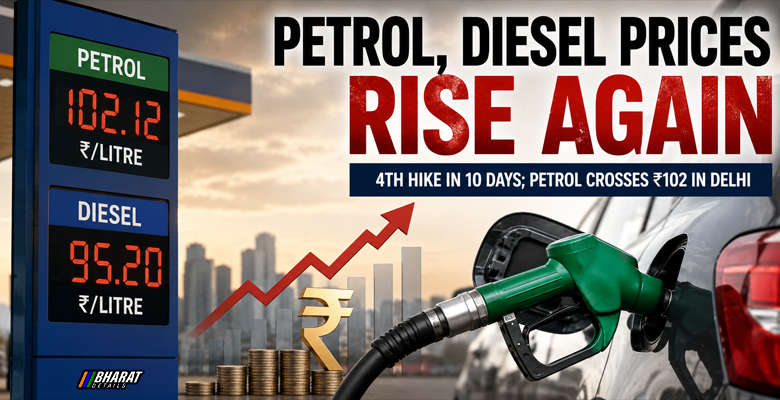
India’s latest petrol diesel price hike has once again pushed fuel costs higher across major cities, adding pressure on household budgets, transport operators, and businesses already dealing with rising operational expenses. State-run oil marketing companies on Monday announced another sharp increase in petrol and diesel rates, marking the fourth revision in less than two weeks as global crude oil markets continue to remain volatile due to geopolitical tensions in West Asia.
With the latest revision, petrol prices in Delhi climbed by ₹2.61 per litre to ₹102.12, while diesel prices increased by ₹2.71 per litre to ₹95.20 per litre. Similar hikes were reported across Mumbai, Kolkata, Chennai, and several other cities, where local taxes and VAT structures influence the final retail price.
The latest increase has taken the cumulative rise in petrol and diesel prices to nearly ₹7.5 per litre within a short span, making it one of the sharpest fuel price correction cycles seen in recent years.
| City | Petrol Price (₹/Litre) | Increase | Diesel Price (₹/Litre) | Increase |
|---|---|---|---|---|
| Delhi | ₹102.12 | +₹2.61 | ₹95.20 | +₹2.71 |
| Mumbai | ₹111.21 | +₹2.72 | ₹97.83 | +₹2.81 |
| Kolkata | ₹113.51 | +₹2.87 | ₹99.82 | +₹2.80 |
| Chennai | ₹107.77 | +₹2.46 | ₹99.55 | +₹2.57 |
For many consumers, the increase is significant not just because of the direct impact on fuel bills, but also because of the broader economic ripple effect that often follows sustained fuel inflation.
Contents
Fuel Prices Back Above ₹100 Mark
The latest revision has pushed petrol prices in Delhi above ₹100 per litre once again, something that had not happened in several years. The last time fuel prices crossed similar levels was during the global crude oil surge following geopolitical disruptions in 2022.
This time, however, the situation is being closely linked to instability in West Asia, particularly tensions involving the United States and Iran. Market uncertainty surrounding oil transportation routes, especially through the Strait of Hormuz, has kept crude oil prices fluctuating sharply over the past several weeks.
The Strait of Hormuz remains one of the world’s most critical oil transit routes, carrying nearly one-fifth of global energy supplies. Any disruption or threat to movement in the region immediately impacts international crude markets, eventually affecting countries like India that rely heavily on imported crude oil.
Industry analysts say the government and oil companies initially tried to shield consumers from the full impact of rising crude prices. However, sustained pressure on oil marketing companies reportedly resulted in mounting daily losses, forcing gradual revisions in retail fuel rates.
Why Fuel Prices Are Increasing
According to officials and sector experts, oil marketing companies had been absorbing significant losses for weeks while international crude prices continued to rise. Brent crude had surged sharply after tensions escalated in West Asia earlier this year, at one point nearing $120 per barrel before easing slightly in recent sessions.
Even though crude prices have recently softened below earlier peak levels, companies are still attempting to recover previous under-recoveries incurred during the period when retail prices remained unchanged.
Energy market observers say the present pricing cycle resembles the incremental hikes witnessed after the Russia-Ukraine conflict disrupted global energy markets in 2022. Instead of a single steep increase, fuel prices are being revised gradually over several days to reduce sudden shock to consumers while allowing oil companies to recover accumulated losses.
Executives within the sector believe additional revisions may still be possible if international crude prices remain elevated or if geopolitical uncertainty continues.
Oil Companies Under Pressure Despite Strong Annual Profits
Interestingly, the current round of fuel hikes comes despite state-run oil companies reporting strong annual profits for the financial year. Combined earnings of major public sector oil firms reportedly saw substantial growth due to stable refining margins and relatively controlled crude prices during most of the previous financial year.
However, company officials maintain that recent geopolitical developments dramatically altered cost calculations. Industry insiders argue that the recent surge in crude prices, coupled with losses on LPG and transportation fuels, created financial pressure that could not be sustained indefinitely.
Analysts estimate that before the first price revision earlier this month, oil marketing companies were collectively losing nearly ₹1,000 crore daily due to the gap between international crude prices and domestic retail rates.
Subsequent hikes have reduced those losses, though experts believe under-recoveries have not been completely eliminated yet.
Impact on Consumers and Businesses
The increase in fuel prices is expected to affect far more than just personal vehicle owners. Transportation costs influence almost every sector of the economy, from food distribution and public transport to logistics, manufacturing, and e-commerce.
Economists warn that continued increases in petrol and diesel rates could eventually contribute to higher prices for vegetables, groceries, essential goods, and consumer products due to rising freight and transportation expenses.
Commercial vehicle operators and cab aggregators are also expected to feel the pressure. Many transport associations have already indicated that repeated fuel hikes may force fare revisions if the trend continues.
For middle-class households, the increase comes at a time when inflation remains a major concern. Rising commuting costs combined with higher prices of daily essentials could further stretch monthly budgets in urban and semi-urban regions.
Global Crude Prices Remain Unpredictable
International crude oil markets have remained highly sensitive to developments in West Asia. Prices have shown sharp fluctuations almost daily depending on reports of possible diplomatic negotiations, military activity, or supply disruptions.
Energy experts note that every indication of a possible peace agreement temporarily pushes crude prices lower. However, uncertainty quickly returns whenever negotiations appear stalled.
Despite a recent decline in Brent crude prices from earlier highs, analysts caution that the market remains unstable. Any escalation in tensions could once again push oil prices upward.
Currency movement is another major factor influencing domestic fuel pricing. A weaker rupee increases India’s import bill because crude oil purchases are largely conducted in US dollars. Even small currency fluctuations can significantly affect overall fuel import costs.
Fuel Prices in Major Cities
Following the latest hike, fuel prices in major Indian metros stand at the following levels:
- Todays Delhi Fuel Price: Petrol ₹102.12 | Diesel ₹95.20
- Todays Mumbai Fuel Price: Petrol ₹111.21 | Diesel ₹97.83
- Todays Kolkata Fuel Price: Petrol ₹113.51 | Diesel ₹99.82
- Todays Chennai Fuel Price: Petrol ₹107.77 | Diesel ₹99.55
Local taxes, transportation costs, and state-level levies continue to create price differences between cities.
Also read | Best Electric Two Wheeler In India
Political and Economic Implications
Fuel prices have historically remained a politically sensitive issue in India because of their direct effect on inflation and public sentiment. With several state elections approaching in different parts of the country over the coming months, analysts believe continued hikes could become a major public discussion point.
At the same time, policymakers face the challenge of balancing consumer relief with fiscal realities. India imports a significant portion of its crude oil requirement, making domestic pricing vulnerable to global disruptions.
If international crude prices stabilise or geopolitical tensions ease, fuel prices could eventually stop rising. However, market experts currently believe volatility may continue for some time.
For ordinary citizens, businesses, and transport operators, the coming weeks will likely determine whether this current fuel price cycle slows down or leads to another round of increases that further impact the broader economy.