Delimitation Bill 2026: Centre Proposes 50% Increase in Lok Sabha Seats, Women’s Quota by 2029

India’s proposed Delimitation Bill 2026 has triggered a fresh political debate, with the Union government planning a 50% increase in Lok Sabha seats while seeking to protect the existing share of parliamentary representation held by individual states.
The Union Cabinet, chaired by Prime Minister Narendra Modi, has approved a revised set of proposals linked to delimitation and the implementation of 33% reservation for women in Parliament and state legislative assemblies. The move is aimed at addressing concerns raised by several political parties, particularly those from southern India, over the possible impact of constituency redistribution on their political representation.
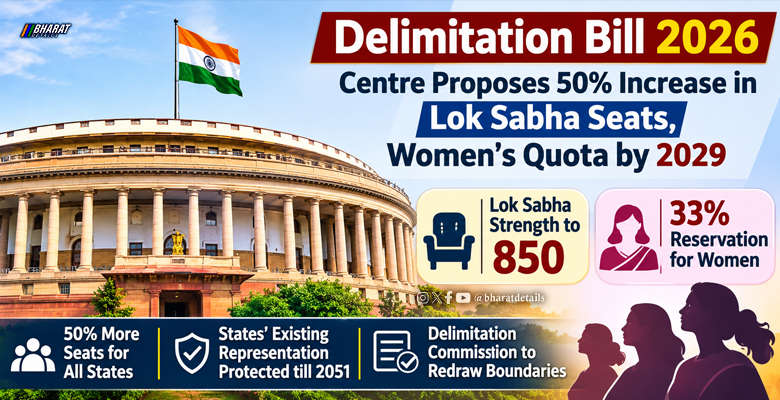
Under the revised proposal, the Lok Sabha’s maximum strength could increase to 850 members, including 815 representatives from states and 35 from Union Territories. The maximum permissible strength of state legislative assemblies would also rise from 500 to 650 seats.
The government is seeking to introduce the proposed changes during Parliament’s special sitting scheduled to begin on November 30, 2026. The larger objective is to make the women’s reservation provision operational before the 2029 Lok Sabha elections.
Contents
What Is Changing Under the Delimitation Bill 2026?
The revised proposal introduces significant changes to the way parliamentary and assembly constituencies could be structured.
The most important provision is a uniform 50% increase in the existing number of Lok Sabha seats allocated to every state and Union Territory. Instead of redistributing parliamentary representation solely according to population differences, the proposal seeks to retain the existing relative share of each state.
For example, Kerala currently holds approximately 3.6% of the Lok Sabha’s total seats. Under the proposed expansion, its number of seats would increase to 30, while its overall share of parliamentary representation would remain broadly unchanged.
The government believes this arrangement can accommodate a larger Parliament without reducing the relative political influence of states that have raised concerns about population-based delimitation.
Other important provisions include:
- Lok Sabha expansion: The constitutional maximum strength would increase to 850 members, comprising 815 seats for states and 35 for Union Territories.
- Assembly expansion: The maximum strength of state legislative assemblies would increase from 500 to 650 members.
- Protection of state representation: The existing relative allocation of Lok Sabha seats among states would remain protected until the relevant figures of the first Census conducted after 2051 are published.
- Census data: The proposed delimitation exercise would use the 2011 Census as its population reference.
- Delimitation Commission: A commission would be constituted to redraw constituency boundaries after the legislation comes into force.
- Women’s reservation: One-third of seats in the Lok Sabha and state assemblies would be reserved for women.
- SC/ST constituencies: The commission would also undertake adjustments to constituencies reserved for Scheduled Castes and Scheduled Tribes.
- Public consultation: Proposed constituency boundaries would be published, allowing people to submit objections and suggestions before finalisation.
Why Is the Government Proposing a 50% Increase in Lok Sabha Seats?
The proposed expansion is closely connected to the implementation of the Women’s Reservation Act, which was passed by Parliament in September 2023.
The Constitution (106th Amendment) Act, 2023, also known as the Nari Shakti Vandan Adhiniyam, provides for 33% reservation for women in the Lok Sabha and state legislative assemblies.
However, the legislation linked the implementation of the reservation to a Census exercise followed by delimitation. As a result, the quota has not yet become operational.
The government wants to accelerate this process rather than wait for the completion of the next Census and subsequent delimitation exercise.
Increasing the number of legislative seats would create additional constituencies, making it possible to reserve approximately one-third of the expanded strength for women while retaining existing representation for other members.
The proposed arrangement is expected to provide more opportunities for women to contest elections and participate in legislative decision-making.
Why Has Delimitation Become a Political Issue?
Delimitation is not simply an exercise in changing constituency boundaries. It can significantly influence the distribution of political power between states.
India’s current Lok Sabha strength of 543 elected seats is largely based on the allocation determined using the 1971 Census.
A constitutional freeze on readjusting the allocation of seats among states was introduced through the 42nd Constitutional Amendment in 1976. The freeze was subsequently extended until 2026 through the 84th Constitutional Amendment.
The arrangement was intended to prevent states that had successfully controlled population growth from losing parliamentary representation compared with states experiencing higher population growth.
This is particularly important for southern states such as Tamil Nadu, Kerala, Karnataka, Andhra Pradesh and Telangana.
Several southern political leaders have argued that a fresh population-based redistribution could increase the parliamentary influence of more populous northern states while reducing the relative representation of southern states.
The revised proposal attempts to address these concerns by providing for a uniform 50% increase in seats while protecting the existing relative shares among states.
Nevertheless, Opposition parties have questioned whether the proposed safeguards are sufficient.
What Happened to the Earlier Delimitation Bill in April 2026?
The government had previously attempted to introduce a similar legislative framework during a special sitting of Parliament in April 2026.
The earlier Constitution (131st Amendment) Bill, 2026, sought to link the implementation of women’s reservation with a fresh delimitation exercise and an expansion of parliamentary representation.
However, the proposal failed to secure the required constitutional majority in the Lok Sabha.
Of the 528 members who voted, 298 supported the Bill, while 230 opposed it. A constitutional amendment required a two-thirds majority of members present and voting, amounting to 352 votes.
The defeat exposed the political disagreements surrounding delimitation, particularly over the potential impact on states’ representation and the timing of women’s reservation.
The revised proposal introduces additional safeguards aimed at addressing some of the concerns raised during the earlier debate.
Why Are Opposition Parties Raising Concerns?
Congress and several other Opposition parties have questioned the government’s approach, arguing that women’s reservation should not be linked to a large-scale delimitation exercise.
Their preferred approach is to implement the 33% women’s quota within the existing 543-seat Lok Sabha framework.
The Opposition has also expressed concerns about the representation of southern states and the potential consequences of changing constituency boundaries.
Congress president Mallikarjun Kharge has indicated that the Opposition intends to oppose the proposed legislation, raising questions about its impact on democracy and the representation of Scheduled Castes and Scheduled Tribes.
The INDIA bloc has outlined three major demands:
- The existing strength of the Lok Sabha should be maintained.
- Women’s reservation should be implemented within the current parliamentary strength.
- The existing allocation of Lok Sabha seats among states should remain unchanged for the next 25 years.
Several Opposition leaders have also argued that the government should hold wider consultations with political parties and state governments before proceeding with such a significant constitutional change.
DMK Backs the Revised Proposal
The revised proposal has also received support from some regional political parties.
The Dravida Munnetra Kazhagam (DMK), which had earlier raised strong objections over the possibility of southern states losing their parliamentary influence, announced its support for the proposed Bills following discussions among its MPs.
DMK leader A Raja said the party had decided to support the proposed 50% increase in seats across states.
The party has consistently maintained that Tamil Nadu’s existing share of parliamentary representation, which stands at approximately 7.18%, must be protected.
According to the information provided on the revised proposal, Tamil Nadu’s share is expected to increase marginally to approximately 7.21%.
The DMK’s position is significant because support from regional parties could influence the government’s efforts to secure the required numbers for the constitutional amendment.
The Nationalist Congress Party (Sharadchandra Pawar) has also indicated a willingness to support the proposal, with party MP Supriya Sule suggesting that the legislation should be discussed in Parliament.
Meanwhile, Bharat Rashtra Samithi leader K T Rama Rao has stressed that Telangana and other southern states must not suffer any reduction in their parliamentary representation.
How Will the Delimitation Commission Work?
A Delimitation Commission will be responsible for determining the new constituency boundaries under the proposed framework.
Delimitation refers to the process of redrawing electoral boundaries and determining the geographical areas represented by elected members.
In India, the exercise has been conducted through independent commissions constituted under parliamentary legislation.
The proposed commission will undertake the redistribution of constituencies, identify seats reserved for women and adjust constituencies reserved for Scheduled Castes and Scheduled Tribes.
The commission is also expected to invite public objections and suggestions before finalising its recommendations.
Historically, delimitation commissions have been given considerable legal authority. Their final orders carry the force of law and cannot ordinarily be challenged in courts.
This makes the commission’s decisions particularly important because they will determine how electoral representation is structured across the country.
__________________________
Also read | Vardhaman Jain Donates 121 Kg Gold Ornaments Worth ₹160 Crore To Tirumala Temple
__________________________
When Will Women’s Reservation Be Implemented?
The government is targeting the 2029 general elections for implementing the 33% reservation for women.
The 106th Constitutional Amendment, passed in 2023, created the legal framework for reserving one-third of seats for women in the Lok Sabha and state legislative assemblies.
However, the requirement of a Census followed by delimitation has delayed its implementation.
The revised legislation seeks to provide an alternative route by expanding the number of seats and allowing the delimitation exercise to proceed using the 2011 Census figures.
If the proposed constitutional and delimitation legislation receives parliamentary approval and the subsequent process is completed on schedule, women could see a substantial increase in opportunities to enter elected legislatures by 2029.
What Happens Next?
The government’s revised proposals are expected to be discussed during the special sitting of Parliament beginning November 30, 2026.
The Lok Sabha is scheduled to meet on November 30 and December 1, while the Rajya Sabha will take up its proceedings on December 2 and 3.
The government will need to secure the constitutionally required majority to pass the amendment. This requires both a majority of the total membership of the House and at least two-thirds of members present and voting.
The debate is likely to focus on the protection of states’ representation, the use of 2011 Census data, the role of the Delimitation Commission and the implementation of women’s reservation.
For India, the proposed changes could mark a major transformation in the structure of Parliament and state legislatures. However, the final outcome will depend on parliamentary approval and the subsequent delimitation process.
The central question is whether the government can expand political representation and accelerate women’s participation while addressing concerns about the balance of power between India’s states.