RBI May Introduce Plastic Notes in India: Why Polymer Currency Could Replace Traditional Paper Banknotes

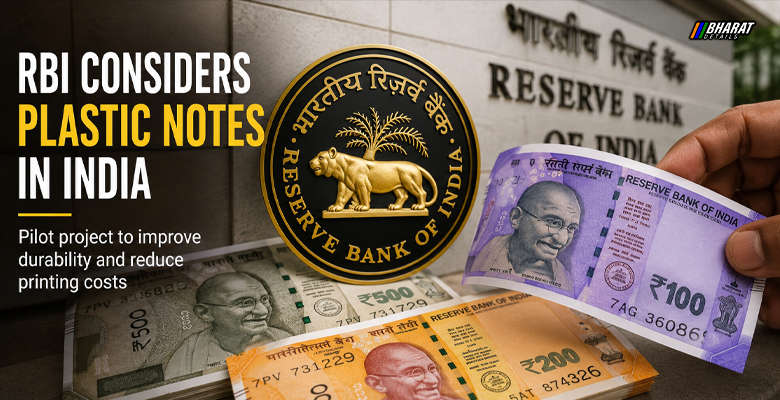
RBI plastic notes could soon become a reality in India as the country’s central bank once again explores a plan that was first discussed more than a decade ago. With currency printing costs rising sharply and billions of damaged notes being removed from circulation every year, the Reserve Bank of India is reportedly considering a pilot project for polymer-based banknotes.
The proposal comes at a time when India continues to witness a rapid expansion in digital transactions while simultaneously seeing strong demand for physical cash. While digital payments through UPI and banking platforms have transformed everyday transactions, cash remains deeply integrated into India’s economy, especially for small purchases, local businesses, and rural markets.
The renewed discussion around polymer notes reflects a broader effort to improve the efficiency and lifespan of India’s currency system.
According to officials familiar with recent developments, the proposal was discussed during recent board meetings of the central bank. Reports suggest that lower-value notes such as ₹10 and ₹20 may be selected first for testing because these denominations circulate frequently and wear out much faster than higher-value notes.
Unlike conventional banknotes printed on cotton-based paper material, polymer banknotes are made using a thin and flexible plastic substrate. Although commonly called “plastic notes,” they do not resemble hard plastic cards. Instead, they remain soft, lightweight, foldable, and easy to use in everyday transactions.
For ordinary users, the appearance and handling experience may feel familiar. However, the underlying material offers several practical advantages.
One of the biggest issues with paper notes is their relatively short lifespan. Frequent use causes notes to become dirty, folded, torn, stained, or damaged. Banks regularly collect these notes and replace them with newly printed currency.
This process is expensive and operationally intensive.
Polymer notes are designed to survive far longer under regular use. They are generally more resistant to moisture, dirt, and physical damage. Since they remain usable for longer periods, central banks may reduce the frequency of printing replacement notes.
Experts believe this longer shelf life can significantly reduce long-term operating costs.
Another major benefit is security.
Counterfeit currency has historically been a concern for financial systems worldwide. Polymer technology allows banks to introduce sophisticated security elements that are difficult to duplicate. These include transparent windows, complex holographic patterns, advanced printing techniques, and specialized security features embedded directly into the material.
Because of these features, fake note production becomes more difficult and expensive for counterfeit networks.
The RBI’s renewed interest appears closely linked to increasing financial pressure associated with maintaining paper currency circulation.
Recent financial figures indicate that the cost of printing currency has increased considerably. Expenditure on currency printing reportedly rose substantially during the latest financial year as demand for fresh banknotes increased.
Simultaneously, the number of damaged or soiled notes withdrawn from circulation also climbed significantly.
Billions of notes reportedly had to be removed from circulation during the previous financial year. A large proportion of these were ₹500 and ₹100 notes, which remain heavily used across the country.
The increase in damaged notes creates a cycle that continuously drives additional printing requirements. More notes in circulation lead to more wear and tear, which in turn increases replacement expenses.
Interestingly, this trend has emerged even while India experiences record growth in digital payments.
Many observers once believed that digital adoption would sharply reduce cash usage. However, recent trends suggest that both systems are expanding simultaneously.
Physical cash continues to play an important role in India’s economic activity.
The total value of currency circulating in the economy has reportedly reached record levels. The growth suggests that despite the convenience of digital transactions, consumers and businesses still rely heavily on cash for daily operations.
For policymakers, this creates a practical challenge.
If cash demand remains strong, improving the durability and cost-effectiveness of banknotes becomes increasingly important.
India’s consideration of polymer currency is not entirely new.
The country previously attempted a similar experiment in 2012 when authorities approved a field trial involving polymer ₹10 notes. The objective at that time was primarily to evaluate whether the notes could survive longer under varied Indian climatic conditions.
Several cities with different weather conditions participated in the test phase.
However, the earlier initiative did not progress further.
Operational challenges reportedly affected implementation. Technical limitations existed at the time, particularly involving ATM systems and handling mechanisms that struggled to process the new material accurately.
Technology, however, has evolved considerably over the last decade.
Modern currency processing systems and ATM technology have become significantly more advanced. Officials reportedly believe that many earlier challenges can now be addressed effectively.
India would not be entering unfamiliar territory if it decides to proceed.
Also read | Siddhivinayak Temple Redevelopment: Mumbai’s Iconic Ganpati Shrine Set For ₹500 Crore Transformation
More than sixty countries have already introduced polymer banknotes into their financial systems, either partially or completely.
Australia became the first country to launch polymer currency in 1988 and is often viewed as a successful example of the transition. Countries including Canada, the United Kingdom, Singapore, Malaysia, New Zealand, Vietnam, and Romania later adopted similar systems.
Many central banks cite similar reasons for the transition: stronger durability, reduced replacement costs, and enhanced security measures.
Some countries shifted entirely to polymer notes, while others maintained a combination of paper and polymer currency depending on denomination and operational requirements.
For India, any transition is likely to happen gradually.
The RBI is expected to begin with limited testing before considering a wider rollout. Authorities will likely assess factors including public acceptance, operational feasibility, banking infrastructure compatibility, and cost efficiency.
The proposed pilot project does not necessarily indicate an immediate replacement of all paper notes in circulation. Instead, it appears to be an exploratory step toward determining whether polymer technology can provide a practical long-term solution.
If successful, the move could eventually reduce the burden of replacing damaged notes, lower recurring expenses, and improve the overall durability of India’s currency ecosystem.
For now, consumers are unlikely to see immediate changes in their wallets. But if pilot testing moves ahead successfully, India’s familiar currency notes could gradually evolve into a more durable and technologically advanced form in the years ahead.